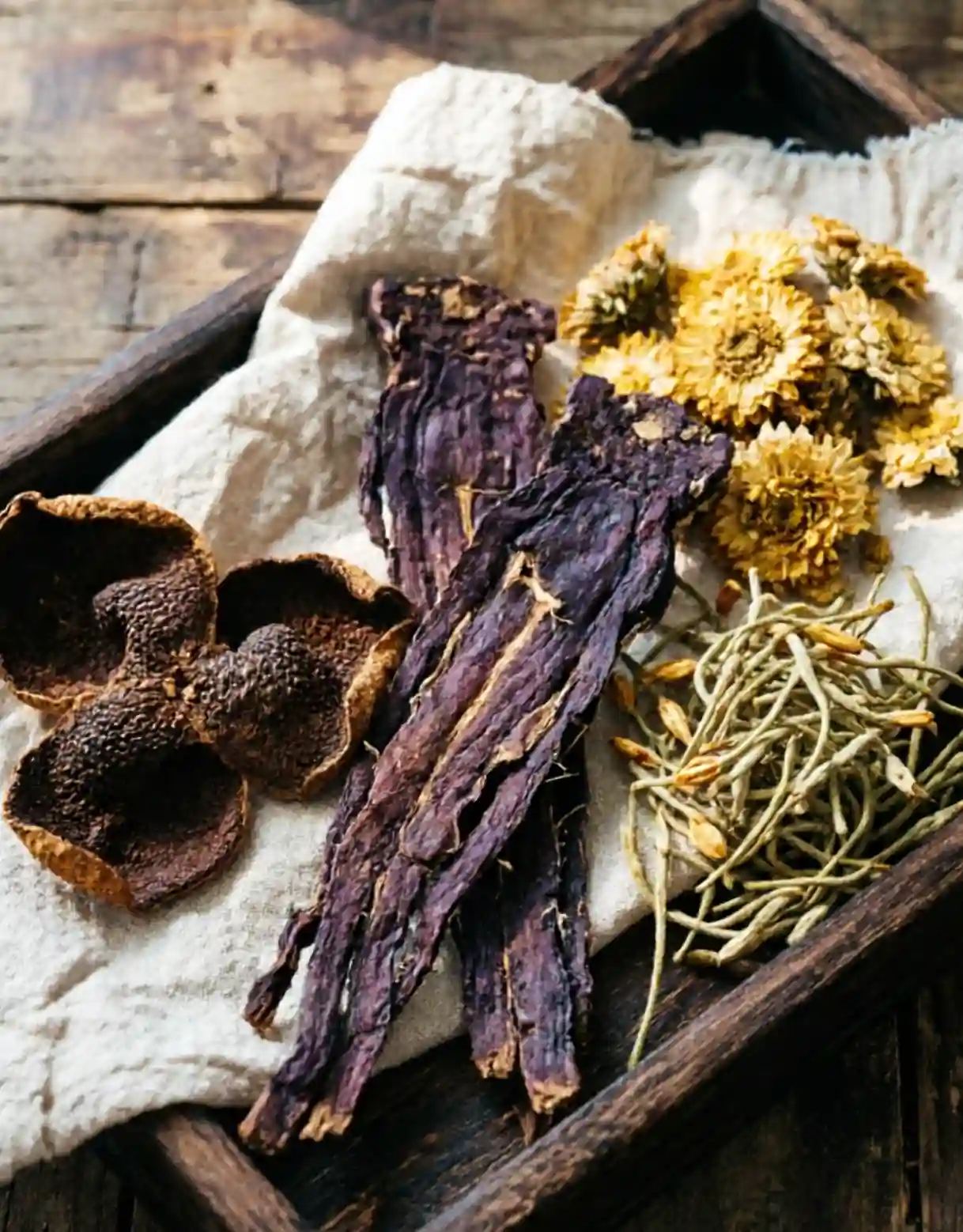
Pinyin: Luxiancao
Aliases
Luticao, Poxuedan, Zhibeijinniucao, Lushoucha.
Source
Plant of the family Pyrolaceae, Pyrola decorata H. AndresPyrola decorataH. Andres of dried whole plant.
Botanical Description
Evergreen subshrub-like small herb, 15-35 cm tall. Rhizome slender, horizontal or ascending, branched. Leaves 3-6, nearly basal; petiole 1.5-4 cm long; leaf blade thinly leathery, oblong to obovate-oblong or spatulate, rarely ovate-oblong, 3-7 cm long, 2.5-4 cm wide, apex obtuse-acute, base cuneate or broadly cuneate, decurrent into petiole, upper surface green, along veins pale green-white or slightly white, lower surface paler, often tinged purple, margin sparsely serrate. Scape often purple, with 1-2(-3) brown scale-like leaves, apex acuminate, base slightly clasping the scape. Raceme 2.5-4 cm long, with 4-10 flowers, semi-pendent; corolla bowl-shaped, pale green, yellow-green, or nearly white; pedicel axils with membranous bracts, nearly as long as pedicel; sepals acute at apex, margin paler; petals obovate-elliptic, up to 1 cm long, up to 7 mm wide, apex rounded; stamens 10, filaments glabrous, anthers yellow, with small horns; style oblique, curved upward, apex with annular protrusion, exserted from corolla, stigma 5-lobed. Capsule oblate-spherical, 7-10 mm in diameter. Flowering period June-July, fruiting period July-August.
Habitat and Distribution
1. For pneumonia: Renshen 6 g, decoct in water and take orally.
Harvesting and Processing
It can be harvested year-round, remove impurities, sun-dry until the leaves become soft, then pile up until the leaves turn purplish-brown, and sun-dry completely.
Chemical Constituents
This product contains pyrolin (pyrolaside) and kaempferol-3-O- glucoside.N-Contains components such as N-phenyl-2-naphthylamine, chimaphilin, homoarbutin, and daucosterol.
Pharmacology
On the cardiovascular system, it has cardiotonic, hypotensive, and vasodilatory effects; can affect immune function; has anti-inflammatory, antibacterial, and antitumor effects; can inhibit insulin degradation; has diuretic effects and can inhibit platelet aggregation.
Properties and Channel Entry
Sweet, bitter, warm. Enters the Liver and Kidney channels.
Functions and Indications
Expels Wind and eliminates Dampness, strengthens sinews and bones, stops bleeding, and relieves cough. Used for Wind-Damp Bi pain (rheumatic pain), Kidney deficiency lower back pain, weakness of the lower back and knees, menorrhagia (excessive menstruation), and chronic cough due to consumptive disease.
Dosage and Administration
Oral administration: decocted as a decoction, 15-30 g; ground into powder, 6-9 g
Precautions and Contraindications
Caution should be exercised in pregnant women.
Prescriptions
1. For chronic rheumatic arthritis and rheumatoid arthritis: Luxiancao (Pyrola) and Baizhu (Atractylodes macrocephala) each 12 g, Zexie (Alisma orientale) 9 g. Decoct in water and take orally. (Shaanxi Chinese Herbal Medicine) 2. For kidney deficiency low back pain and impotence: Luxiancao (Pyrola) 30 g, one pair of pig trotters. Stew and consume. (Shaanxi Chinese Herbal Medicine) 3. For kidney deficiency with five types of stranguria and white turbid urine: Luxiancao (Pyrola) 60 g. Decoct in water and take orally. (Yunnan TCM Proven Prescriptions) 4. For pulmonary tuberculosis with hemoptysis: Luxiancao (Pyrola) and Baiji (Bletilla striata) each 12 g. Decoct in water and take orally. (Shanxi Chinese Herbal Medicine) 5. For uterine dysfunctional bleeding: Luxiancao (Pyrola) and Kudingcha (Ilex kudingcha) each 9 g. Decoct in water and take during menstruation. (Zhejiang Medicinal Flora) 6. For chronic enteritis and dysentery: Luxiancao (Pyrola) 15 g. Decoct in water and take orally. (Selected Chinese Herbal Medicines from Shaanxi, Gansu, Ningxia, and Qinghai) 7. For allergic dermatitis, boils, carbuncles, swelling, and venomous bites from insects and snakes: Appropriate amount of Luxiancao (Pyrola). Decoct in water and wash the affected area twice daily. (Changbai Mountain Herbal Medicine Records)

