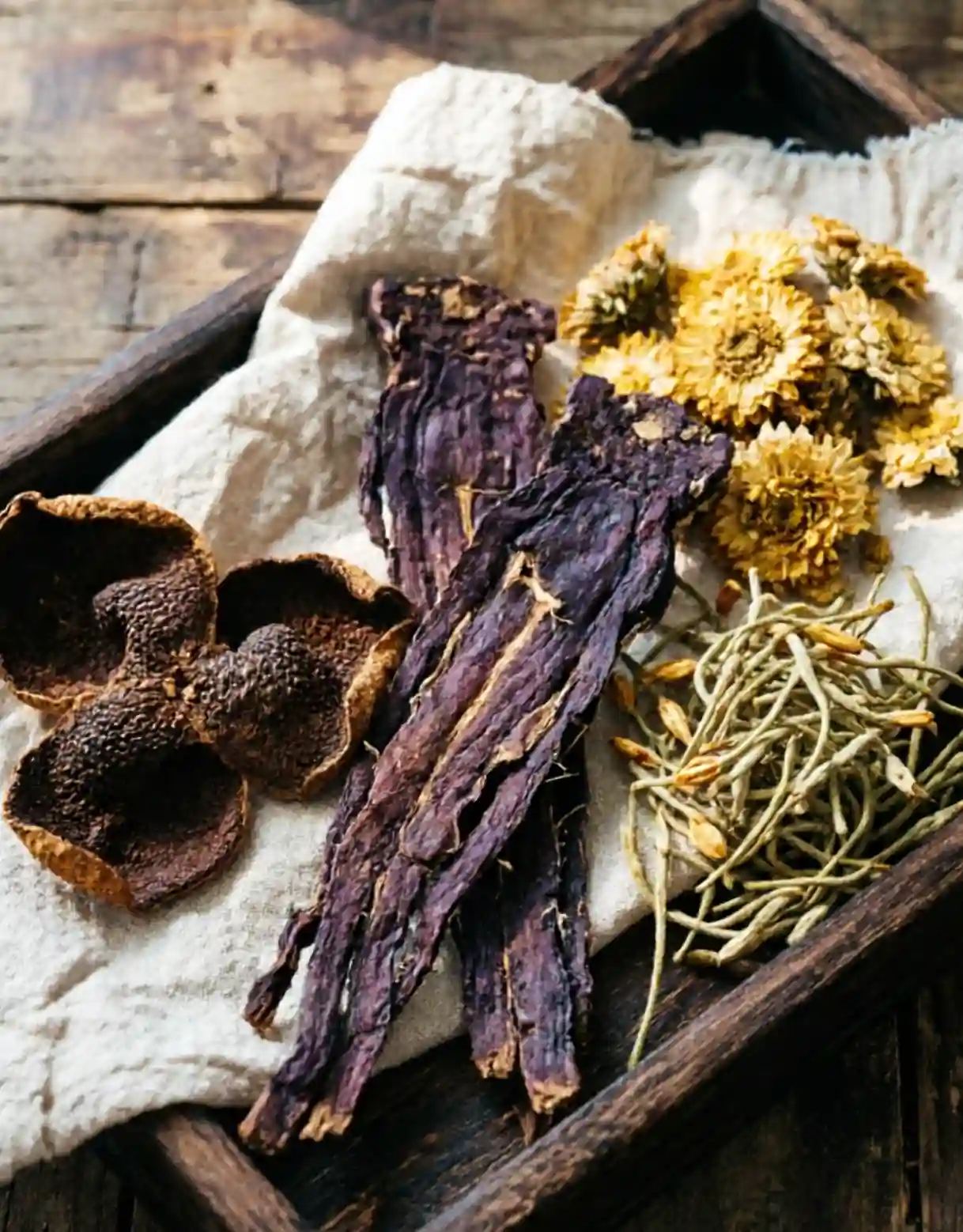
Pinyin: Yinyanghuo
Aliases
Xianlingpi, Jiuyecao, Sanjiaolian
Source
Berberidaceae plant *Epimedium sagittatum*Epimedium sagittatumDried leaves of *Eucommia ulmoides* Oliv. (Sieb. et Zucc.) Maxim.
Botanical Description
Perennial evergreen herb, 25-50 cm tall. Rhizome short and thick, somewhat nodular, firm, with brown outer bark and white cross-section. Stem ridged, glabrous (hairless). Basal leaves 1-3, once ternately compound; petiole slender, 4-18 cm long; cauline leaves 2, often borne at the stem apex, similar to basal leaves; leaflets leathery, narrowly ovate to lanceolate, 15-19 cm long, 3-8 cm wide, apex acute or acuminate, base cordate or sagittate, with asymmetrical cordate bases on lateral leaflets, shallowly lobed, margins with fine bristles, initially glabrous beneath, later sparsely covered with unicellular short stiff hairs; terminal leaflet with nearly rounded and equal basal lobes, lateral leaflets with asymmetrical basal lobes, inner lobe smaller and rounded, outer lobe larger, triangular, acute. Panicle terminal, erect, rachis and pedicels usually glabrous, sometimes with a few glandular hairs; flowers white, about 6 mm in diameter, 20-60 flowers; pedicel about 1 cm long; outer sepals 4, oblong-ovate, 3-4 mm long, 1.5-2 mm wide, purplish; inner sepals 4, ovate or ovate-triangular, about 4 mm long, about 2 mm wide, apex acute, white; petals nearly as long as inner sepals, brownish-yellow, with a short spur; stamens 4, about 5 mm long, anthers dehiscing by valves, about 3 mm long. Follicle about 1 cm long, beaked. Seeds kidney-shaped-oblong, about 4 mm long, dark brown. Flowering period February to March, fruiting period May to June.
Habitat and Distribution
Born in mountainous areas, dense forests, rock crevices, stream sides, or damp shaded places. Distributed in Shaanxi, Gansu, Jiangsu, Anhui, Zhejiang, Jiangxi, Fujian, Taiwan, Hubei, Hunan, Guangdong, Guangxi, Sichuan, Guizhou, and other regions.
Harvesting and Processing
Harvested in summer and autumn when stems and leaves are lush, dried in the sun or in the shade.
Chemical Constituents
This product contains icariin, sagittatoside A, sagittatoside B, sagittatoside C, and other constituents.
Yao.
Li
It has a regulatory effect on the function of the hypothalamic-pituitary-gonadal axis; regulates the body's immune function; has a "Yang-assisting" effect on Yang-deficient animal models, can increase coronary blood flow, lower blood pressure, etc.; delays aging, and has a strong anti-HSV-II effect.
Properties and Channel Entry
Pungent, sweet, warm. Enters the Liver and Kidney channels.
Functions and Indications
Tonifies Kidney Yang, strengthens sinews and bones, and expels Wind-Dampness
Dosage and Administration
Internal: decoct in water, 3-9 g, up to 15 g for large doses; or steep in wine, decoct into a paste, or prepare as pills or powder. External: apply an appropriate amount, decoct and use as a mouth rinse.
Precautions and Contraindications
Contraindicated in patients with Yin deficiency and tendency toward ministerial fire hyperactivity.
Prescriptions
1. For impotence: Epimedium 9 g, Evolvulus alsinoides 24 g, fresh Polygala arillata 30 g, fresh Rosa laevigata 60 g. Decoct in water for oral administration. (Fujian Materia Medica) 2. For migratory arthralgia with variable pain: Epimedium, Clematis chinensis, Ligusticum chuanxiong, Cinnamomum cassia twig, Xanthium sibiricum, each 30 g. Grind the above drugs into fine powder and sift. Take 3 g with warm wine at any time. (Xianling Pi San from Sheng Hui Fang) 3. For Sanjiao cough with abdominal distension, poor appetite, and disordered Qi flow: Epimedium, Rubus chingii, Schisandra chinensis (stir-fried), each 30 g. Grind into powder, form pills with honey, size of Chinese arborvitae seed. Take 20 pills with ginger tea each time. (Sheng Ji Zong Lu) 4. For blurred vision and corneal opacity: Epimedium and fresh Trichosanthes kirilowii (red variety), equal parts. Grind into powder, take 3 g with tea, twice daily. (Sheng Ji Zong Lu) 5. For pox rash entering the eyes: Epimedium and Clematis chinensis (root removed), equal parts. Grind into fine powder, take 1.5 g after meals with rice soup. (Xianling Pi San from Xiao Er Wei Sheng Zong Wei Lun Fang) 6. For toothache: Epimedium, an appropriate amount. Coarsely grind, decoct and use the liquid to rinse the teeth. (Gu Ben San from Wei Sheng Jia Bao) 7. For menopausal syndrome, dizziness, hypertension, and other chronic diseases with Chong and Ren disharmony pattern: Curculigo orchioides 6-15 g, Epimedium 9-15 g, Angelica sinensis 9 g, Morinda officinalis 9 g, Phellodendron chinense 6-9 g, Anemarrhena asphodeloides 6-9 g. Decoct in water for oral administration. (Formulary from Shanghai College of Traditional Chinese Medicine)

