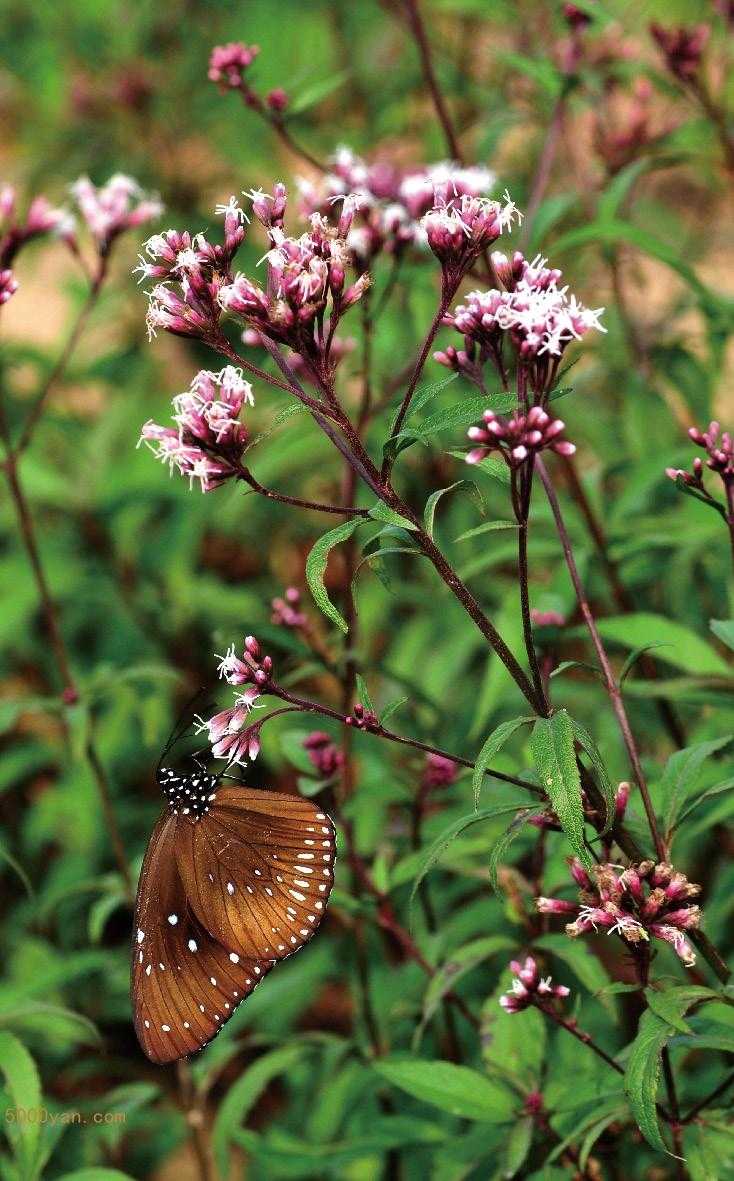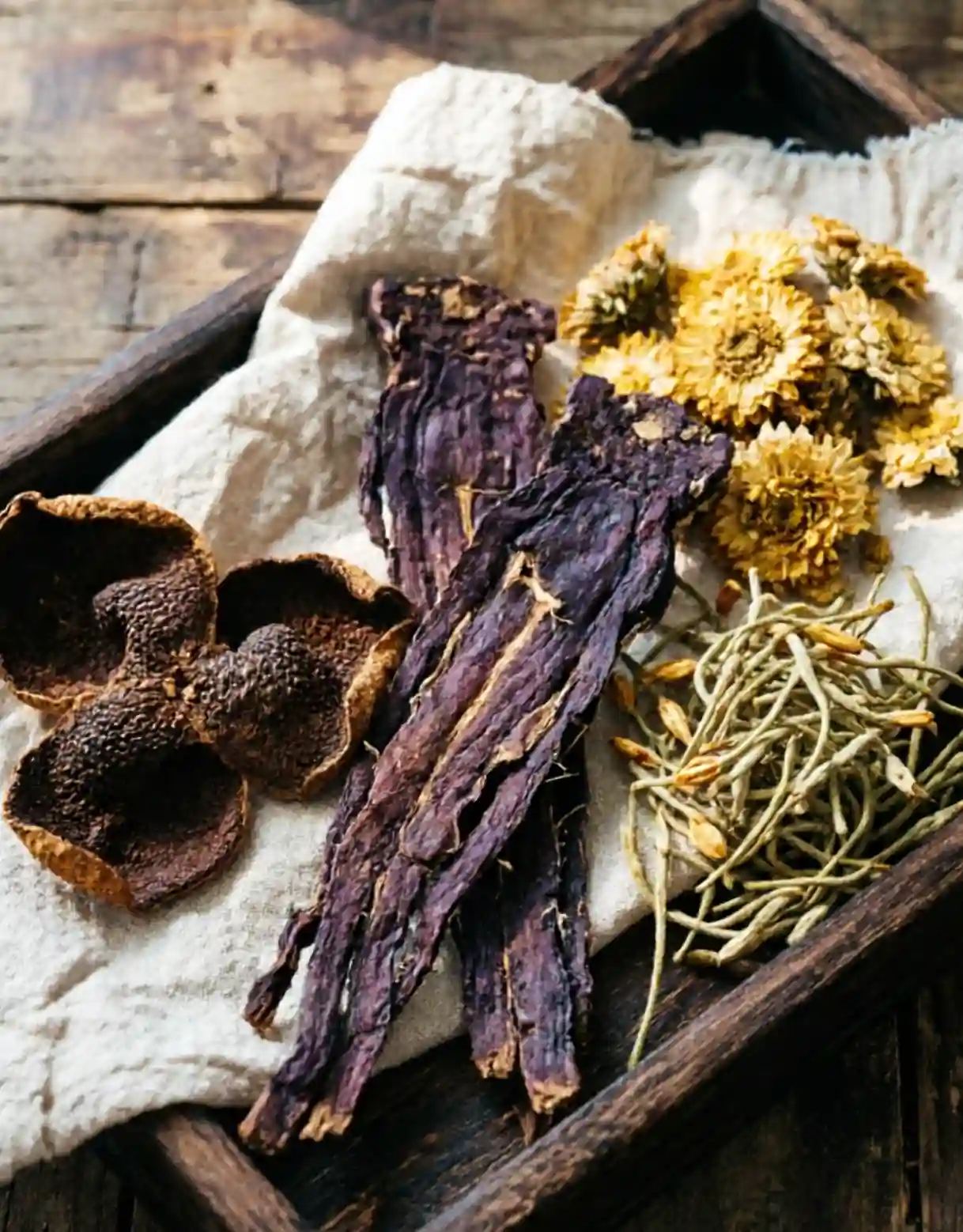
Pinyin: Peilan
Aliases
Lan Cao, Da Ze Lan, Xiang Shui Lan
Source
Asteraceae plant *Eupatorium fortunei* Turcz.Eupatorium fortuneiThe dried aerial part of *Turcz*.
Botanical Description
Perennial herb, 40-100 cm tall. Rhizomes creeping. Stems erect, green or reddish-purple, glabrous (hairless) below. Leaves opposite, lower leaves often withered; middle leaves with short petioles, larger leaf blades, usually 3-parted or 3-cleft, with the middle lobe larger, oblong or oblong-lanceolate, 5-10 cm long, 1.5-2.5 cm wide; upper leaves smaller, often undivided or all stem leaves undivided, apex acuminate, margins with coarse or irregular fine teeth, without glands. Capitula numerous, arranged in compound corymbs at stem apex and branch tips. Involucre campanulate, 6-7 mm long, phyllaries in 2-3 layers, imbricate, outer ones short, ovate-lanceolate, middle and inner ones gradually longer, all phyllaries purplish-red, glabrous and without glands on the outside, apex obtuse; each capitulum with 4-6 flowers, flowers white or slightly reddish, all tubular, bisexual. Stamens 5, syngenesious; pistil 1, ovary inferior, style branches 2, exserted beyond the corolla. Achenes cylindrical, blackish-brown when mature, 5-ribbed. Flowering and fruiting period: July to November.
Habitat and Distribution
Born by roadsides in thickets or streamsides. Wild or cultivated. Distributed in Hebei, Shaanxi, Shandong, Jiangsu, Anhui, Zhejiang, Jiangxi, Hubei, Hunan, Guangdong, Guangxi, Sichuan, Guizhou, Yunnan, and other regions.
Harvesting and Processing
Harvested and cut twice in summer and autumn, remove impurities, and sun-dry.
Chemical Constituents
This product contains geranyl acetate, thymol methyl ether, p-cymene, taraxasterol acetate,β- Contains components such as sitosterol.
Pharmacology
Has expectorant, antiviral, and anticancer effects.
Properties and Channel Entry
Acrid, neutral. Enters the Spleen, Stomach, and Lung channels.
Functions and Indications
Aromatically transforms Dampness, awakens the Spleen and opens the Stomach, releases the exterior and resolves Summerheat. Used for Dampness-Turbidity obstructing the Middle, epigastric distension, nausea and vomiting, sweet and greasy taste in the mouth, halitosis, excessive salivation, Summerheat-Dampness exterior patterns, early-stage Damp-Warmth, fever with fatigue and lassitude, and chest oppression with discomfort.
Dosage and Administration
Internal use: decoction, 6-10 g; fresh product may be used at 15-30 g.
Precautions and Contraindications
Yin deficiency with blood dryness and Qi deficiency should be used with caution.
Prescriptions
1. For Dampness in the fifth lunar month and for treating foul and turbid Qi: Huoxiang leaf 3 g, Peilan leaf 3 g, Chenpi 4.5 g, prepared Banxia 4.5 g, Dafupi (washed in wine) 3 g, Houpo (fried with ginger juice) 2.4 g, add fresh Heye 9 g as a guide. Decoct in water and take orally. (from "Treatise on Seasonal Diseases," the Aromatic Transformation of Turbidity formula) 2. For headache due to Heatstroke: Peilan, Qinghao, Juhua each 9 g, Lüdouyi 12 g. Decoct in water and take orally. (from "Qingdao Chinese Herbal Medicine Manual") 3. For acute gastroenteritis: Peilan, Huoxiang, Cangzhu, Fuling, Sankezhen each 9 g. Decoct in water and take orally. (from "National Compilation of Chinese Herbal Medicine") 4. For lip sores: Take Peilan leaf juice and wash the affected area, three times daily, until healed. (from "Pu Ji Fang") 5. For wind toothache with cheek swelling and for uncontrolled bleeding: Peilan 150 g, water 1 dou (approx. 10 liters), decoct to 5 sheng (approx. 5 liters). Hold the warm decoction in the mouth, then spit it out; use up the entire amount within one day. (from "Pu Ji Fang")