Pinyin: Yangticao
Aliases
Zǐbèi cǎo, Hóngbèi yè, Tǔ huánglián.
Source
Asteraceae plant Emilia sonchifoliaEmiliasonchifolia(L.) DC. dried whole plant.
Botanical Description
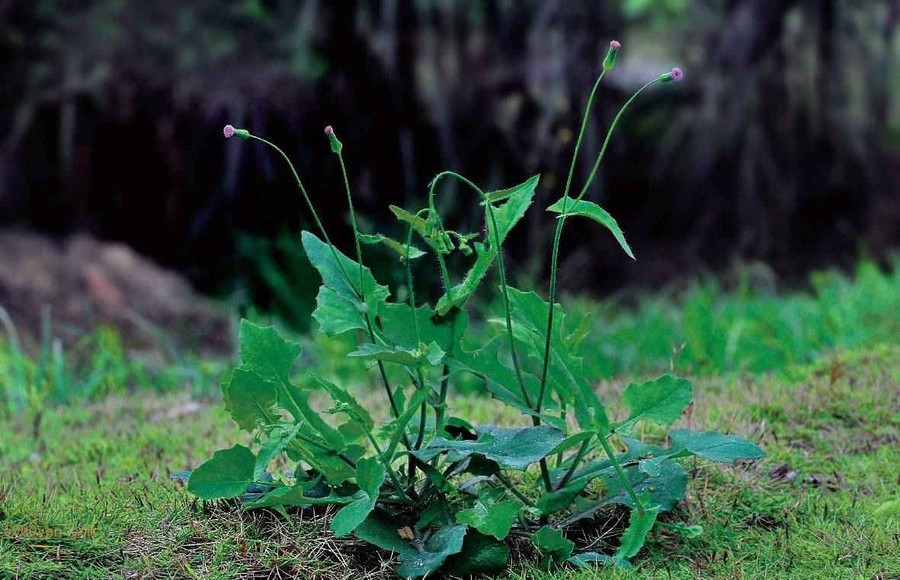
Annual or perennial herb, 10-40 cm tall. Stem erect or nearly prostrate at base, purplish-red or green, glabrous (hairless) or sparsely hairy, somewhat branched, branches slender, pale green. Leaves alternate; sessile; leaf blades somewhat fleshy, lower leaves ovate, 5-10 cm long, 4-5 cm wide, lyre-shaped with blunt teeth on margins; upper stem leaves smaller, usually entire or with fine teeth, dark green above, often purplish-red below, base auriculate, clasping the stem. Capitula 1-1.3 cm in diameter, long-peduncled, forming loose corymbs, flower branches often dichotomously branched; flowers all bisexual, tubular, corolla purplish-red, 5-lobed; involucre cylindrical, bracts in 1 row, as long as the corolla. Achenes narrowly oblong, about 3 mm long, ribbed; pappus white, soft, very abundant. Flowering period July to November; fruiting period September to December.
Habitat and Distribution
It grows in thickets near villages, along roadsides, in fields, and in open grasslands. It is distributed in Shaanxi, Jiangsu, Zhejiang, Jiangxi, Fujian, Hubei, Hunan, Guangdong, Guangxi, Sichuan, Guizhou, Yunnan, and other regions.
Harvesting and Processing
Can be harvested year-round, wash clean, use fresh or sun-dry.
Chemical Constituents
This product contains senkirkine, doronine, hyperoside, trifolin, ursolic acid, and simiarenol.
Pharmacology
Has inhibitory effects on Staphylococcus aureus, Pseudomonas aeruginosa, and Salmonella typhi.
Properties and Channel Entry
Bitter, cool.
Functions and Indications
Clears Heat, resolves toxicity, disperses stasis, and reduces swelling. Indicated for upper respiratory tract infection, oral ulcers, pneumonia, mastitis, enteritis, bacillary dysentery, urinary tract infection, furuncles, carbuncles, and swelling, eczema, and traumatic injuries.
Dosage and Administration
Oral: decoct 9-18 g, fresh product 15-30 g; or crush for juice to hold in the mouth and swallow. External use: appropriate amount, decoct for washing; or crush for topical application.
Precautions and Contraindications
Use with caution during pregnancy.
Prescriptions
1. For tonsillitis: 9 g of *Emilia sonchifolia* (L.) DC. Decoct with 3 bowls of water until 1 bowl remains, take in 2 divided doses, frequently holding in mouth and swallowing. (Jiangxi *Herbal Manual*) 2. For chronic gastroenteritis: 60 g of *Emilia sonchifolia* (L.) DC. and 6 g of cinnamon bark. Decoct in water, take 1 dose daily. (Jiangxi *Herbal Manual*) 3. For wind-heat corneal opacity: 120 g of *Emilia sonchifolia* (L.) DC. and 0.3 g of borneol. Pound together into a paste and apply around the eye sockets. (*Guangxi Folk Commonly Used Chinese Herbal Medicine Manual*) 4. For vaginitis and vulvar eczema: 30-50 g of fresh *Emilia sonchifolia* (L.) DC. and a pinch of salt. Decoct in water for fumigation and washing. (*Anhui Chinese Herbal Medicine*) 5. For edema: 60 g each of whole *Emilia sonchifolia* (L.) DC. and rush pith. Decoct in water, take before meals, 2 times daily. (*Fujian Folk Herbal Medicine*) 6. For mastitis and furuncles: Appropriate amount of fresh whole *Emilia sonchifolia* (L.) DC. with a pinch of salt, pound into a paste. Apply to the affected area, change once daily. Also take 30 g of fresh whole herb (15 g dried) decocted in water orally. (*Zhejiang Folk Commonly Used Herbal Medicine*)