Pinyin: Donglingcao
Aliases
Shanxiangcao, Poxuedan, Yehuoxiang, Liuyueling.
Source
Plant of the Lamiaceae family, *Isodon rubescens* (Hemsl.) H. Hara.Rabdosia rubescensThe dried aerial part of (Hemsl.) Hara.
Botanical Description
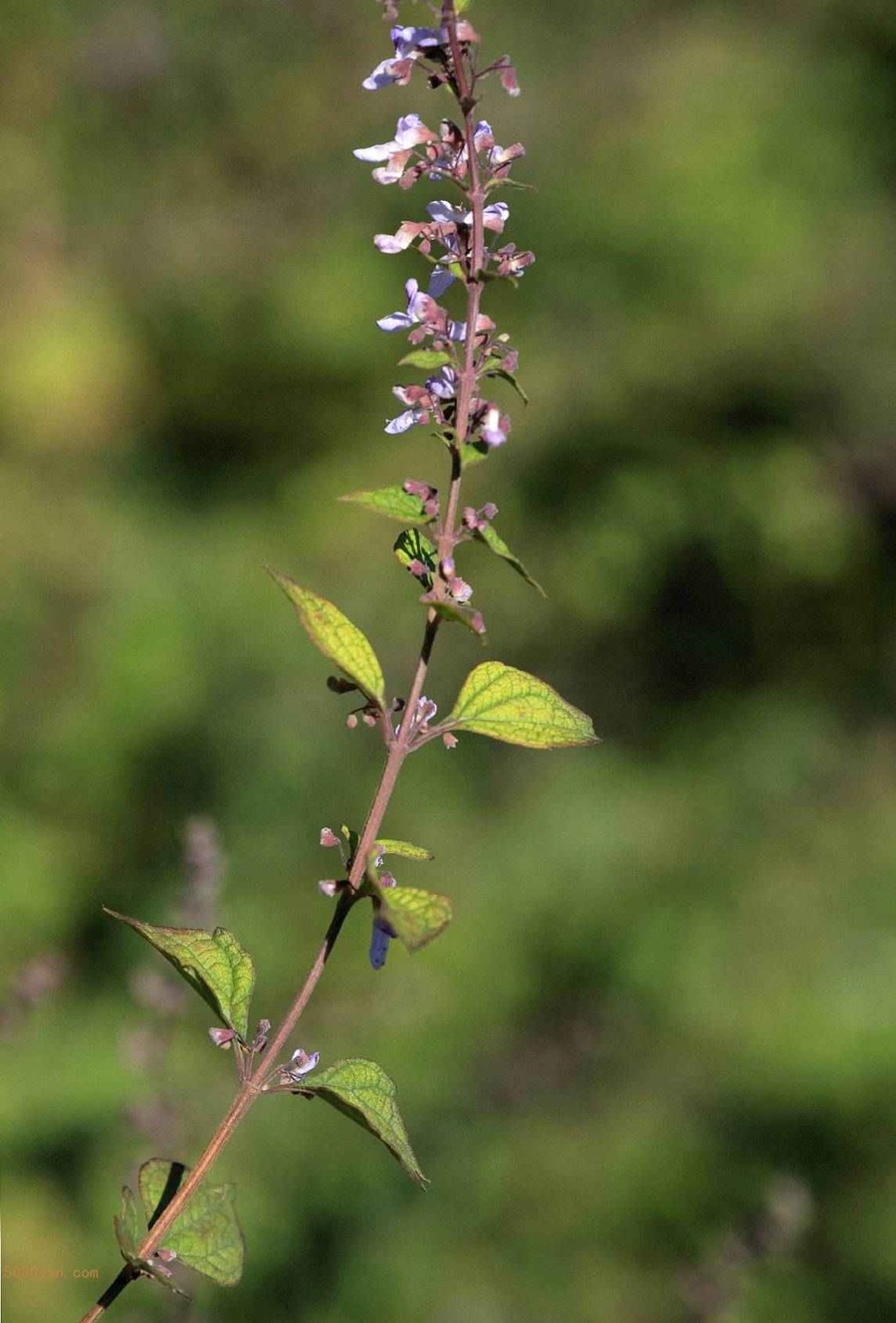
Small shrub, 0.5-1 m tall. Rhizome woody, with long fibrous rootlets. Stem erect, base nearly terete, bark peeling longitudinally, upper part and branches quadrangular, striate, brown or purplish-red, densely covered with fine pubescence, young branches densely tomentose, purplish-red. Leaves opposite, blade ovate or rhombic-ovate, 2-6 cm long, 1.3-3 cm wide, apex acute or acuminate. Cymes 3-5-flowered, arranged in narrow panicles at the top of stems and branches, peduncles and pedicels 2-5 mm long, rachis densely minutely pubescent; bract leaves rhombic or rhombic-ovate to lanceolate, gradually smaller upward; bracteoles subulate-linear or linear, minutely pubescent; calyx campanulate, 2.5-3 mm long, densely grayish minutely pubescent and glandular outside, distinctly purplish-red; corolla about 7 mm long, tube 3.5-5 mm long, slightly saccate above base, 2-2.5 mm in diameter at throat, limb 2-lipped, upper lip reflexed, apex with 4 rounded teeth, lower lip broadly ovate, concave; stamens 4, slightly exserted, filaments flattened, bearded below middle; style filiform, exserted, apex equally 2-cleft; disk annular. Nutlets obovoid-trigonous. Flowering July-October, fruiting August-November.
Habitat and Distribution
Growing on sunny slopes, shrub thickets, forest edges, and roadsides. Distributed in Hebei, Shanxi, Shaanxi, Gansu, Anhui, Zhejiang, Jiangxi, Henan, Hubei, Hunan, Guangxi, Sichuan, and Guizhou.
Harvesting and Processing
Harvested in summer and autumn when the stems and leaves are lush, cut and dried in the sun.
Chemical Constituents
This product mainly containsα1. For pneumonia: Renshen 6 g, decoct in water and take orally. Internal use: decoct 3-10 g.β- Pinene, Limonene.β- Lianxiangxi (elemene), palmitic acid, oridonin, and ponicidin.α-α-amyrin, ludongnins A, and cirsiliol.
Pharmacology
It has a pronounced cytotoxic effect on cancer cells and exhibits anti-tumor activity; it has a significant blood pressure-lowering effect and may also have vasodilatory effects; it has a certain stimulatory effect on cellular immunity; it also has antibacterial effects and a mild inhibitory effect on smooth muscle tone.
Properties and Channel Entry
Bitter, sweet, and slightly cold. Enters the Lung, Stomach, and Liver channels.
Functions and Indications
Clears Heat and resolves toxicity, activates Blood and alleviates pain. Used for swollen and sore throat, abdominal masses and lumps, and snake or insect bites.
Dosage and Administration
Oral administration: decoction, 30-60 g; or steep in wine.
Prescriptions
1. For cold and headache: Donglingcao 30 g, simmer in water and take orally. (Guizhou Herbal Medicine) 2. For rheumatic bone and muscle pain: Donglingcao 90 g, soak in 500 mL of wine. Take 30 g each morning and evening. (Guizhou Herbal Medicine) 3. For joint pain: Donglingcao 250 g, simmer in water and wash the affected area. (Guizhou Herbal Medicine)