Pinyin: Xifanlian
Aliases
Wangruihua, Zhuanxinlian, Longzhucai.
Source
Plant of the family Passifloraceae - PassifloraPassiflora caeruleaL. in the dried whole herb.
Botanical Description
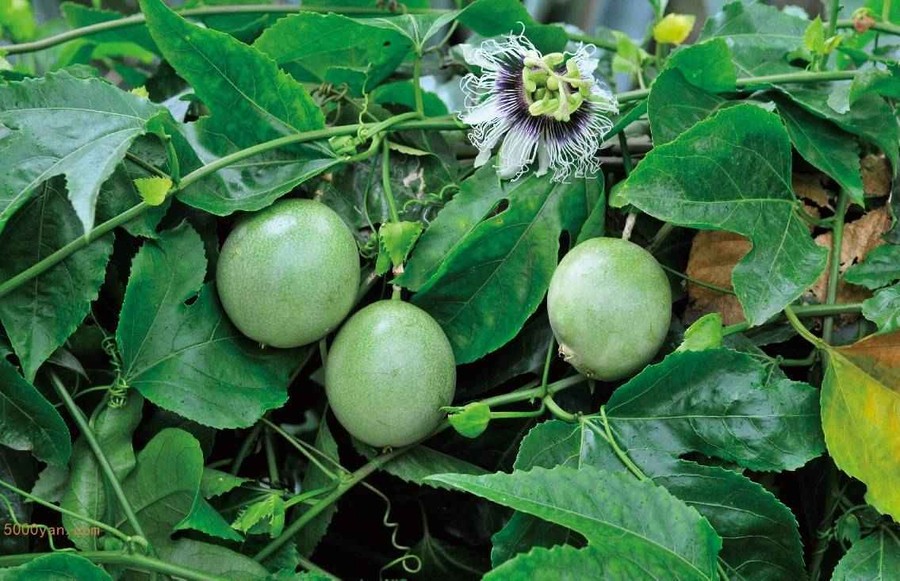
Perennial herbaceous vine. Stem cylindrical, slightly ridged and grooved, with numerous branches, older branches often purplish-red; tendrils axillary, 13-17 cm long. Leaves alternate; petiole 2-3 cm long; 2-6 small glands scattered in the middle; stipules relatively large, reniform, clasping the stem; leaves palmately 5-lobed, 5-7 cm long, 6-8 cm wide, lobes oblong-elliptic, the central one larger, lateral ones slightly smaller, entire margin. Flowers solitary, axillary, large, 6-10 cm in diameter, pale green; bracts 3, broadly ovate; sepals 5, with a horn-like process near the apex on the back; petals 5, oblong-lanceolate, nearly as long as sepals; corona lobes in 3 whorls, filiform, white, with blue or purplish-red tips; inner corona fimbriate, purplish-red, with a disc below; stamens 5, filaments basally fused with the ovary stalk; ovary ovoid, styles 3, purplish-red. Berry ovoid or subglobose, yellow when ripe. Seeds numerous, with a red aril. Flowering period: May to July.
Habitat and Distribution
It has been introduced and cultivated in Jiangxi, Guangdong, Guangxi, Sichuan, Guizhou, Yunnan, and other regions.
Harvesting and Processing
Harvest the whole plant in summer and autumn when the aerial parts are growing vigorously, then dry in the sun.
Chemical Constituents
This product primarily contains chrysin, benzodiazepine compounds, tetraphyllin B-4-sulfate, vitexin, isoorientin, apigenin-8-C-diglucoside, pyrocatechol, and other components.
Properties and Channel Entry
Bitter, warm.
Functions and Indications
Expels Wind, eliminates Dampness, activates Blood, and alleviates pain
Dosage and Administration
Oral: 15-20 g decocted in water. External: appropriate amount of fresh product, mashed for application.
Prescriptions
1. For exogenous wind-heat cough: 9 g each of *Passiflora edulis* stems and leaves, *Caryopteris incana*, and loquat leaves. Decoct in water and take orally. (Xichang Chinese Herbal Medicine) 2. For mania (mental disorder): 15-25 g of *Passiflora edulis* root, stewed with 1 pig heart (with 1 g of cinnabar added inside). Eat. (Guizhou Herbal Medicine) 3. For insomnia: 15 g of *Passiflora edulis* fruit, 30 g of *Agrimonia pilosa*. Steep in water and take orally. (Guizhou Herbal Medicine) 4. For menstrual abdominal pain: 1-2 *Passiflora edulis* fruits, 10 g of *Cynanchum atratum* root. Soak in wine and take orally. (Guizhou Herbal Medicine) 5. For dysentery with abdominal pain: 10 g each of *Passiflora edulis* root and *Polygonum bistorta*. Steep in water and take orally. (Guizhou Herbal Medicine) 6. For fractures: 15 g of *Passiflora edulis* root, 30 g of loquat leaves, 15 g each of *Adina racemosa* root bark and *Dipsacus asper* root. Pound into a paste, mix with wine, and apply externally to the affected area. (Guizhou Herbal Medicine)