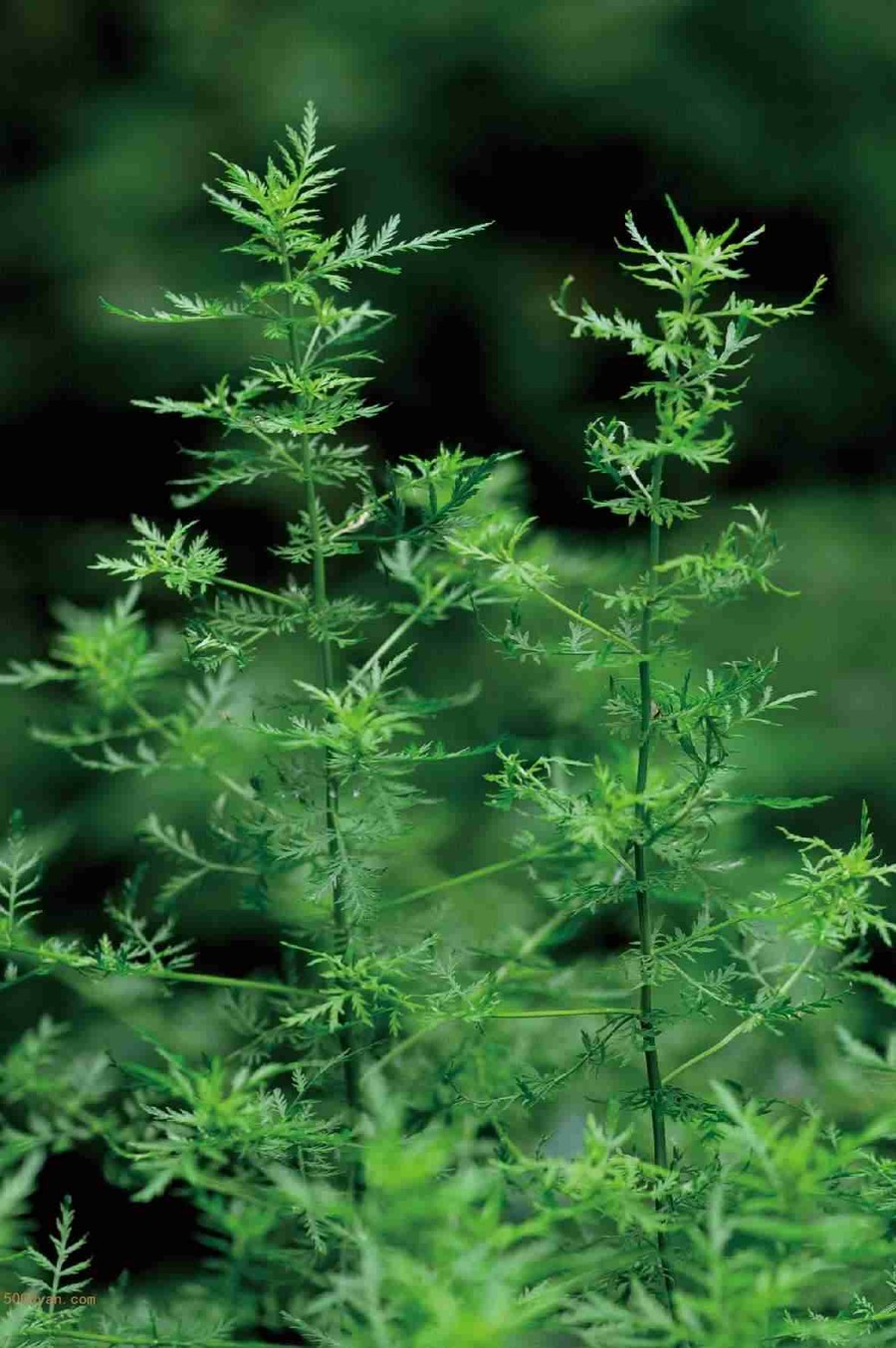
Pinyin: Qinghao
Aliases
Chouhao, Xiangsicao, Jiubingcao.
Source
Compositae family plant Artemisia annuaArtemisia annuaL. of the dried aerial parts.
Botanical Description
Annual herb, 40-150 cm tall. The entire plant has a strong volatile oil odor. Stem erect, with longitudinal stripes, much branched, glabrous (hairless). Basal leaves prostrate on the ground, withering at flowering; cauline leaves alternate, green when young, turning yellowish-brown when old, glabrous, with short petioles, becoming sessile upward; leaves usually tripinnately dissected, segments short and fine, with very fine powdery pubescence, dark green above, pale green below, with fine hairs or powdery glandular spots; rachis with narrow wings on both sides; upper stem leaves gradually smaller and linear. Capitula small, globose, about 2 mm in diameter, with fine soft short pedicels, numerous in panicles; involucre small, globose; florets all tubular, yellow, outer florets female, central florets bisexual. Achenes ellipsoid. Flowering period August to October, fruiting period October to November.
Habitat and Distribution
It grows in open fields, hillsides, roadsides, riverbanks, and other areas. It is distributed throughout various regions of China, both north and south.
Harvesting and Processing
Harvested in autumn when flowers are in full bloom, cut the plant, remove old stems, and dry in the shade.
Chemical Constituents
This product contains artemisinin, artemisinic alcohol, artemisic acid, methyl artemisinate, quercetin, fenchone, and scopoletin.
Pharmacology
It has antibacterial, antiviral, antiparasitic, antitumor, and antipyretic effects; regulates immune function; can slow heart rate, inhibit myocardial contractility, reduce coronary flow, lower blood pressure, and has certain antiarrhythmic effects; also protects the liver, provides radiation protection, shortens pentobarbital sleep time, etc.
Properties and Channel Entry
Bitter, acrid, and cold. Enters the Liver and Gallbladder channels.
Functions and Indications
Clears vacuity heat, relieves steaming bone disorder, resolves summerheat, interrupts malaria, and abates jaundice. Used for warm pathogen damaging yin, night fever with morning coolness, yin deficiency fever, steaming bone fatigue fever, summerheat pathogen fever, malaria with alternating chills and fever, and damp-heat jaundice.
Dosage and Administration
Oral administration: decoct in water, 6-15 g; for treating malaria, 20-40 g may be used, but avoid prolonged decoction; when using fresh herb, double the dosage, soak in water and squeeze out the juice for drinking; or made into pills or powder. External use: appropriate amount. Grind into powder for topical application; or mash fresh herb for external application; or decoct and wash the affected area.
Precautions and Contraindications
Those with Spleen and Stomach deficiency-cold should use with caution.
Prescriptions
1. For heatstroke: Mash tender leaves of Qinghao (Artemisia annua), roll into soybean-sized pills by hand, swallow several pills with freshly drawn water for immediate recovery. (Ben Cao Hui Yan) 2. For summer-heat toxic dysentery: Qinghao leaves 30 g, Gancao (Glycyrrhizae Radix) 3 g, decoct in water and take orally. (Sheng Ji Zong Lu) 3. For warm malaria with profuse phlegm, fever without chills: Qinghao 60 g (soaked in boy's urine, dried), Huangdan (lead oxide) 15 g, grind into powder. Take 6 g per dose with plain boiled water. (Ren Cun Tang Jing Yan Fang) 4. For epistaxis (nosebleed): Squeeze juice from Qinghao and take orally, also stuff the nose with the pulp. (Wei Sheng Yi Jian Fang) 5. For suppurative otorrhea with persistent pus and blood: Pound Qinghao into powder, wrap in cotton and insert into the ear. (Sheng Hui Fang) 6. For tooth swelling and pain: Take one handful of Qinghao, decoct in water and use as a mouth rinse. (Ji Ji Xian Fang) 7. For verruca (warts): Squeeze juice from Qinghao with freshly drawn water, mix with clam shell powder (Gefen) and apply topically. (Bai Yi Xuan Fang) 8. For bee stings: Chew Qinghao and apply the pulp to the sting site. (Zhou Hou Fang)