Pinyin: Zhongjiefeng
Aliases
Jiegumu, Jiujiefeng, Jiegujinsulan, Zhujiecha
Source
Herb from the Chloranthaceae family, Sarcandra glabraSarcandra glabraDried whole herb of (Thunb.) Nakai.
Botanical Description
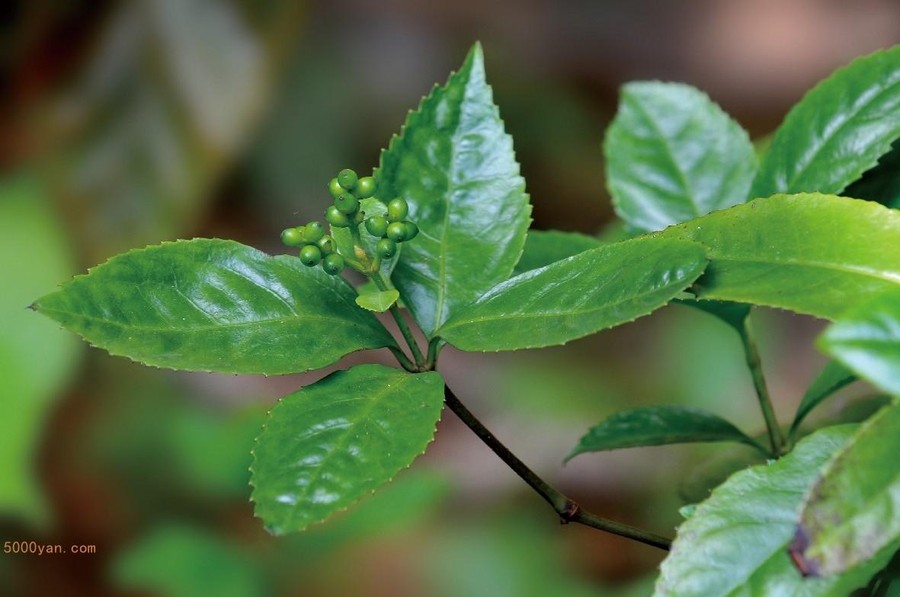
Evergreen subshrub, 50-150 cm tall. Stems several, clustered, green, with distinctly swollen nodes. Leaves opposite; petiole 0.5-1.5 cm long, base connate and sheath-like; stipules subulate; leaf blade leathery, elliptic, ovate to ovate-lanceolate, 6-17 cm long, 2-6 cm wide, apex acuminate, base cuneate, margin with coarse, sharp serrations, each tooth tip with a gland, both surfaces glabrous. Inflorescence a terminal, branched spike, including peduncle 1.5-4 cm long; bracts triangular; flowers yellow-green; stamen 1, fleshy, club-shaped to cylindrical, anther 2-celled, attached on both sides of the upper part of the connective, lateral or sometimes introrse; pistil 1, composed of 1 carpel; ovary spherical or ovoid, style absent, stigma nearly capitate. Drupe spherical, 3-4 mm in diameter, bright red when ripe. Flowering period June-July, fruiting period August-October.
Habitat and Distribution
It grows in shaded, damp areas under forests in valleys. It is distributed in Anhui, Zhejiang, Jiangxi, Fujian, Taiwan, Hunan, Guangdong, Guangxi, Sichuan, Guizhou, and Yunnan.
Harvesting and Processing
Harvested in summer and autumn, remove impurities, and dry in the sun.
Chemical Constituents
This product primarily contains isofraxidin, rosmarinic acid, fumaric acid, levofraxidin A, succinic acid, and other constituents.
Pharmacology
Has anti-tumor effects; antibacterial and antiviral; promotes fracture healing; has a promoting effect on the repair of experimental gastric ulcers and stimulates appetite.
Properties and Channel Entry
Bitter, acrid, and neutral. Enters the Heart and Liver channels.
Functions and Indications
Clears Heat and cools Blood, activates Blood circulation and disperses macules, expels Wind and unblocks collaterals. Used for febrile rashes and macules due to Blood Heat, rheumatic arthralgia, and traumatic injuries.
Dosage and Administration
Internal: decoct 9-15 g in water, or steep in wine
Precautions and Contraindications
Contraindicated in cases of Yin deficiency with intense Fire, and during pregnancy. It should be decocted first or decocted for a prolonged period.
Prescriptions
1. For rheumatic joint pain: Caoshanhu root, Gouteng root, Yeyachun root, 30 g each. Decoct in water to extract the juice, add an appropriate amount of yellow rice wine, and stew with 1 pig trotter. Take orally. (Fujian Materia Medica) 2. For fractures: Caoshanhu, Yeputao root, Paotongshu root bark, Sikuaidai. All herbs use fresh products, mash them, add an appropriate amount of white liquor. Apply externally to the fracture site. (Miao Ethnic Group Materia Medica) 3. For postpartum abdominal pain: Caoshanhu root 9 g, Tiesaoju 30 g, white sugar and rice wine each a small amount. Decoct in water and take orally. (Fujian Materia Medica) 4. For scalds and burns: Dried Caoshanhu leaves, grind into powder, 1 part; tea oil, 2 parts. Mix well and apply to the affected area. (Fujian Chinese Herbal Medicine) 5. For wound ulceration: Caoshanhu stems and leaves, an appropriate amount, decoct in water for external washing. (Jiangxi Chinese Herbal Medicine) 6. For oral mucositis: Caoshanhu 6 g, Sheshe 3 g. Decoct in water for internal use. (Jiangxi Herbal Medicine Manual)