Pinyin: Muzei
Aliases
Jiejiecao, Wuxincao, Biguancao
Source
Equisetum hyemale L.Equisetum hiemaleL. of the dried aerial parts.
Botanical Description
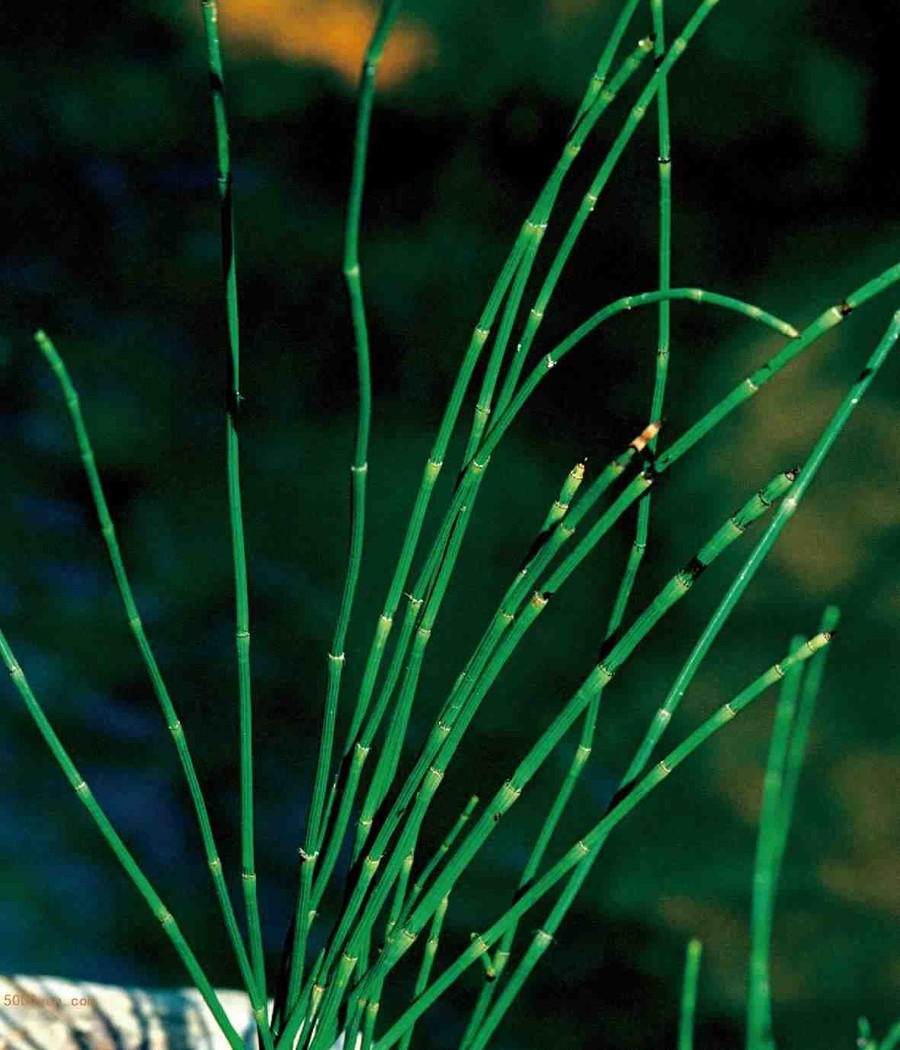
A perennial evergreen herb, stem 40-100 cm tall. Rhizome thick, dark brown; aboveground stem erect, single, hollow, 5-10 mm in diameter, surface with 20-30 longitudinal ridges. Leaves reduced to scales, base united into a tubular sheath, sheath 6-10 mm long, with a black ring at the base of the leaf sheath and at the sheath tooth; sheath teeth linear-subulate, apex caudate, early deciduous leaving a blunt tip, with 2 rows of ridges on the back forming shallow grooves. Spore spikes terminal, long-conical, 7-15 mm long, apex with a dark brown small tip, composed of many whorled hexagonal peltate sporophylls, each with a central stalk and surrounding elliptical sporangia; spores numerous, spherical. Spore period June to August.
Habitat and Distribution
It prefers to grow in shaded, damp areas under forest cover on mountain slopes, as well as in moist riverbanks and streamsides. It is distributed in Northeast, North, Northwest, Central, and Southwest China.
Harvesting and Processing
Harvested in summer and autumn, remove impurities, and dry in the sun or in the shade.
Chemical Constituents
This product contains kaempferide, gossypitrin, succinic acid, fumaric acid, and other constituents.
Pharmacology
It exhibits a sustained antihypertensive effect; significantly enhances the central inhibitory effect of sodium pentobarbital. It can raise the threshold for electroshock-induced convulsions and suppress epileptic seizures; it can significantly reduce serum total cholesterol and triglyceride levels, exerting a preventive and therapeutic effect on experimental hyperlipidemia; it inhibits platelet aggregation and shortens blood clotting and bleeding time; it demonstrates broad-spectrum antibacterial activity in vitro and possesses antiviral activity. It has antimalarial effects.
Properties and Channel Entry
Sweet, bitter, neutral. Enters the Lung and Liver channels.
Functions and Indications
Disperses Wind-Heat, brightens the eyes and removes nebula. Used for red eyes due to Wind-Heat, tearing when exposed to wind, and nebula (cloudy corneal opacity).
Dosage and Administration
Oral: 3-10 g in decoction; or made into pills or powder. External: appropriate amount, ground into powder for topical application.
Precautions and Contraindications
Individuals with Qi and Blood deficiency should use with caution.
Prescriptions
1. For excessive tearing and blurred vision: Muzei (Equisetum hiemale, nodes removed) 30 g, Cangzhu (Atractylodes lancea, soaked in rice-washed water) 30 g. Grind into powder, take 6 g with tea, or form into honey pills. (From *Sheng Hui Fang*) 2. For wind-cold-dampness pathogens requiring sweating: Muzei (nodes removed) 30 g, Shengjiang (fresh ginger) 15 g, Congbai (scallion white) 15 g. Decoct in water and drink hot to induce sweating. (From *Sheng Hui Fang*) 3. For red and painful throat: fresh Muzei, crush and extract juice, mix with honey and take orally. (From *Quanzhou Bencao*) 4. For chronic intestinal hemorrhoids with persistent bleeding: Muzei 60 g, Zhiqiao (Citrus aurantium, processed) 60 g, Ganjiang (dried ginger) 30 g, Dahuang (Rheum palmatum) 0.3 g. Grind the four ingredients, stir-fry until black while retaining one-third of their efficacy, sift into powder, take 6 g before meals with warm millet congee; highly effective. (From *Bencao Tujing*)