Pinyin: Banzhilian
Aliases
Tongjingcao, Yashuacao, Erwacao.
Source
Plant of the Lamiaceae family, Scutellaria barbata.Scutellaria barbataDried whole herb of *Wikstroemia indica* (L
Botanical Description
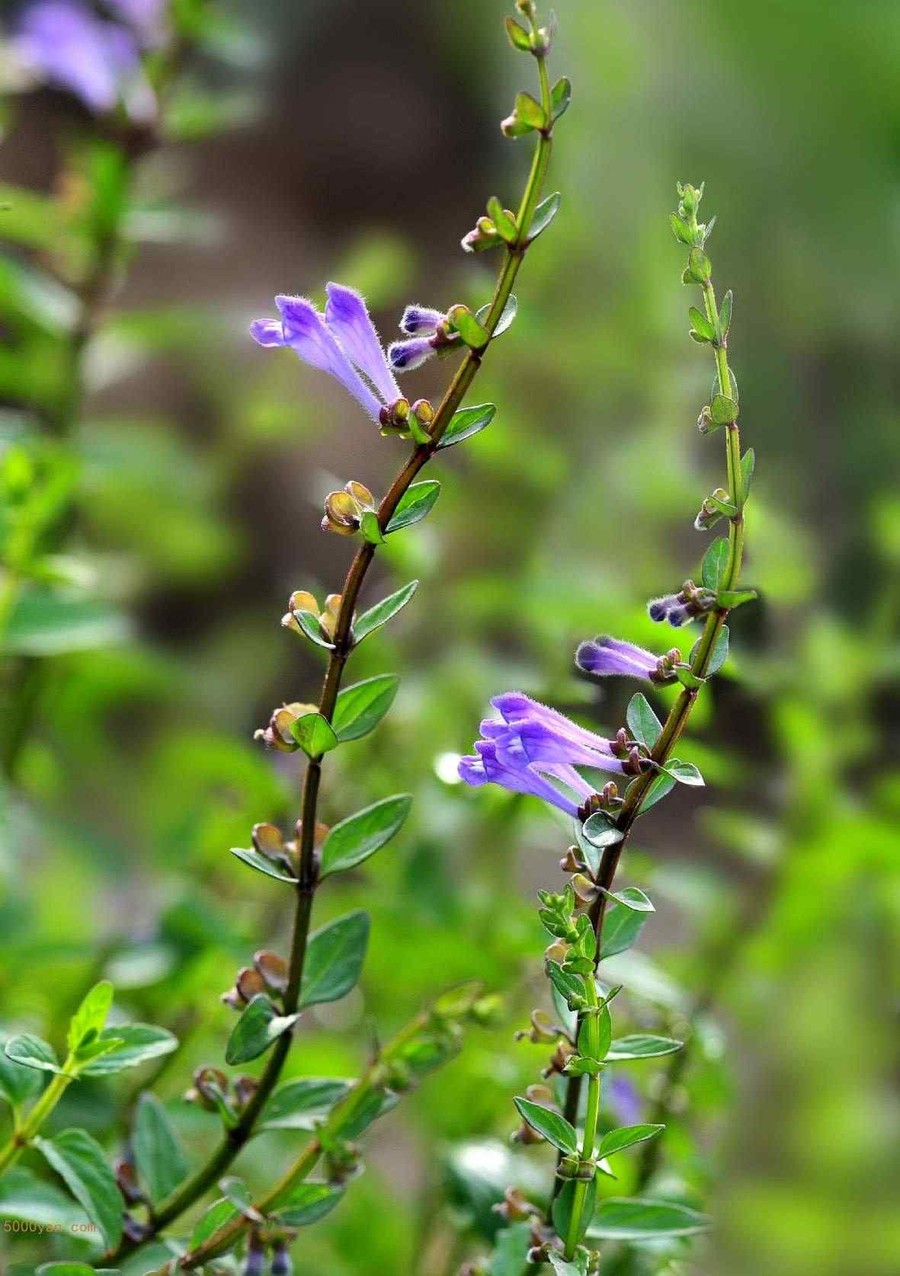
Perennial herb, 15-50 cm tall. Stem quadrangular. Leaves opposite; petiole 1-3 mm long; leaf blade ovate, triangular-ovate, or lanceolate, 1-3 cm long, 0.4-1.5 cm wide, apex acute or slightly obtuse, base broadly cuneate or nearly truncate, margin with sparse shallow blunt teeth, upper surface olive green, lower surface purplish, lateral veins 2-3 pairs, raised together with the midvein on the lower surface. Flowers opposite, secund, arranged in terminal or axillary racemes 4-10 cm long; lower bracts leaf-like, smaller, gradually becoming even smaller upward, entire; corolla blue-purple, externally pubescent, corolla tube base saccate and enlarged, gradually widening upward, upper lip galeate, lower lip broader, middle lobe trapezoidal, lateral lobes triangular-ovate; stamens 4; disc discoid, anteriorly raised, posteriorly extended into a short ovary stalk; ovary 4-lobed, style slender. Nutlets brown, oblate-spherical, with small verrucose protrusions. Flowering period May to October, fruiting period June to November.
Habitat and Distribution
Grows along streams, field edges, or in moist grasslands. Distributed in East China, South China, Southwest China, as well as Hebei, southern Shaanxi, Henan, Hubei, and Hunan.
Harvesting and Processing
Harvested in summer and autumn when the stems and leaves are lush, washed clean, and dried in the sun.
Chemical Constituents
This product contains carthamin, isocarthamin, scutellarin, scutellarein, scutellarin, scutellarein, p-coumaric acid, protocatechuic acid, and other constituents.
Pharmacology
Anticancer, exhibits mild inhibitory effects on blood cells in acute myeloid leukemia (AML). Enhances immune system function, but high-dose injection can suppress the thymus index in mice; has antibacterial effects; demonstrates strong antagonistic action against smooth muscle contraction induced by histamine. Has good antispasmodic and expectorant effects.
Properties and Channel Entry
Acrid, bitter, and cold. Enters the Lung, Liver, and Kidney channels.
Functions and Indications
Clears Heat and resolves toxicity, transforms stasis and promotes diuresis
Dosage and Administration
Internal use: decoction, 15-30 g, double the amount for fresh product, or made into pills or powder. External use: appropriate amount, fresh product mashed for application.
Precautions and Contraindications
Use with caution in individuals with weak constitution and during pregnancy.
Prescriptions
1. For stomach Qi pain: 30 g of *Scutellaria barbata*, 1 piece of pork liver or chicken (remove head, feet, and internal organs), stew with equal parts water and wine until cooked. Take in 2-3 divided doses. (*Quanzhou Bencao*) 2. For hematemesis, hemoptysis, hematuria, and traumatic bleeding: 30-50 g of *Scutellaria barbata*. Decoct in water, strain, and mix with honey to take; apply the residue to the wound externally. (*Zhe Nan Bencao Xuanbian*) 3. For chronic nephritis with edema: 30 g of fresh *Scutellaria barbata*. Finely chop and mash, mix well with eggs, steam until cooked to form an egg cake, let cool, apply to the navel area, once daily for about 6 hours. (*Zhe Nan Bencao Xuanbian*) 4. For hepatitis: 15 g of fresh *Scutellaria barbata*, 5 red dates. Decoct in water and take. (*Zhejiang Minjian Changyong Caoyao*) 5. For herpes zoster: Mash an appropriate amount of *Scutellaria barbata* with rice-washing water, extract the juice and apply externally, several times daily. (*Zhe Nan Bencao Xuanbian*) 6. For early-stage lung cancer, liver cancer, and rectal cancer: 30 g each of *Scutellaria barbata* and *Hedyotis diffusa*. Decoct and take. (*Anhui Zhongcaoyao*)