Pinyin: Liujinu
Aliases
Liuyuexue, Baihuawei, Kulianpo.
Source
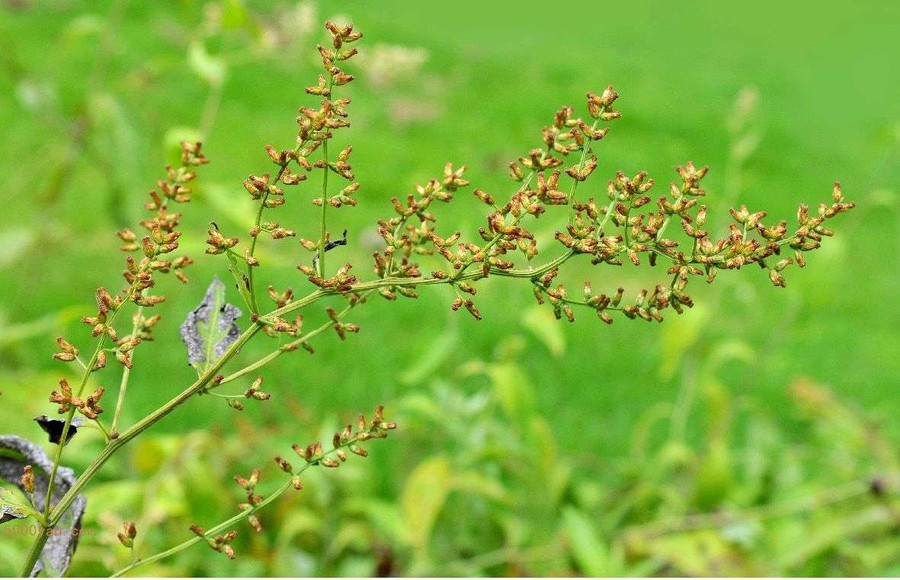
Asteraceae family plant *Artemisia anomala*.Artemisia anomalaDried flowering whole plant of S. Moore.
Botanical Description
Perennial herb, 80-150 cm tall. Stem erect, often branched above the middle, upper part with inflorescence branches, sparsely pubescent. Lower leaves wither at flowering time; middle leaves nearly leathery, oblong or ovate-lanceolate, 7-11 cm long, 3-4 cm wide, apex acuminate, base attenuate into a short petiole, undivided, margin densely serrate, upper surface sparsely hispid, lower surface paler, arachnoid-pubescent or nearly glabrous; with 5-8 pairs of pinnate veins. Capitula very numerous, sessile, densely arranged on flower branches, forming compound racemes up to 25 cm long at stem apex and upper leaf axils; involucre nearly campanulate, glabrous, about 3 mm long; phyllaries in 3-4 series, oblong, margin broadly scarious, whitish; flowers tubular, outer ones female, inner ones bisexual; synantherous stamens 5; pistil 1. Achenes minute, oblong, glabrous.
Habitat and Distribution
Growing at forest edges, in thickets, and along riverbanks. Widely distributed throughout central to southern regions of China.
Harvesting and Processing
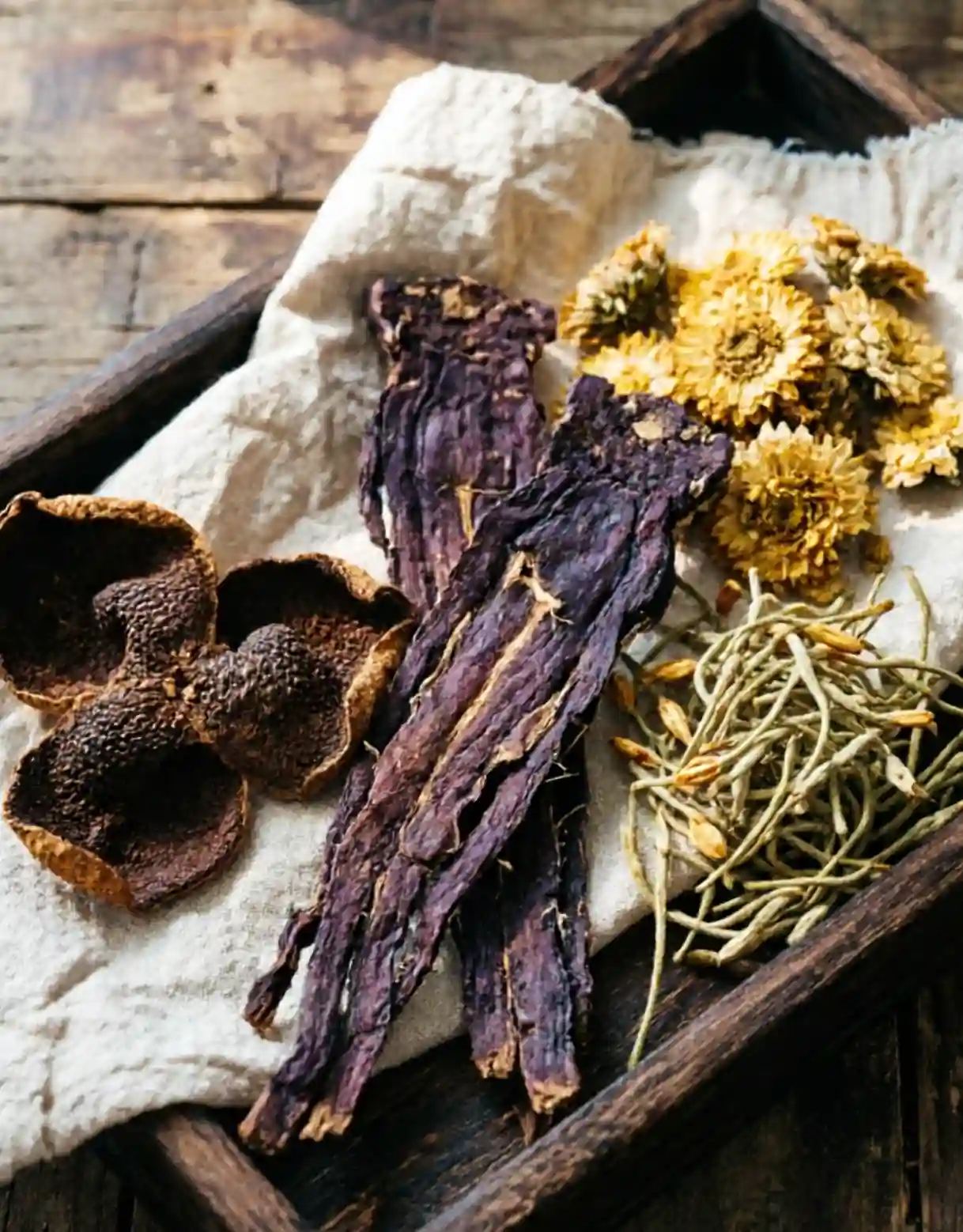
Harvested during flowering in summer and autumn, pulled up by the roots, washed, used fresh, or dried in the sun, tied into bundles for later use.
Chemical Constituents
This product primarily contains artemisia lactone, artemisia flavone, coumarin, and simiarenol among its constituents.
Properties and Channel Entry
Pungent, slightly bitter, and warm. Enters the Heart, Liver, and Spleen channels.
Functions and Indications
Breaks blood stasis and unblocks the menses, stops bleeding and reduces swelling, promotes digestion and transforms accumulations. Mainly indicated for amenorrhea, dysmenorrhea, postpartum stasis and abdominal pain, persistent lochia, abdominal masses, traumatic injury, incised wounds with bleeding, wind-damp painful obstruction, hemafecia, hematuria, carbuncles, sores, and toxic swellings, scalds and burns, food stagnation with abdominal pain, diarrhea, and dysentery.
Dosage and Administration
Oral: Decoct in water, 5-10 g; when used alone for resolving food accumulation, up to 15-30 g; or taken as powder. External use: Appropriate amount, pounded and applied; or ground into powder and applied. For reducing swelling, use raw; for promoting blood circulation, stir-fry with wine; for stopping bleeding, stir-fry with vinegar.
Precautions and Contraindications
Pregnant women should avoid taking this; those with Qi and Blood deficiency or Spleen deficiency causing diarrhea should use with caution.
Prescriptions
1. For hemorrhoids: Liujinu (Herba Artemisiae Anomalae) and Wuweizi (Fructus Schisandrae Chinensis), equal parts, grind into a fine powder. Take with wine on an empty stomach. Also apply the powder directly to the hemorrhoids, which will then heal. (Liujinu Decoction from Zhushi Jiyan Fang) 2. For wounds from caning: Liujinu powder 18 g and Mabiancao (Herba Verbenae Officinalis) powder 12 g. Mix with honey and apply topically. If the wound is moist, apply the powder directly. (Zhangchuang Dan from Zhengzhi Zhunsheng) 3. For red and white dysentery: Liujinu, Wumei (Fructus Mume), and Baijiang (dried ginger), equal parts. Decoct in water and take orally. For red dysentery, add Wumei; for white dysentery, add Baijiang. (Ruyi Fang) 4. For cholera with dysentery: Decoct Liujinu herb in water and drink the juice. (Shengji Zonglu) 5. For heart and spleen pain: Liujinu powder 18 g and Yanhusuo (Rhizoma Corydalis) powder 12 g. Mix with ginger juice and warm wine and take. (Zhengzhi Zhunsheng) 6. For visceral toxicity with blood in stool and urine: Take Liujinu powder, mixed with tea, and take orally. (Weisheng Yijian Fang)