Pinyin: Luying
Aliases
Jiegucao, Paifengcao, Dachoucao.
Source
It is the plant *Sambucus chinensis* Lindl. of the family Caprifoliaceae.Sambucus chinensisDried stems and leaves of Lindl.
Botanical Description
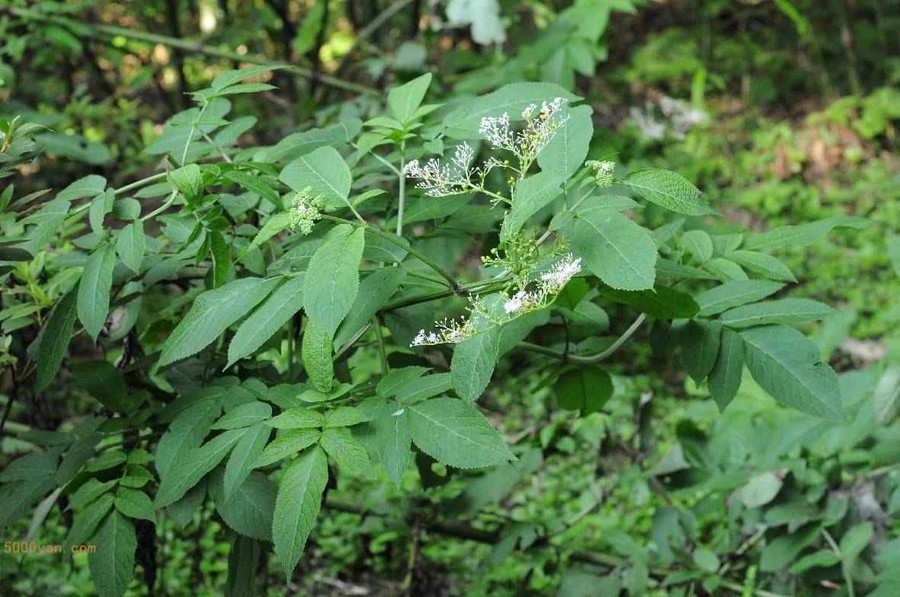
Tall herbaceous plant or semi-shrub, up to 2 m tall. Stems angular with white pith. Leaves opposite, odd-pinnately compound; stipules small, linear or glandular; leaflets 5-9, the uppermost pair basally connate, sometimes also adnate to the terminal leaflet, leaflets lanceolate, 5-15 cm long, 2-4 cm wide, apex long-acuminate, base obtuse-rounded. Inflorescence terminal, large compound corymb; few yellow cup-shaped glands transformed from sterile flowers; bracts and bracteoles linear to linear-lanceolate, 4-5 mm long; flowers small, calyx tube cup-shaped, calyx teeth triangular; corolla rotate, lobes ovate, reflexed; anthers yellow or purple; ovary 3-locular, style very short, stigma 3-lobed. Berry red, subglobose, 3-4 mm in diameter; pyrenes 2-3, ovoid, 2-5 mm long, with small tubercles. Flowering April to May, fruiting August to September.
Habitat and Distribution
Grows under forests, along ditches, or in grassy areas on hillsides; also cultivated. Distributed in Hebei, Shaanxi, Gansu, Qinghai, Jiangsu, Anhui, Zhejiang, Jiangxi, Fujian, Taiwan, Hubei, Hunan, Guangdong, Guangxi, Sichuan, Guizhou, Yunnan, and other regions.
Harvesting and Processing
Harvested in summer and autumn, cut into segments, used fresh or dried in the sun.
Chemical Constituents
This product primarily contains flavonoids, phenolic constituents, tannins, and sugars. Among these is chlorogenic acid.
Pharmacology
Has analgesic effects.
Properties and Channel Entry
Sweet, slightly bitter, neutral.
Functions and Indications
Expels Wind, promotes diuresis, relaxes tendons, and activates Blood circulation. Indications: rheumatic arthralgia, lower back and leg pain, edema, jaundice, traumatic injury, postpartum lochiorrhea, rubella with pruritus, erysipelas, and sores/swelling.
Dosage and Administration
Oral: decoction, 9-15 g, fresh product 60-120 g. External use: appropriate amount, pound and apply; or decoct and wash; or grind into powder and mix for application.
Precautions and Contraindications
Contraindicated during pregnancy.
Prescriptions
1. For rheumatic arthritis: 15-30 g of *Sambucus chinensis* stems and branches. Decoct in water for oral administration. (Qingdao Chinese Herbal Medicine Manual) 2. For nephritis edema: 30-60 g of *Sambucus chinensis* whole plant. Decoct in water for oral administration. (National Chinese Herbal Medicine Compilation) 3. For traumatic injuries and sprains: Crush *Sambucus chinensis* leaves and apply as a poultice to the affected area. (Weisheng Yijian Fang) 4. For postpartum lochiostasis: 30 g of *Sambucus chinensis* stems or roots. Decoct in water for oral administration. (Qingdao Chinese Herbal Medicine Manual) 5. For scabies and psoriasis: Dry *Sambucus chinensis* leaves in the shade, grind into powder, and mix with light oil for topical application. (Weisheng Yijian Fang) 6. For red, swollen carbuncles: Chop fresh *Sambucus chinensis* roots or leaves, crush them, mix with a small amount of egg white, and apply to the affected area. (Jiangxi Folk Herbal Medicine)