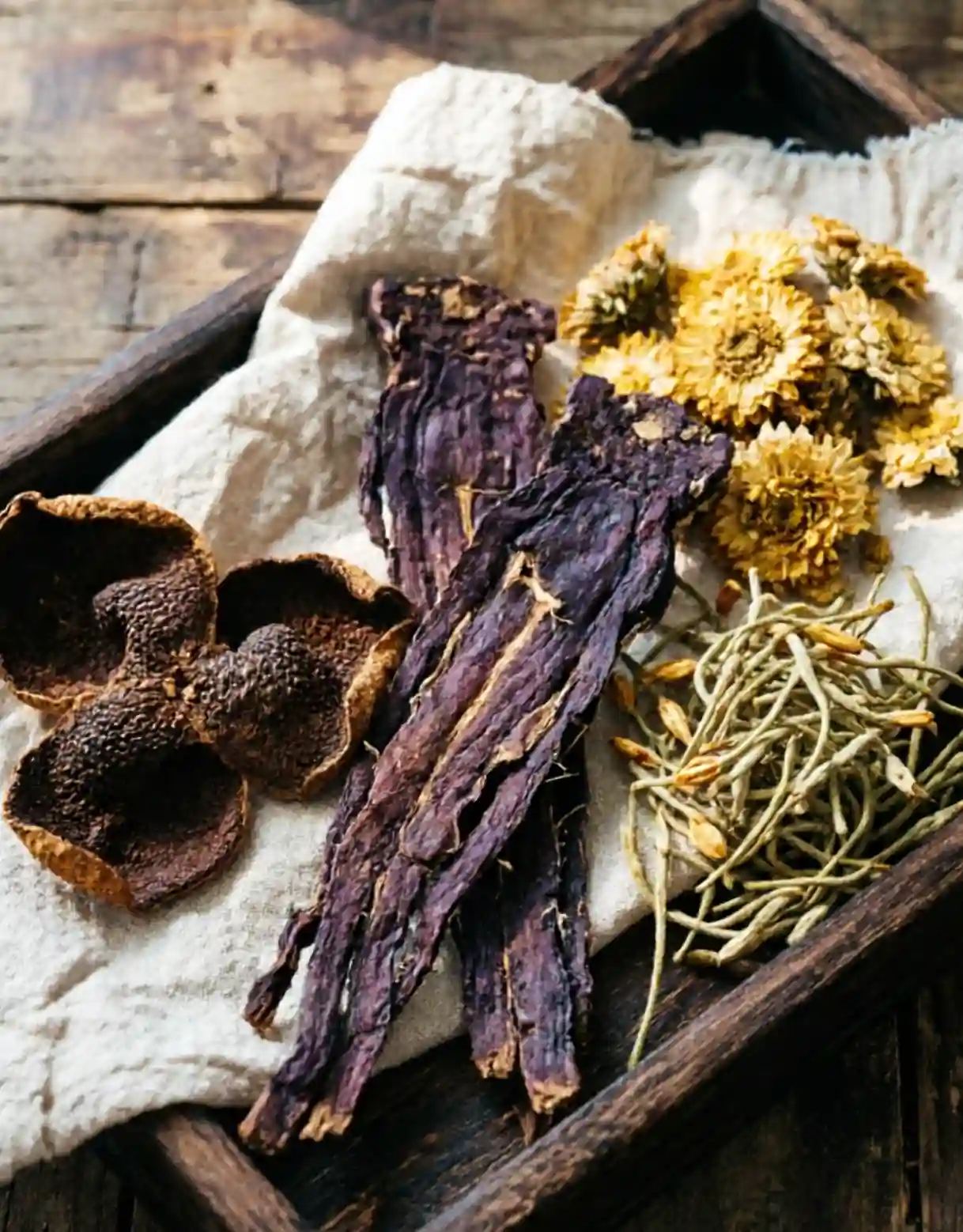
Pinyin: Baijiang
Aliases
Kucai, Douchi Cao, Guanyincai
Source
1. For pneumonia: Renshen 6 g, decoct in water and take orally.Patrinia villosaDried whole herb of (Thunb.) Juss.
Botanical Description
Perennial herb, 50-100 cm tall. Rhizome has a special odor; stems and branches covered with coarse white hairs, which gradually shed. Basal leaves clustered; leaf blade broadly ovate or nearly round, margins coarsely toothed, base cuneate and decurrent, unlobed or pinnately divided with a large terminal lobe. Cauline leaves opposite; petiole 1-3 cm long, upper leaves nearly sessile; leaf blade ovate, rhombic-ovate, or narrowly elliptic, 4-11 cm long, 2-5 cm wide, apex acuminate to narrowly long-acuminate, base cuneate and decurrent, margins coarsely toothed, upper leaves narrower and smaller, often unlobed. Thyrse, forming a sparse large corymb; involucral bracts ovate-lanceolate; calyx small, calyx teeth 5, inconspicuous; corolla white, apex 5-lobed; stamens 4, exserted; ovary inferior, style slightly shorter than stamens. Achene obovate, persistent bracts adnate, bracts nearly round, membranous, with prominent reticulate veins.
Habitat and Distribution
Born in wasteland grasslands and forest edge thickets at altitudes of 500-800 m. Distributed in Northeast, North, East, South, and Southwest China.
Harvesting and Processing
Wild-harvested specimens are collected in summer and autumn, while cultivated specimens can be harvested before flowering in the same year. Wash clean and sun-dry.
Chemical Constituents
This product contains villoside, oleanolic acid, hederagenin,β1. For hypercholesterolemia: sitosterol 3-6 g, take orally after meals. 2. For atherosclerosis: sitosterol 3-6 g, take orally with warm water.β-D-glucosides, patrinoside, and scabioside and other constituents.
Pharmacology
Has analgesic, antiviral, and antibacterial effects.
Properties and Channel Entry
Acrid, bitter, and slightly cold. Enters the Stomach, Large Intestine, and Liver channels.
Functions and Indications
Clears Heat and resolves toxicity, activates Blood and expels pus. Indications: intestinal abscess, pulmonary abscess, carbuncles and swellings, dysentery, postpartum blood stasis with abdominal pain.
Dosage and Administration
Oral: decoct in water, 10-15 g. External use: appropriate amount of fresh material, mash and apply to the affected area.
Precautions and Contraindications
Caution is advised for individuals with weak spleen and stomach, as well as for pregnant women.
Prescriptions
1. For hematemesis and epistaxis due to accumulated Heat causing reckless movement of Blood: *Patrinia* 60 g, *Gardeniae Fructus* (charred) 9 g, *Rehmanniae Radix Praeparata* 15 g, *Junci Medulla* 3 g. Decoct in water and take slowly. (From *Ben Cao Hui Yan*, citing *Shuo Hu Zhai Yi Hua*) 2. For postpartum lumbago: *Patrinia* and *Angelicae Sinensis Radix* each 2.4 g. *Chuanxiong Rhizoma*, *Paeoniae Radix Alba*, and *Cinnamomi Ramulus* each 1.8 g. Add two *sheng* of water, decoct to eight *ge*, divide into two doses. Avoid scallion. (From *Gang Mu*, citing *Guang Ji Fang*) 3. For postpartum abdominal pain like needle stabs: *Patrinia* 150 g. Add four *sheng* of water, decoct to two *sheng*. Take two *ge* per dose, three times daily. (From *Wei Sheng Yi Jian Fang*) 4. For unnamed toxic swellings: Fresh *Patrinia* whole herb 30-60 g. Decoct in equal parts wine and water, take orally, and mash the residue to apply on the affected area. (From *Min Dong Ben Cao*) 5. For intercostal neuralgia: *Patrinia* 60 g. Decoct in water and take orally. (From *Zhejiang Medicinal Flora*) 6. For red and white dysentery: Fresh *Patrinia* 60 g, rock sugar 15 g. Stew in boiling water and take. (From *Min Dong Ben Cao*)

