Pinyin: Xiangru
Aliases
Xiangcai, Shi Xiangru, Shi Ai.
Source
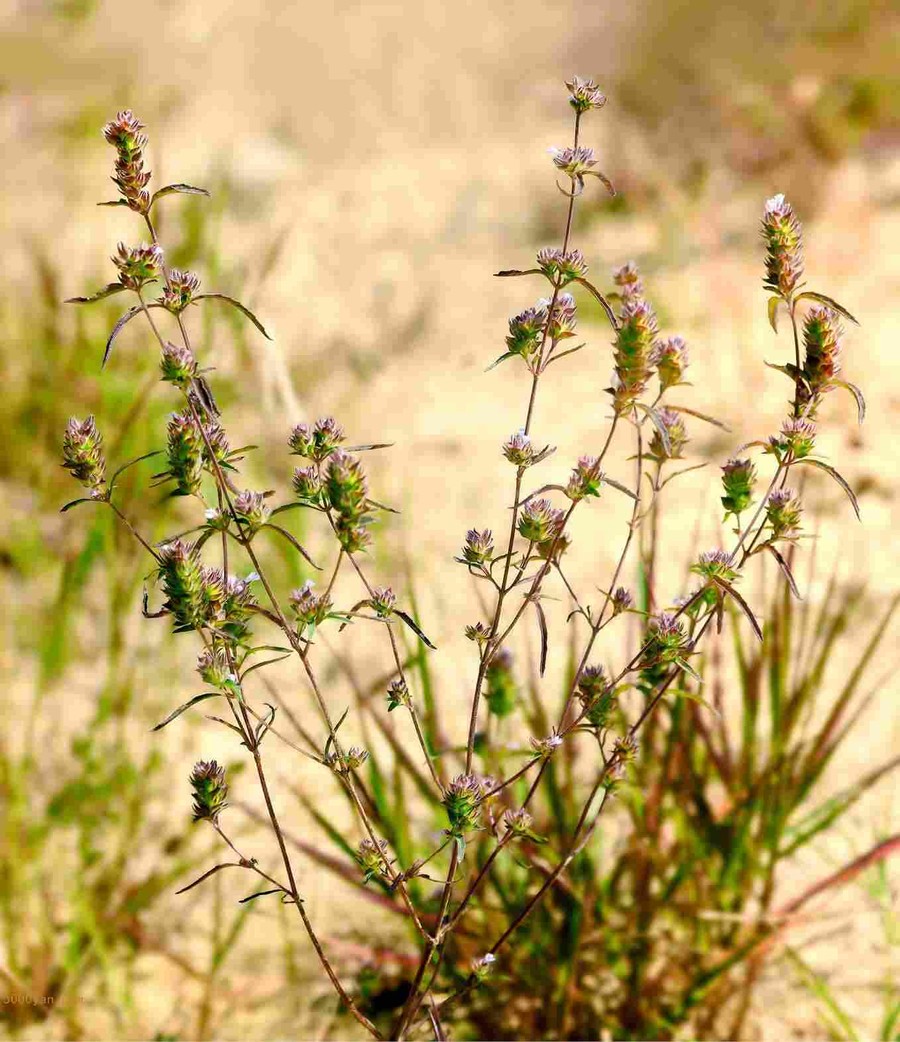
Herb of the Lamiaceae family, *Mosla chinensis* Maxim.Mosla chinensis ‘Jiang-xiangru. Dried aerial parts.
Botanical Description
Erect herb. Stem quadrangular. Leaves opposite; leaf blade lanceolate, 3-6 cm long, 0.6-1 cm wide, apex acuminate, base attenuate, margin with 5-9 sharp shallow serrations, lateral veins prominent, upper surface yellowish-green, pubescent with intermixed long cottony hairs, lower surface paler, midvein with long soft hairs, remainder pubescent, both surfaces with sunken glandular dots. Racemes densely spicate, 2-3.5 cm long; bracts imbricate, obovate or ovate, upper half densely with sunken glandular dots, margin with long cilia, veins 7-9. Calyx campanulate, teeth 5, subulate or lanceolate, subequal; corolla pale purple, rarely white, externally puberulent; stamens and pistil included, staminodes 2, fertile, thecae subequal, filaments very short, glabrous, inserted on corolla tube; stigma 2-lobed, reflexed; disc anteriorly finger-like swollen. Nutlets oblate-spheroid, 0.9-1.4 mm in diameter, surface with sparse reticulations, areoles flat, with verrucose protuberances. Flowering June, fruiting July.
Habitat and Distribution
Cultivated in Fenyi and Xinyu of Jiangxi and other areas.
Harvesting and Processing
Harvest during summer when the stems and leaves are lush and flowers are in full bloom, on a sunny day; cut, remove impurities, and dry in the shade.
Chemical Constituents
This product primarily contains flavonoids, volatile oils, terpenoids, and fatty acids as its main chemical constituents.
Pharmacology
Has antipyretic and analgesic effects; inhibits isolated intestines; enhances immune function; exhibits strong broad-spectrum antibacterial activity and certain antiviral effects; antagonizes angiotensin receptors in vitro.b- hydroxyl-bAll had significant inhibitory effects on HMG-CoA reductase, potentially possessing antihypertensive and cholesterol-lowering effects. Additionally, it has diuretic, antitussive, and expectorant effects.
Properties and Channel Entry
Acrid, slightly warm. Enters the Lung and Stomach channels.
Functions and Indications
Induces sweating to release the Exterior, transforms Dampness and harmonizes the Middle
Dosage and Administration
Internal: decoct 3-9 g in water, or prepare as pills or powder, or use the decoction as a mouthwash. External: apply an appropriate amount of the mashed herb topically.
Precautions and Contraindications
For internal use, it is suitable to take it as a cool decoction; taking it hot may easily induce vomiting. Those with exterior deficiency should avoid taking it.
Prescriptions
1. For summer heat stroke with vexation and thirst: Xiangru 60 g. Grind the single herb into powder, take 6 g per dose, decoct with one cup of water until seven-tenths remains, take warm without removing the dregs, regardless of meal time. (From *Shengji Zonglu*: Xiangru Powder) 2. For cholera with vomiting and diarrhea, vexation and pain in the limbs, cold sweating, and excessive thirst: Xiangru 60 g, Liaozi 30 g. Coarsely grind and sieve the two herbs. Take 6 g per dose, decoct with one cup of water until seven-tenths remains, strain and take warm, three times daily. (From *Shengji Zonglu*) 3. For pediatric tinea capitis (white baldness) with no hair growth and sweating: Boil aged Xiangru in water to make a concentrated decoction, mix with lard and lead powder (hu fen), and apply topically. (From *Zimu Milu*) 4. For halitosis: Take one handful of Xiangru, decoct with one dou of water until three sheng remains, and hold small amounts in the mouth. (From *Qianjin Yaofang*) 5. For multiple furuncles and miliaria: Use an appropriate amount of fresh Xiangru, mash into a paste, and apply externally. (From Jiangxi *Cao Yao Shouce*) 6. For skin pruritus and genital eczema: Use an appropriate amount of fresh Xiangru (whole plant). Decoct in water and wash externally. (From *Zhejiang Yaoyong Zhiwu Zhi*)