Pinyin: Mohanlian
Aliases
Heimocao, Shuihanlian.
Source
Asteraceae plant Eclipta prostrataEclipta prostrataL. of the dried aerial parts.
Botanical Description
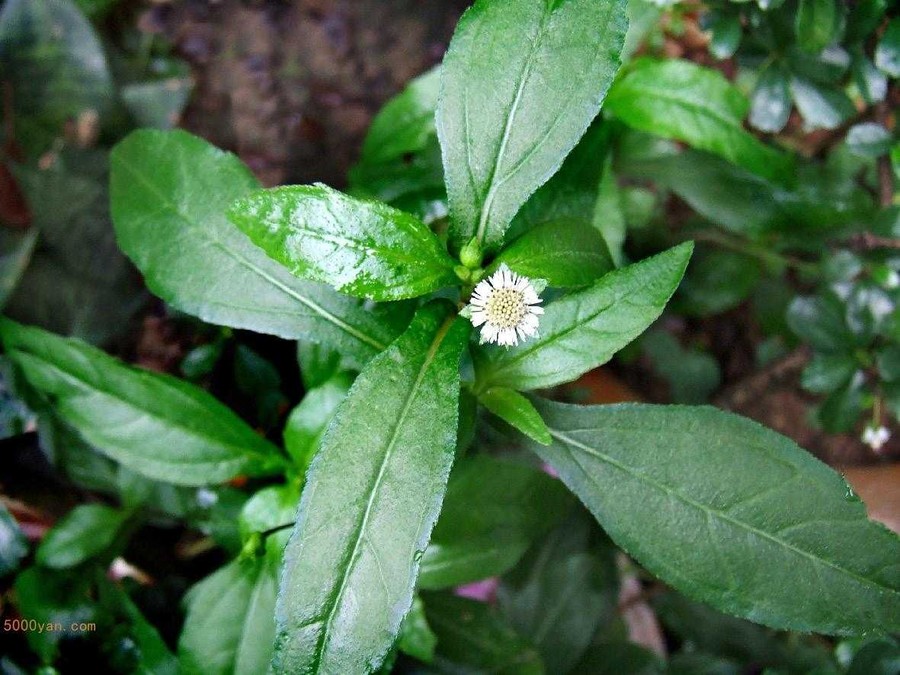
Annual herbaceous plant, 10-60 cm tall. Entire plant covered with white coarse hairs; the sap that flows out after breaking turns blue-black within a few minutes. Stems erect or decumbent at base, rooting at nodes, green or reddish-brown. Leaves opposite; leaf blades linear-elliptic to lanceolate, 3-10 cm long, 0.5-2.5 cm wide, entire or with fine teeth, both surfaces covered with white coarse hairs. Capitula axillary or terminal; involucre campanulate, with 5-6 bracts; receptacle flat, bearing a few ray florets and numerous tubular florets; ray florets female, corolla white, fertile or sterile; tubular florets bisexual, yellow-green, all fertile. Achenes yellow-black, about 3 mm long, without pappus. Flowering period July to September, fruiting period September to October.
Habitat and Distribution
1. Grows along roadsides, wetlands, ditch banks, or in fields. Distributed throughout the country.
Harvesting and Processing
Harvested during flowering, dried in the sun.
Chemical Constituents
This product contains 2-(butadiynyl)-5-(vinylethynyl)thiophene, demethylwedelolactone-7-glucoside, echinacoside C, wedelolactone,α- Trienylthiophene methanol and other constituents.
Pharmacology
It exhibits inhibitory effects on bacterial growth; demonstrates significant protective effects on liver function; enhances the body's immune function; possesses obvious anti-mutagenic effects; has hemostatic and cardiovascular system-improving effects; shows moderate cytotoxic activity against esophageal cancer 109 cells; in addition, it has significant analgesic effects in mice and can markedly reduce the increase in hexobarbital sleep time induced by carbon tetrachloride and the increase in chlorzoxazone paralysis time.
Properties and Channel Entry
Sweet, sour, and cold. Enters the Kidney and Liver channels.
Functions and Indications
Tonifies the Liver and Kidneys, cools the Blood and stops bleeding. Used for Liver and Kidney Yin deficiency, loosening teeth, premature graying of hair and beard, dizziness and tinnitus, soreness and weakness of the lower back and knees, Yin deficiency with Blood Heat causing hematemesis, epistaxis, hematuria, bloody dysentery, metrorrhagia and metrostaxis, and traumatic bleeding.
Dosage and Administration
Internal: decoct in water, 9-30 g; or simmer into a paste; or crush to extract juice; or prepare into pills or powder. External: apply an appropriate amount of crushed herb as a compress; or tamp crushed floss into the nostrils; or grind into powder for topical application.
Precautions and Contraindications
Use with caution in cases of Spleen and Kidney deficiency-cold.
Prescriptions
1. For hemoptysis and hematochezia: Mohanlian (Eclipta prostrata) and Baiji (Bletilla striata) 10 g each. Grind into powder, take with boiling water. (Fujian Materia Medica) 2. For gastric and duodenal ulcer bleeding: Mohanlian (Eclipta prostrata) and Dengxincao (Juncus effusus) 30 g each. Decoct in water and take orally. (National Compilation of Chinese Herbal Medicine) 3. For intestinal wind and visceral toxicity with incessant bleeding: Mohanlian (Eclipta prostrata) seeds, roast on a tile, grind into powder. Take 6 g per dose with rice water. (Puji Prescriptions, citing Household Treasured Formulas: Lianzi Powder) 4. For bloody dysentery: Mohanlian (Eclipta prostrata) and Tiexiancai (Acalypha australis) 15 g each. Decoct and take. (Anhui Chinese Herbal Medicine) 5. For dysfunctional uterine bleeding: Fresh Mohanlian (Eclipta prostrata) and fresh Xianhecao (Agrimonia pilosa) 30 g each, Xueyutan (carbonized human hair) and Binlangtan (carbonized betel nut) 9 g each (ground into powder). Decoct the first two herbs in water, then mix with the powder of the last two herbs; take after cooling. (National Compilation of Chinese Herbal Medicine) 6. For knife wound bleeding: Fresh Mohanlian (Eclipta prostrata), mash and apply to the wound; dried material, grind into powder and apply to the wound. (Hunan Materia Medica) 7. For leukorrhea and nocturnal emission: Mohanlian (Eclipta prostrata) 60 g, Baiguo (Ginkgo biloba) 14 kernels, Bingtang (rock sugar) 30 g. Decoct in water and take orally. (Fujian Materia Medica) 8. For white turbidity (stranguria): Mohanlian (Eclipta prostrata) 15 g, Cheqianzi (Plantago asiatica) 9 g, Yinhua (Lonicera japonica) 15 g, Tufuling (Smilax glabra) 15 g. Decoct in water and take orally. (Luchuan Bencao)