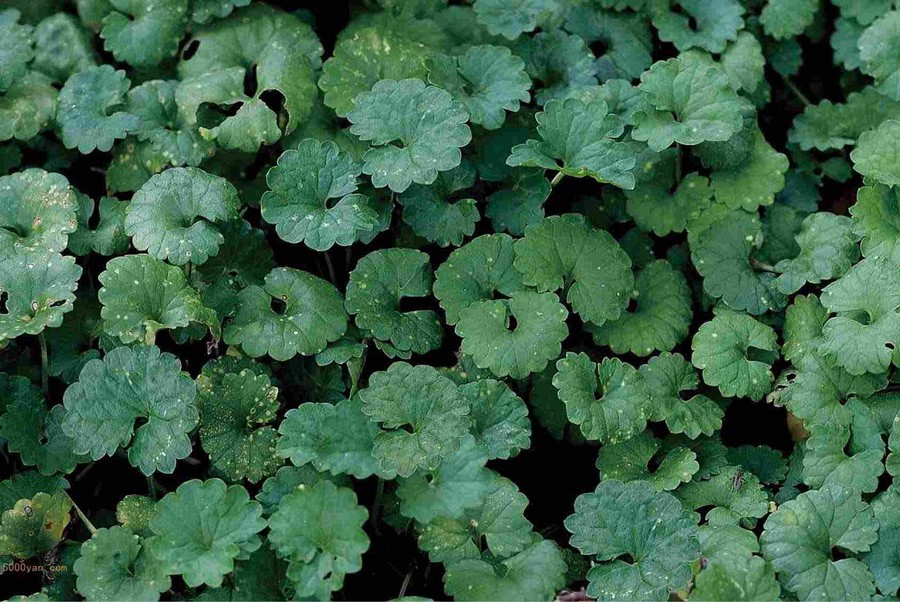
Pinyin: lianqiancao
Aliases
Huoxue Dan, Jinqian Cao, Mati Cao.
Source
Plant of the Lamiaceae family *Glechoma longituba* (Nakai) Kupr.Glechoma longitubaDried aerial parts of (Nakai) Kupr.
Botanical Description
Perennial herb, 10-30 cm tall, young parts sparsely covered with long soft hairs. Stolons root at nodes, stems ascending, quadrangular. Leaves opposite; petiole 1.5 times the length of the leaf blade, covered with long soft hairs; leaf blade cordate or subreniform, 1.8-2.6 cm long, 2-3 cm wide, apex acute or obtuse, margin crenate, both surfaces pubescent or hirsute. Verticillasters usually 2-flowered; bracteoles linear, 4 mm long, ciliate; calyx tubular, 9-11 mm long, externally villous, internally slightly pubescent, calyx teeth 5, upper lip 3 teeth longer, lower lip 2 teeth slightly shorter, apex awned, ciliate; corolla blue or purple, lower lip with dark spots, corolla tube of two types: long type 1.7-2.2 cm, short type 1-1.4 cm, externally somewhat pubescent, upper lip 2-lobed, lobes subreniform, lower lip elongated, 3-lobed, middle lobe largest, apex emarginate; stamens 4, included, posterior pair longer, anthers 2-celled; ovary 4-lobed; style slightly exserted, stigma 2-lobed; disc cupular, anteriorly finger-like swollen. Nutlets oblong-ovoid, about 1.5 mm long, dark brown. Flowering April to May, fruiting May to June.
Habitat and Distribution
It grows at elevations of 50-2000 m in shaded and moist areas such as forest edges, under sparse forests, on grasslands, or by streams. It is distributed throughout China except in Gansu, Qinghai, Xinjiang, and Tibet.
Harvesting and Processing
Harvested from spring to autumn, remove impurities and sun-dry.
Chemical Constituents
The stems and leaves contain volatile oil, with the main constituents being l-pinocamphone, isopinocamphone, l-menthone, isomenthone, and pulegone.α1. For pneumonia: Renshen 6 g, decoct in water and take orally. Internal use: decoct 3-10 g.β- α-pinene, limonene, menthol, linalool, etc.
Pharmacology
Has cholagogic, diuretic, and litholytic (stone-dissolving) effects, and also exhibits antibacterial activity, showing high sensitivity to Staphylococcus aureus.
Properties and Channel Entry
Acrid, slightly bitter, and slightly cold. Enters the Liver, Kidney, and Urinary Bladder channels.
Functions and Indications
Promotes diuresis and treats stranguria, clears Heat and resolves toxicity, disperses stasis and reduces swelling. Used for Heat stranguria, stone stranguria, Damp-Heat jaundice, sores, carbuncles, swelling and pain, and traumatic injuries.
Dosage and Administration
Internal: decoct in water, 15-30 g; or steep in wine, or crush for juice. External: appropriate amount, crush for poultice or squeeze for topical application.
Precautions and Contraindications
For Yin abscesses, blood deficiency, and pregnant women, use with caution.
Prescriptions
1. For promoting urination and treating bladder stones: a. Lianqiancao, Longxucao, and Cheqiancao 15 g each, decoct in water and take orally. (Zhejiang Folk Herbal Medicine) b. Lianqiancao 100 g, Oujie 100 g, decoct in water and take orally. (Jilin Chinese Herbal Medicine) 2. For treating kidney and ureteral stones: Lianqiancao 120 g, decoct in water, mix with honey, take orally twice daily. (Jilin Chinese Herbal Medicine) 3. For treating nephritis edema: Lianqiancao and Bianxu 30 g each, Jicaihua 15 g, decoct and take orally. (Shanghai Commonly Used Chinese Herbal Medicine) 4. For treating damp-heat jaundice: Lianqiancao 60 g, Popozhen 75 g, decoct in water and take orally. (Zhejiang Medicinal Flora) 5. For treating cholecystitis and gallstones: Lianqiancao and Pugongying 30 g each, Xiangfuzi 15 g, decoct and take orally, one dose daily. (Zhejiang Medicinal Flora) 6. For treating traumatic injuries: Fresh Lianqiancao 30 g, fresh Duheng root 3 g, extract juice, mix with water and wine and take orally; apply the residue to the affected area after mashing. (Jiangxi Herbal Medicine) 7. For treating abscesses: Equal amounts of fresh Lianqiancao and fresh Machixian, decoct in water for fumigation and washing. (Shanghai Commonly Used Chinese Herbal Medicine) 8. For treating boils and erysipelas: Equal parts of fresh Lianqiancao and fresh Cheqiancao, mash to extract juice, add equal amount of liquor, and apply to the affected area. (Jilin Chinese Herbal Medicine)