Pinyin: Chixiaodou
Aliases
Chidou, Hongdou, Hongxiaodou, Zhuxiaodou.
Source
Fabaceae plant Vigna umbellata (red adzuki bean)Vigna umbeuata Ohwiet Ohashi dried mature seeds.
Botanical Description
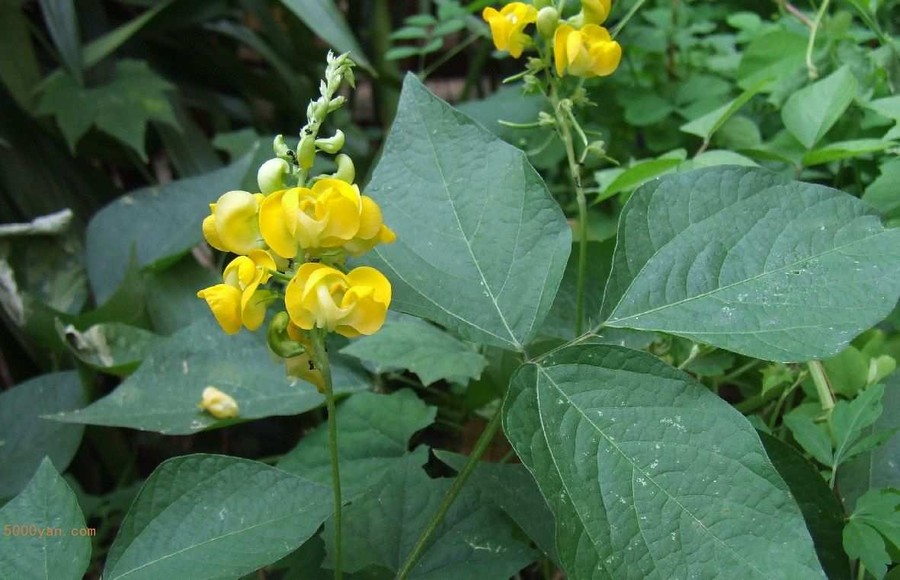
Annual semi-climbing herbaceous plant. Stem up to 1.8 m long, densely covered with retrorse hairs. Leaves trifoliolate, petiole 8-16 cm long; stipules lanceolate or ovate-lanceolate, leaflets 3, lanceolate or oblong-lanceolate, 6-10 cm long, 2-6 cm wide, apex acuminate, base broadly triangular or suborbicular, margin entire or 3-lobed, both surfaces glabrous, papery; leaflets petiolulate, 3-veined. Racemes axillary, many-flowered, pedicels very short; bracteoles 2, lanceolate-linear, about 5 mm long, hairy; calyx short-campanulate, teeth 5; corolla papilionaceous, yellow, standard reniform, apex slightly concave, base cordate, wings obliquely ovate, base with gradually narrowed claw, keel narrowly oblong, with horn-like process; stamens 10, diadelphous, anthers small; ovary superior, densely covered with short stiff hairs, style linear. Legume linear-compressed-cylindrical. Seeds 6-10, dark purple, oblong, both ends rounded, with straight and sunken hilum. Flowering period May to August, fruiting period August to September.
Habitat and Distribution
Cultivated or wild, distributed in Zhejiang, Jiangxi, Hunan, Guangdong, Guangxi, Guizhou, Yunnan, and other regions, commonly cultivated throughout southern China.
Harvesting and Processing
Harvest the whole plant in autumn when the fruit is ripe but not yet split, dry in the sun, thresh the seeds, remove impurities, then dry again in the sun.
Medicinal Properties
This product is oblong and slightly flat, 5-8 mm long, 3-5 mm in diameter. The surface is purplish-red, dull or slightly lustrous; on one side, there is a linear protruding hilum, inclined toward one end, white, about 2/3 of the total length, with a sunken longitudinal groove in the middle; on the other side, there is an indistinct raphe. The texture is hard, not easily broken. Cotyledons 2, milky white. Odor: faint; Taste: slightly sweet.
Chemical Constituents
This product contains 3-furanmethanol-β- D-glucopyranoside, azuki saponins I-VI, procyanidin B1Proanthocyanidin B3D-catechin, D-epicatechin, niacin, riboflavin, and other constituents.
Pharmacology
Inhibits trypsin.
Properties and Channel Entry
Sweet, sour, neutral. Enters the Heart and Small Intestine channels.
Functions and Indications
Induces diuresis to reduce edema, resolves toxicity and expels pus
Dosage and Administration
Internal: decoct in water, 10-30 g; or use in powder form. External: appropriate amount, grind fresh and apply as a paste; or decoct and wash.
Precautions and Contraindications
Use with caution in patients with Yin deficiency and fluid damage; excessive dosage may cause diuresis and further damage body fluids.
Prescriptions
1. For early-stage carbuncles: Powder *Chixiaodou* (Red Bean) and apply with vinegar to the affected area; it also resolves the condition. (From *Xiaopin Fang*) 2. For mumps, deep-rooted carbuncles, and furuncles: Grind *Chixiaodou* into a fine powder, mix with freshly drawn water, and apply to the sore and its surrounding area; reapply when the red, swollen area dries. (From *Zhengzhi Zhunsheng*) 3. For hot, swollen cheeks: Powder *Chixiaodou*, mix with honey, and apply to the area; it resolves overnight. Adding powdered hibiscus leaves improves the effect. (From *Compendium of Materia Medica*) 4. For infant double tongue: Powder *Chixiaodou*, mix with vinegar, and apply to the tongue. (From *Qianjin Yaofang*) 5. For insufficient lactation: Boil *Chixiaodou* and drink the decoction to promote milk flow. (From *Wangyue Chanshu*)