Pinyin: Nanheshi
Aliases
Yehu luobo zi, Qie yi zi, He shi.
Source
1. For pneumonia: Renshen 6 g, decoct in water and take orally.Daucus carotaL. dried mature fruit.
Botanical Description
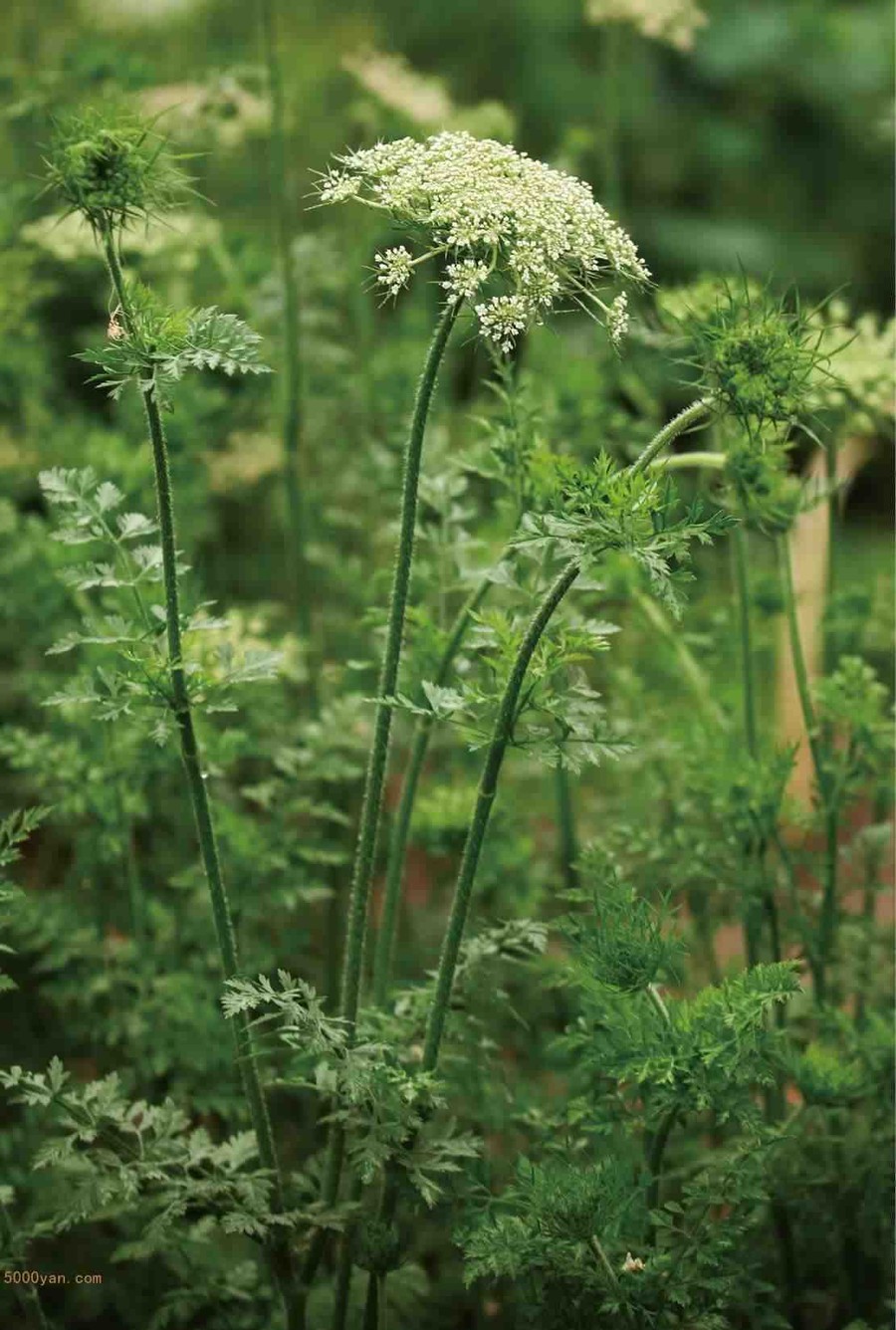
Biennial herb, 20-120 cm tall. Entire plant covered with white coarse stiff hairs. Roots slender conical, fleshy, yellow-white. Basal leaves membranous, oblong, 2-3 times pinnately divided, ultimate segments linear or lanceolate, 2-15 mm long, 0.5-4 mm wide, apex acute, with small tip, glabrous or with coarse stiff hairs; petiole 3-12 cm long; cauline leaves nearly sessile, with leaf sheath, ultimate segments small and slender. Compound umbel terminal, peduncle 10-55 cm long, with coarse stiff hairs; involucre bracts numerous, leaf-like, pinnately divided, segments linear, 3-30 mm long; rays numerous, outer rays curved inward at fruiting; involucel bracts 5-7, linear, undivided or 2-3 lobed, margin membranous, ciliate; flowers usually white, sometimes tinged pale red. Cremocarp long-ovoid, 3-4 mm long, 2 mm wide, with ribs, ribs winged, with short hooked spines or white bristles. Flowering period May-July, fruiting period June-August.
Habitat and Distribution
Grows on hillsides, roadsides, open fields, or farmlands. Distributed in Jiangsu, Anhui, Zhejiang, Jiangxi, Hubei, Sichuan, Guizhou, and other regions.
Harvesting and Processing
For spring-sown crops, harvest in summer; for autumn-sown crops, harvest in winter. Remove impurities and dry in the sun.
Medicinal Properties
The mericarp is elliptical, mostly split into separate mericarps, measuring 3-4 mm in length and 1.5-2.5 mm in width. The surface is brownish-yellow or grayish-brown, with a remnant style at the apex and a blunt round base. The dorsal side bears 4 narrow wing-like secondary ridges, densely covered with a single row of transverse yellowish-white hooked prickles up to 1.5 mm long. Between the secondary ridges are indistinct primary ridges with sparse short pubescence. The commissural surface is relatively flat, with 3 dark longitudinal stripes (oil ducts) and 3 arcuate veins (vascular bundles), the margins of which bear pubescence. The seed kernel is off-white and oily. Light in weight, when rubbed it emits a characteristic aroma, and the taste is slightly pungent followed by bitterness.
Chemical Constituents
This product contains asarone, camphene,α- curcumene, linalool, linoleic acid, oleic acid and other components.
Pharmacology
Expands coronary arteries, lowers blood pressure; relaxes smooth muscle of the small intestine and trachea, contracts the uterus; inhibits respiration; has anticonvulsant effects, among other actions.
Properties and Channel Entry
Bitter, acrid, neutral; mildly toxic. Enters the Spleen and Stomach channels.
Functions and Indications
Kills parasites and removes accumulations. Used for ascariasis, enterobiasis, taeniasis, abdominal pain due to parasitic accumulation, and infantile malnutrition due to parasitic infestation.
Dosage and Administration
Internal use: decoct 6-9 g; or prepared as pills or powder. External use: appropriate amount, decoct for fumigation and washing.
Prescriptions
1. For ascariasis, taeniasis, and enterobiasis: Nanheshi 6 g, grind into powder and take with water. (*Hubei Chinese Herbal Medicine Annals*) 2. For hookworm disease: Nanheshi 45 g, decoct to concentrate and combine the two decoctions, add an appropriate amount of sugar for flavor, take before bedtime, and use for 2 consecutive doses. (*Zhejiang Medicinal Plants Annals*) 3. For abdominal pain due to worm accumulation: Nanheshi 9 g, Nanguazi (pumpkin seeds) and Binglang (areca nut) 15 g each. Decoct in water and take orally. (*Hubei Chinese Herbal Medicine Annals*) 4. For anal itching due to enterobiasis: Nanheshi, Huajiao (Sichuan pepper), and Baixianpi 15 g each, Kuliangenpi 9 g. Decoct in water, fumigate and wash while hot, or sit in the warm decoction. (*Zhejiang Medicinal Plants Annals*) 5. For vulvar itching: Nanheshi 6 g. Decoct in water and fumigate and wash the vulvar area. (*Hubei Chinese Herbal Medicine Annals*)