Pinyin: Jindenglong
Aliases
Guajindeng, Suanjiangshi, Denglong'er, Wangmuzhu, Hongguniang.
Source
1Physalis alkekengiL.var.franchetii(Dried persistent calyx or persistent calyx with fruit of (Mast.) Makino.)
Botanical Description
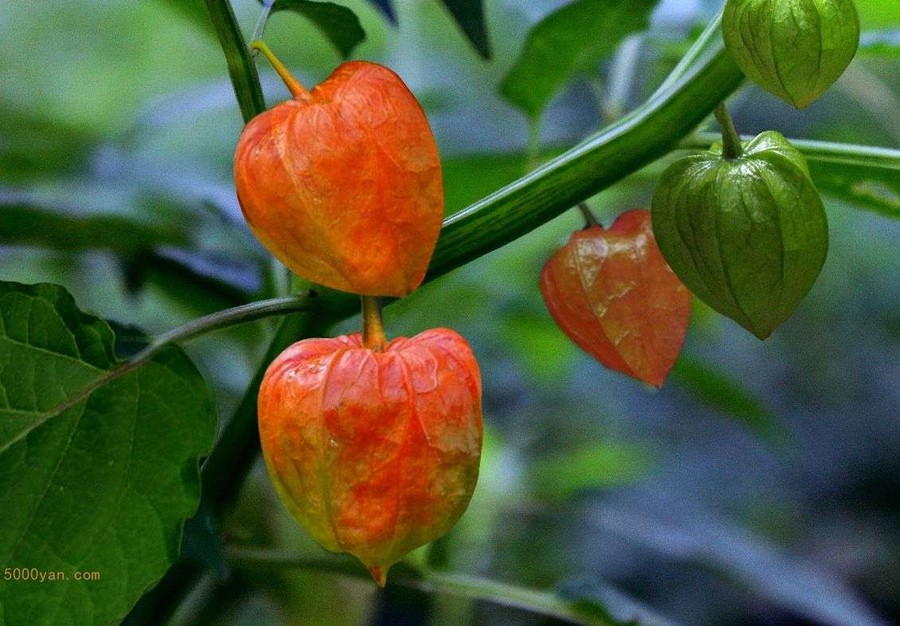
Perennial herb, base often creeping and rooting. Stems 40-80 cm tall, base slightly woody. Leaves alternate, often 2 per node; petiole 1-3 cm long; leaf blade long-ovate to broad-ovate, 5-15 cm long, 2-8 cm wide, apex acuminate, base asymmetrically cuneate, decurrent into petiole, margin entire and undulate or coarsely toothed, both surfaces pubescent, with short stiff hairs along veins. Flowers solitary in leaf axils; pedicel 6-16 mm long, erect at anthesis, later curved downward, densely pubescent, persistent in fruit; calyx broadly campanulate, densely pubescent, 5-lobed, lobes triangular, calyx tube enlarged after anthesis, becoming orange-red or deep red, lantern-shaped enclosing the berry; corolla rotate, white, 5-lobed, lobes spreading, broad and short. Stamens 5, anthers pale yellowish-green; ovary superior, ovoid, 2-locular. Berry globose, orange-red, 10-15 mm in diameter, soft and juicy. Seeds reniform, pale yellow. Flowering May to September, fruiting June to October.
Habitat and Distribution
It grows in open areas or on hillsides. It is distributed in Shaanxi, Gansu, Henan, Hubei, Hunan, Sichuan, Guizhou, and Yunnan, among other regions.
Harvesting and Processing
Harvest in autumn when the fruit is ripe and the persistent calyx appears red or orange-red, then dry.
Medicinal Properties
This product is slightly lantern-shaped, mostly flattened, 3-4.5 cm long, 2.5-4 cm wide. The surface is orange-red or orange-yellow, with 5 distinct longitudinal ridges, and fine reticulate veins between the ridges. The apex is gradually tapered and slightly 5-lobed, the base is slightly truncate, and the center is depressed with a fruit stalk. The body is light, the texture is soft and pliable, hollow, or containing a brownish-red or orange-red fruit inside. The fruit is spherical, mostly flattened, 1-1.5 cm in diameter, with a wrinkled pericarp, containing numerous seeds. Odor: faint; persistent calyx: bitter; fruit: sweet and slightly sour.
Chemical Constituents
This product contains physalin A, physalin B, luteolin, ombuin, cycloartenol, 24-methylcholesterol, trans-ferulic acid, and other constituents.
Pharmacology
Inhibits cancer; inhibits bacteria.
Properties and Channel Entry
Bitter, cold. Enters the Lung channel.
Functions and Indications
Clears Heat and resolves toxicity, benefits the throat and transforms Phlegm, promotes urination and treats strangury. Used for sore throat and hoarseness, cough due to Phlegm-Heat, difficult urination, painful strangury due to Heat; externally used for pemphigus and eczema.
Dosage and Administration
Oral: decoct in water, 4.5-9 g; External use: appropriate amount, mash and apply to the affected area.
Precautions and Contraindications
Patients with Spleen and Stomach deficiency-cold and pregnant women should use with caution.
Prescriptions
1. For lung heat cough with dry throat and dry tongue: Jindenglong 9 g, Xingren 6 g, Xuanshen 9 g. Decoct in water and take orally. (From *Shanxi Chinese Herbal Medicine*) 2. For acute bronchitis: Jindenglong 9 g, Jiegeng 9 g, Xingren 9 g, Qianhu 9 g, Gancao 6 g. Decoct in water and take orally. (From *Shandong Chinese Herbal Medicine Manual*) 3. For whooping cough: Suanzao fruit, burn on a tile to preserve the ash. Take 0.3 g per dose, swallowed with white sugar. [From *Jiangxi Traditional Chinese Medicine* 1953, (3): 22] 4. For sore throat: a. Jindenglong 15 g, Gancao 6 g. Decoct in water and take orally. (From *Shandong Chinese Herbal Medicine Manual*) b. Jindenglong 15 g, Niubangzi 9 g, Gancao 3 g. Decoct in water and take orally. (From *Hebei Chinese Herbal Medicine*) 5. For hoarseness and sore throat: Jindenglong 10 pieces. Decoct in water and take orally. (From *Liaoning Common Chinese Herbal Medicine Manual*)