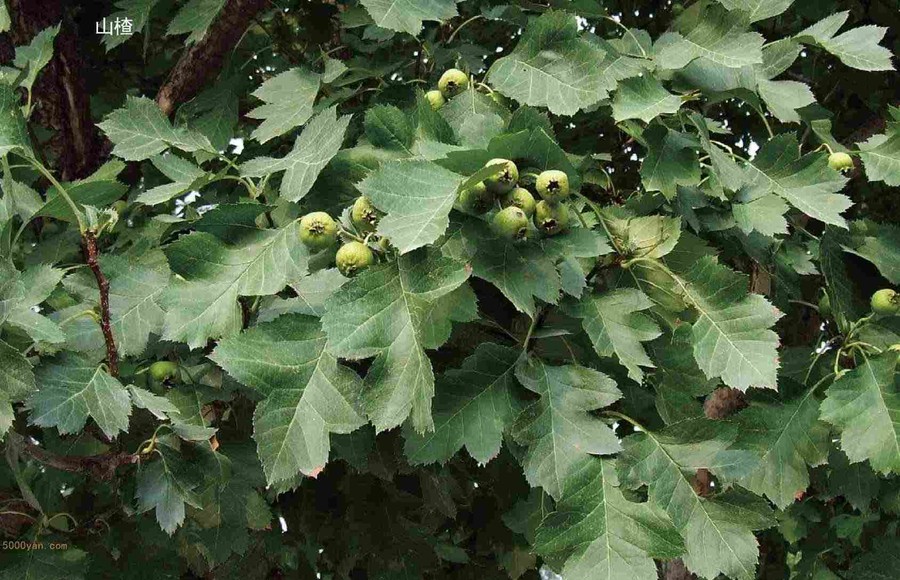
Pinyin: Shanzha
Aliases
Panmei, Shucha, Shanlihongguo, Yingshanhongguo.
Source
Rosaceae plant Crataegus pinnatifida var. majorCrataegus pinnatifidaBge.var.majorN.E.Br. or ShanzhaCrataeguspinnatifidaDried ripe fruit of Bge.
Botanical Description
1. Shanlihong (Chinese Hawthorn): Deciduous tree, up to 6 m tall. Branch thorns 1-2 cm long, or thornless. Leaves simple, alternate; petiole 2-6 cm long; leaf blade broadly ovate or triangular-ovate, rarely rhombic-ovate, 6-12 cm long, 5-8 cm wide, with 2-4 pairs of pinnate lobes, apex acuminate, base broadly cuneate, glossy above, pubescent along veins beneath, margin with irregular double serrations. Corymb inflorescence, about 4-6 cm in diameter; calyx tube campanulate, 5-toothed; corolla white, about 1.5 cm in diameter, petals 5, obovate or suborbicular; stamens about 20, anthers pink; pistil 1, ovary inferior, 5-locular, styles 5. Pome subglobose, up to 2.5 cm in diameter, deep red, with yellowish-white small spots, sepals deciduous very late, leaving a round deep pit at apex; pyrenes 3-5, slightly angled on outer side, smooth on inner sides. Flowering May-June, fruiting August-October.
2. Shanzha: This species is very similar to Shanlihong, with only smaller fruit, diameter 1-1.5 cm; leaves are also smaller and more deeply divided.
Habitat and Distribution
Crataegus pinnatifida var. major is cultivated in North China as well as in Shandong, Jiangsu, Anhui, Henan, and other regions. Crataegus pinnatifida grows at altitudes of 100-1500 m along streams, in valleys, at forest edges, or in thickets; it is distributed in Northeast China as well as Inner Mongolia, Hebei, Shanxi, Shaanxi, Shandong, Jiangsu, Zhejiang, Henan, and other areas. It is also cultivated near villages on the plains.
Harvesting and Processing
Harvested when the fruit ripens in autumn, sliced, and dried.
Medicinal Properties
This product consists of circular slices, wrinkled and uneven, with a diameter of 1-2.5 cm and a thickness of 0.2-0.4 cm. The outer skin is red, with wrinkles and grayish-white small spots. The flesh is deep yellow to light brown in color. The transverse slices in the middle have 5 light yellow fruit stones, but most of the stones have fallen off, leaving a hollow center. Some slices show short and thin fruit stalks or calyx remnants. The odor is faintly fragrant, and the taste is sour and slightly sweet.
Chemical Constituents
This product contains (-)-epicatechin, quercetin, hyperoside,β- Sitosterol, citric acid, ursolic acid, linolenic acid, linoleic acid, gallic acid, protocatechuic acid and other constituents.
Pharmacology
Promotes digestion; protects the cardiovascular system; lowers blood pressure; lowers blood lipids; antioxidant; enhances immunity; antibacterial; prevents cancer; contracts the uterus and promotes uterine involution; analgesic.
Properties and Channel Entry
Sour, sweet, and slightly warm. Enters the Spleen, Stomach, and Liver channels.
Functions and Indications
Promotes digestion and strengthens the Stomach, moves Qi and disperses Blood stasis, transforms turbidity and lowers lipids. Used for meat-based food stagnation, epigastric distension and fullness, diarrhea and dysentery with abdominal pain, amenorrhea due to Blood stasis, postpartum Blood stasis obstruction, sharp pain in the chest and abdomen, chest obstruction and heart pain, hernia pain, and hyperlipidemia. Charred Shanzha has enhanced effects in promoting digestion and guiding out stagnation. Used for meat-based food stagnation and diarrhea and dysentery with difficult defecation.
Dosage and Administration
Internal: decoct in water, 3-10 g; or made into pills or powder. External: appropriate amount, decoct for washing or crush for application.
Precautions and Contraindications
Caution should be exercised in patients with weak Spleen and Stomach and in pregnant women.
Prescriptions
1. Treats all types of food accumulation: Crataegi Fructus 120 g, Atractylodis Macrocephalae Rhizoma 120 g, Massa Medicata Fermentata 60 g. Grind the above ingredients into powder, form into pills using steamed cake, each pill the size of a *Sapindus mukorossi* seed (approximately 0.06 g). Take 70 pills with plain boiled water. (From *Danxi's Experiential Methods*) 2. Treats undigested meat: Crataegi Fructus (flesh) 120 g, boil in water and eat, also drink the juice. (From *Simple and Convenient Prescriptions*) 3. Treats phlegm accumulation: Crataegi Fructus 90 g, alkaline stone 9 g, Pinelliae Rhizoma (soaked thoroughly in *Gleditsiae Sinensis* Fructus water and sun-dried) 30 g. Grind the above ingredients into powder, form into pills using rice porridge. Take 30 pills with plain boiled water. (From *Danxi's Experiential Methods*, Xiao Awei Pill) 4. Treats early-stage dysentery: Crataegi Fructus 30 g, white and brown sugar 15 g each, high-quality Maojian tea 4.5 g. Decoction Crataegi Fructus, then pour the hot decoction over the sugar and tea in a covered bowl, steep for a moment, and drink. (From *Records of Chinese and Western Medicine in Combination*) 5. Treats dysentery with both red and white discharge: Crataegi Fructus (flesh), any amount, stir-fry and grind into powder. Take 3-6 g per dose. For red dysentery, mix with honey; for white dysentery, mix with red and white sugar; for mixed red and white dysentery, mix with equal amounts of honey and sugar. Adjust with plain boiled water and take on an empty stomach. (From *Classified Compilation of Medical Prescriptions*)