Pinyin: Chuanlianzi
Aliases
Lianshi, Jinlingzi, Lianzi, Chuanlianshi
Source
1. For pneumonia: Renshen 6 g, decoct in water and take orally.Melia toosendanDried ripe fruit of *Sieb. et Zucc.*
Botanical Description
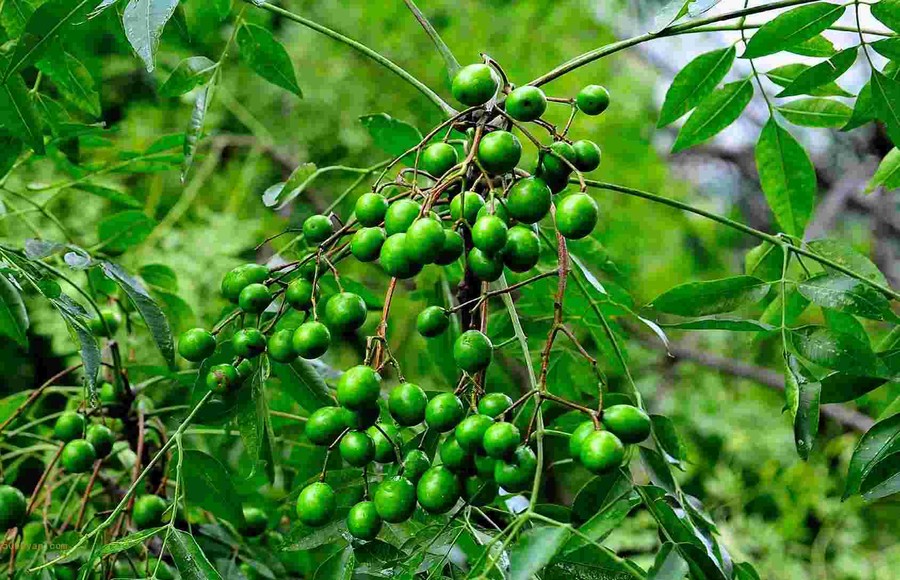
Tree, up to 10 m tall. Bark gray-brown. Leaves bi- to tri-pinnate odd-pinnate compound, approximately 35 cm long; pinnae 4-5 pairs; leaflets ovate or narrow-ovate, 4-10 cm long, 2-4 cm wide, entire margin or sparsely serrate. Panicles axillary, calyx gray-green, sepals 5-6; petals 5-6, pale purple; stamens 10 or 12, filaments fused into a tube. Drupe large, ellipsoid or subglobose, approximately 3 cm long, yellow or chestnut brown, endocarp hard and woody, ridged, 6-8 locules. Seeds long-ellipsoid, flattened. Flowering period March-April, fruiting period September-November.
Habitat and Distribution
It grows in mixed forests and sparse forests at altitudes of 500-2100 m, or in moist areas of flatlands and hills, often cultivated near villages or along roadsides. It is distributed in Gansu, Henan, Hubei, Hunan, Guangxi, Sichuan, Guizhou, and Yunnan.
Harvesting and Processing
Harvest in winter when the fruit is ripe, remove impurities, and dry.
Medicinal Properties
This product is subglobose, 2-3.2 cm in diameter. The surface is golden yellow to brownish-yellow, slightly lustrous, with a few depressions or wrinkles and dark brown spots. The apex has a persistent style scar, and the base is concave with a fruit stalk scar. The exocarp is leathery, often leaving a space between it and the pulp; the pulp is soft, light yellow, and becomes sticky when moistened with water. The endocarp (stone) is spherical or ovoid, hard in texture, truncated at both ends, with 6-8 longitudinal ridges, divided into 6-8 chambers, each chamber containing one blackish-brown, oblong seed. Odor: characteristic; Taste: sour and bitter.
Chemical Constituents
This product contains toosendanin, lipomelianol, melianone, 21-O-acetyltoosendan triol, fraxinol, and other constituents.
Pharmacology
Blocks the transmission at the neuromuscular junction; expels parasites; inhibits bacteria.
Properties and Channel Entry
Bitter, cold; slightly toxic. Enters the Liver, Small Intestine, and Urinary Bladder channels.
Functions and Indications
Soothes the Liver, drains Heat, moves Qi, alleviates pain, and expels parasites
Dosage and Administration
Oral: decoct in water, 3-10 g; or made into pills or powder
Precautions and Contraindications
Contraindicated for those with Spleen and Stomach deficiency-cold pattern
Prescriptions
1. For Heat-type epigastric pain due to reversed Qi flow, with pain that comes and goes, or prolonged cases unresponsive to treatment: Chuanlianzi (Sichuan Chinaberry) and Yanhusuo (Corydalis) 30 g each. Grind into fine powder. Take 9 g per dose, mixed with wine. (From Baoming Ji, Jinlingzi Powder) 2. For intercostal neuralgia: Chuanlianzi 9 g, Juluo (tangerine pith) 6 g. Decoct in water and take orally. (From Zhejiang Medicinal Plants Flora) 3. For heart Qi pain during pregnancy: Chuanlianzi, Huixiang (stir-fried fennel) 9 g each, Aimoye (salt-fried mugwort leaf powder) 4.5 g. Prepare as a single dose, add two cups of water, decoct to one cup. Take regardless of mealtime. (From Weisheng Baojian, Huolong San) 4. For frostbite: Chuanlianzi 120 g. Decoct in water, then while hot steam the affected area, then soak and wash with the herbal liquid. (From Hubei Chinese Herbal Medicine Records) 5. For Cold hernia with pain: Chuanlianzi 12 g, Muxiang (costus root) 9 g, Huixiang (fennel) 6 g, Wuzhuyu (evodia, soaked in hot water) 3 g. Decoct in water. (From Yifang Jijie, Daoqi Tang)