Pinyin: Jixingzi
Aliases
Jinfenghuazi, Fengxianzi.
Source
Balsaminaceae plant Impatiens balsamina L.Impatiens balsaminaL. of dried ripe seeds.
Botanical Description
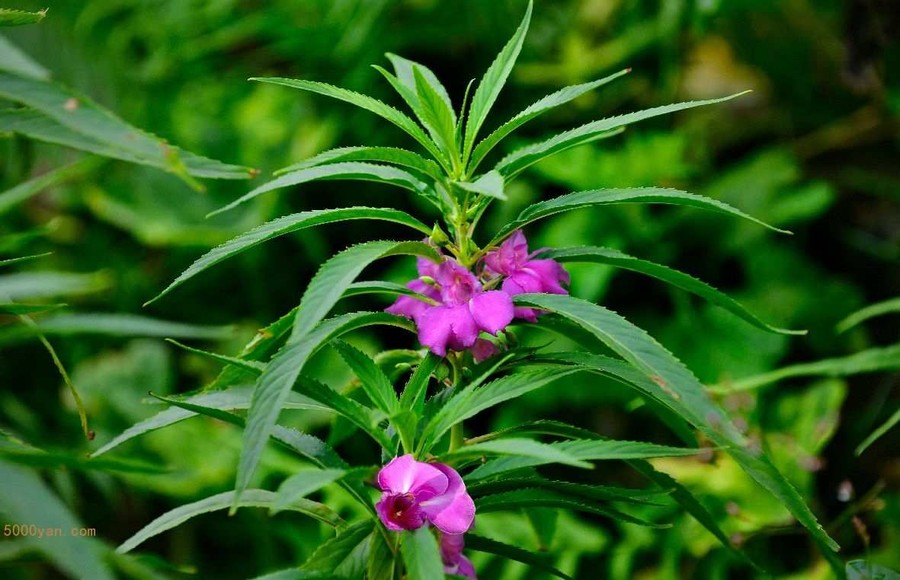
Annual herb, 40-100 cm tall. Stem fleshy, erect, robust. Leaves alternate; petiole 1-3 cm long, with several glands on both sides; leaf blade lanceolate, 4-12 cm long, 1-3 cm wide, apex long acuminate, base attenuate, margin sharply serrate, lateral veins 5-9 pairs. Pedicel short, solitary or several clustered in leaf axils, densely pubescent; flowers large, usually pink or variegated, single or double; sepals 2, broadly ovate, sparsely pubescent; standard petal orbicular, apex emarginate, with a small mucro, dorsal midrib keeled; wing petals broad, shortly clawed, 2-lobed, basal lobe suborbicular, upper lobe broadly axe-shaped, apex 2-lobed; lip boat-shaped, sparsely pubescent, base abruptly prolonged into a slender, incurved spur; anthers obtuse. Capsule fusiform, splitting explosively when ripe, densely hairy. Seeds numerous, globose, black.
Habitat and Distribution
It is cultivated throughout northern and southern China.
Harvesting and Processing
Harvest in summer and autumn when the fruit is about to ripen, dry in the sun, remove the fruit peel and impurities.
Medicinal Properties
This product is oval, flat-oval, or ovate in shape, 2-3 mm long and 1.5-2.5 mm wide. The surface is brown or grayish-brown, rough, with sparse white or light yellowish-brown spots; the hilum is located at the narrow end and slightly protrudes. The texture is firm, the seed coat is thin, and the cotyledons are grayish-white, translucent, and oily. Odor: faint; Taste: mild, slightly bitter.
Chemical Constituents
This product contains stearidonic acid,β- Xiang resinol, balsam sterol, ethyl oleate, linoleic acid and other components.
Pharmacology
Anti-fertility; stimulates uterine smooth muscle; antibacterial.
Properties and Channel Entry
Slightly bitter and acrid, warm; mildly toxic. Enters the Lung and Liver channels.
Functions and Indications
Breaks blood, softens hardness, and disperses accumulations. Used for abdominal masses, amenorrhea, and dysphagia.
Dosage and Administration
Internal use: decoct 3-4.5 g. External use: appropriate amount, grind into powder or boil into paste for topical application.
Precautions and Contraindications
Contraindicated in patients without internal stasis accumulation and in pregnant women.
Prescriptions
1. For amenorrhea with abdominal pain and retained lochia after childbirth: Jixingzi 9 g, crushed. Decoct in water, add an appropriate amount of brown sugar, and take orally. (From *Anhui Chinese Herbal Medicine*) 2. For difficult labor and to hasten delivery: Jixingzi 6 g. Grind into powder, take with water, avoid contact with teeth. Externally, apply castor seed (Ricinus communis) mashed in an amount corresponding to the patient's age to the center of the sole. (From *Binhu Ji Jian Fang*) 3. For retained placenta: Stir-fry Jixingzi until yellow, grind into powder, take 3 g with warm yellow wine. (From *Jingyan Guang Ji*) 4. For dysphagia (difficulty swallowing): Soak Jixingzi in wine for three nights, dry in the sun, grind into powder, form into pills with wine the size of mung beans. Take 8 pills each time with warm wine; do not take excessively. (From *Compendium of Materia Medica*, citing *Zhai Yuan Fang*) 5. For esophageal cancer: Jixingzi, Huangyaozi, Daizheshi, and Banzhilian, 30 g each. Decoct in water, take one dose daily. (From *Kang Ai Ben Cao*)