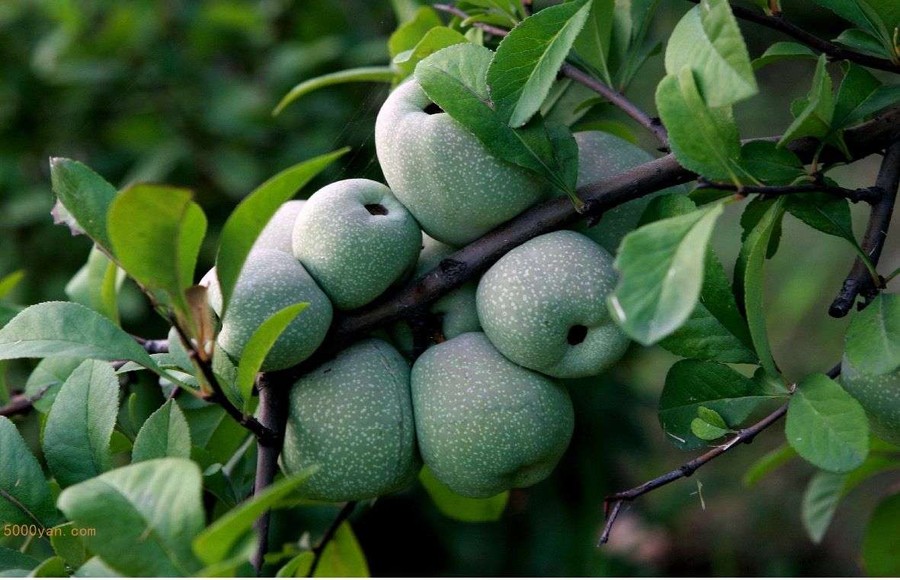
Pinyin: Mugua
Aliases
Mugua shi, Tiejiao li, Qiu mugua, Suan mugua.
Source
Rosaceae plant *Chaenomeles speciosa* (Sweet) NakaiChaenomeles speciosaDried nearly ripe fruit of (Sweet) Nakai.
Botanical Description
Deciduous shrub, approximately 2 m tall. Branches erect and spreading, with spines; branchlets cylindrical, slightly curved, glabrous, purplish-brown or dark brown, with sparse, pale brown lenticels. Leaves ovate to elliptic, 3-9 cm long, 1.5-5 cm wide, base cuneate to broadly cuneate, margin sharply serrate with spreading teeth, glabrous or with short pubescence along veins on lower surface; petiole 1 cm long; stipules large, herbaceous, reniform or semicircular, margin with sharp double serrations, glabrous. Flowers appear before leaves, 3-5 clustered on second-year branches; pedicel short and thick, approximately 3 mm long or nearly sessile; flower diameter 3-5 cm; calyx tube campanulate, glabrous externally; sepals erect, apex obtuse, entire or with wavy teeth; petals obovate or suborbicular, base extended into a short claw, 10-15 mm long, 8-13 mm wide, scarlet, occasionally pale red or white; stamens 45-50, approximately half the length of petals; styles 5, fused at base, glabrous or slightly hairy, stigma capitate, indistinctly lobed, approximately equal in length to stamens. Fruit globose or ovoid, 4-6 cm in diameter, yellow or yellowish-green, with sparse, indistinct spots, fragrant. Flowering period March to May, fruiting period September to October.
Habitat and Distribution
Cultivated or wild. Distributed throughout East China, Central China, and Southwest China.
Harvesting and Processing
Harvested in summer and autumn when the fruit is green-yellow, blanched in boiling water until the outer skin turns gray-white, split in half lengthwise, and dried in the sun.
Medicinal Properties
This product is oblong in shape, mostly split longitudinally into two halves, 4-9 cm long, 2-5 cm wide, and 1-2.5 cm thick. The outer surface is purplish-red or reddish-brown with irregular deep wrinkles; the cut surface edges curl inward, the flesh is reddish-brown, the central part is sunken and brownish-yellow; the seeds are flat, elongated, and triangular, mostly shed. The texture is hard. Odor: faintly aromatic; Taste: sour.
Chemical Constituents
This product contains oleanolic acid, malic acid, ethyl chlorogenate, caffeic acid, chlorogenic acid, aconitic acid, and other components.
Pharmacology
Protects the liver; antibacterial; inhibits tumor growth.
Properties and Channel Entry
Sour, warm. Enters the Liver and Spleen channels.
Functions and Indications
Relaxes tendons and activates collaterals, harmonizes the Stomach and transforms Dampness
Dosage and Administration
Internal use: decoct in water, 5-10 g, or prepare as pills or powder. External use: appropriate amount, decoct in water for fumigation and washing.
Precautions and Contraindications
Do not consume in excess, as it may damage the teeth and bones; avoid contact with lead and iron. Not suitable for those with weakness of the lower back and knees due to deficiency of essence and blood or insufficiency of true Yin. Not suitable for those with food retention where the Spleen and Stomach are not yet deficient but have significant accumulation and stagnation.
Prescriptions
1. For foot Qi (jiao qi) with damp-heat: Mugua (Chaenomeles fruit) and Yiyiren (Coix seed) 15 g each, Baizhu (Atractylodes macrocephala) and Fuling (Poria) 9 g each, Huangbai (Phellodendron bark) 6 g. Decoct in water and take orally. (Qingdao Chinese Herbal Medicine Handbook) 2. For pain below the navel: Mugua 1-2 slices, Sangye (mulberry leaf) 7 pieces, Dazao (jujube) 3 pieces (crushed). Boil with 2 sheng of water until 0.5 sheng remains, take in a single dose. (Meng Shen's Prescriptions) 3. For rheumatism with numbness: Soak Mugua in wine and take orally, one small cup each time, twice daily. (Tianjin Chinese Herbal Medicine) 4. For persistent diarrhea: Midouzi (rice bean) 60 g, Mugua, Ganjiang (dried ginger), and Gancao (licorice) 30 g each. Grind into fine powder. Take 6 g per dose, mixed with rice water, at any time. (Jifeng Puji Fang: Mugua Decoction)