Pinyin: Jili
Aliases
Ci, Pangtong, Ci Jili, Sanjiao Jili
Source
Tribulus terrestris plant of the Zygophyllaceae familyTribulus terrestrisL. dried ripe fruit.
Botanical Description
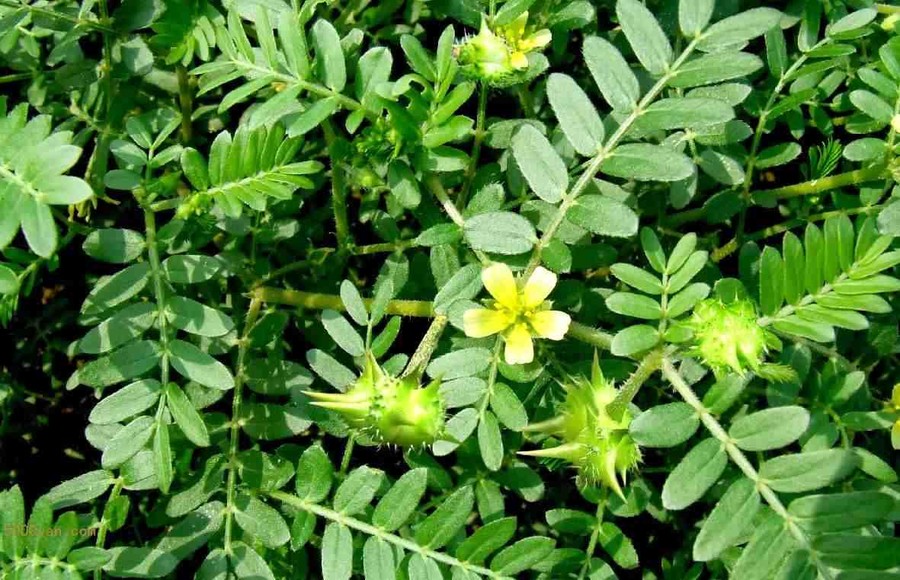
Annual herb. Stems usually branching from the base, prostrate on the ground, with ridges, up to about 1 m long; entire plant covered with silky villi. Stipules lanceolate, small and pointed, about 3 mm long; leaves even-pinnate, opposite, one long and one short; long leaf 3-5 cm long, 1.5-2 cm wide, usually with 6-8 pairs of leaflets; short leaf 1-2 cm long, with 3-5 pairs of leaflets; leaflets opposite, oblong, 4-15 mm long, apex acute or obtuse, surface glabrous or with filiform hairs only along the midvein, underside with white appressed filiform hairs. Flowers pale yellow, small, regular, solitary in the leaf axils of short leaves; pedicel 4-10 mm long, sometimes up to 20 mm; sepals 5, ovate-lanceolate, acuminate, about 4 mm long, hairy on the back, persistent; petals 5, obovate, apex slightly truncate, alternate with sepals; stamens 10, inserted at the base of the disc, with scale-like glands at the base. Ovary with 5 carpels. Fruit a schizocarp, pentagonal or globose, composed of 5 star-shaped arranged mericarps, each mericarp with a pair of long and short spines, with short stiff hairs and tuberculate protrusions on the back. Flowering period May to August, fruiting period June to September.
Habitat and Distribution
It grows on barren hills, field edges, and farmlands. Distributed throughout various regions of the country.
Harvesting and Processing
Harvest the plants when the fruits are ripe in autumn, dry them in the sun, beat out the fruits, and remove impurities.
Medicinal Properties
This product consists of 5 mericarps arranged radially, with a diameter of 7-12 mm. It often splits into single mericarps, which are axe-shaped, 3-6 mm long; the dorsal side is yellow-green, raised, with longitudinal ridges and numerous small spines, and has one pair each of symmetrical long and short spines; the lateral surfaces are rough with reticulate patterns and grayish-white in color. The texture is hard. Odor: faint; Taste: bitter and acrid.
Chemical Constituents
This product primarily contains kaempferol, kaempferol-3-glucoside, kaempferol-3-rutinoside, tribuloside, luteolin, diosgenin, hecogenin, and harmine.
Pharmacology
Lower blood pressure; anti-myocardial ischemia; delays aging; has aphrodisiac effects; has anti-acetylcholine and diuretic effects.
Properties and Channel Entry
Pungent and bitter, slightly warm; with mild toxicity. Enters the Liver channel.
Functions and Indications
Calms the Liver, relieves depression, activates Blood, dispels Wind, brightens the eyes, and stops itching. Used for headache and dizziness, distension and pain in the chest and hypochondrium, breast abscess and mastitis, red eyes with corneal opacity, and rubella with itching.
Dosage and Administration
Oral: decoct in water, 6-9 g; or prepared into pills or powder. External use: appropriate amount, decoct for washing or grind into powder and apply with a medium.
Precautions and Contraindications
For blood deficiency and qi weakness, and pregnant women, use with caution.
Prescriptions
1. For lung abscess, lung atrophy, coughing and spitting pus and blood with foul odor: Jili (Tribulus terrestris, with thorns, stir-fried) 150 g, Baihe (Lilium brownii) and Chuanbei (Fritillaria cirrhosa, each stir-fried) 30 g. Grind together into a fine powder. Take 9 g each morning and evening, mixed with plain boiling water. (From *Bencao Huiyan*, citing *Fang Longtan Jia Mi*) 2. For breast distension with no milk flow, or breast masses with pain: Jili (Tribulus terrestris, with thorns, stir-fried) 2-3 jin, grind into powder. Take at any time in the morning, noon, and evening, mixed with plain boiling water into a paste. (From *Bencao Huiyan*, citing *Fang Longtan Jia Mi*) 3. For dysentery: Jili (Tribulus terrestris) 2 sheng, crush to extract juice, warm and take orally. Continue until cured. (From *Qianjin Yaofang*) 4. For urinary retention with abdominal distension: Jili (Tribulus terrestris) stir-fried until yellow, grind into powder, take with yellow wine. (From *Shou Shi Bao Yuan*) 5. For all types of beriberi, regardless of deficiency or excess, cold or heat: Jili (Tribulus terrestris, with thorns, stir-fried) 240 g, Mugua (Chaenomeles speciosa, stir-fried) 150 g. Grind together into powder. Take 15 g each morning, mixed with plain boiling water. (From *Bencao Huiyan*, citing *Fang Longtan Jia Mi*)