Pinyin: Wuweizi
Aliases
Xuanji, Huiji, Wumeizi, Shanhuajiao
Source
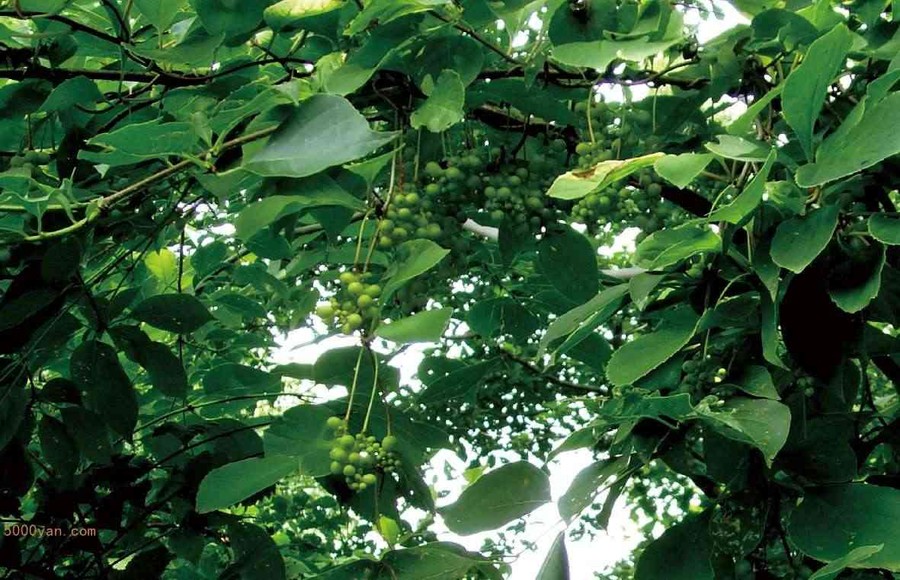
Plant of the Schisandraceae family: Schisandra chinensis.Schisandra chinensisDried ripe fruit of (Turcz.) Baill. Commonly known as "Bei Wuweizi".
Botanical Description
Deciduous woody vine. Young branches reddish-brown, old branches grayish-brown, slightly angular. Petiole 2-4.5 cm long; leaves alternate, membranous; leaf blade obovate or ovate-elliptic, 5-10 cm long, 3-5 cm wide, apex acute or acuminate, base cuneate, margin with glandular serrations, upper surface glabrous, lower surface with short pubescence on veins when young. Flowers mostly unisexual, dioecious, rarely monoecious, solitary or clustered in leaf axils, milky white or pink, perianth segments 6-7; stamens usually 5, anthers clustered at the apex of a cylindrical receptacle, dehiscing laterally; gynoecium ellipsoid, with 17-40 separate carpels, receptacle elongating into a spike 3-10 cm long after anthesis. Berries small, globose, red when mature. Seeds 1-2, reniform, pale brown, shiny. Flowering period May-June, fruiting period August-September.
Habitat and Distribution
It grows in sunny slopes, mixed forests, forest edges, and streamside shrubs below an altitude of 1500 m, distributed in Northeast China, North China, and Henan and other regions.
Harvesting and Processing
Harvest when the fruit ripens in autumn, then dry in the sun or steam and dry in the sun, removing fruit stems and impurities.
Medicinal Properties
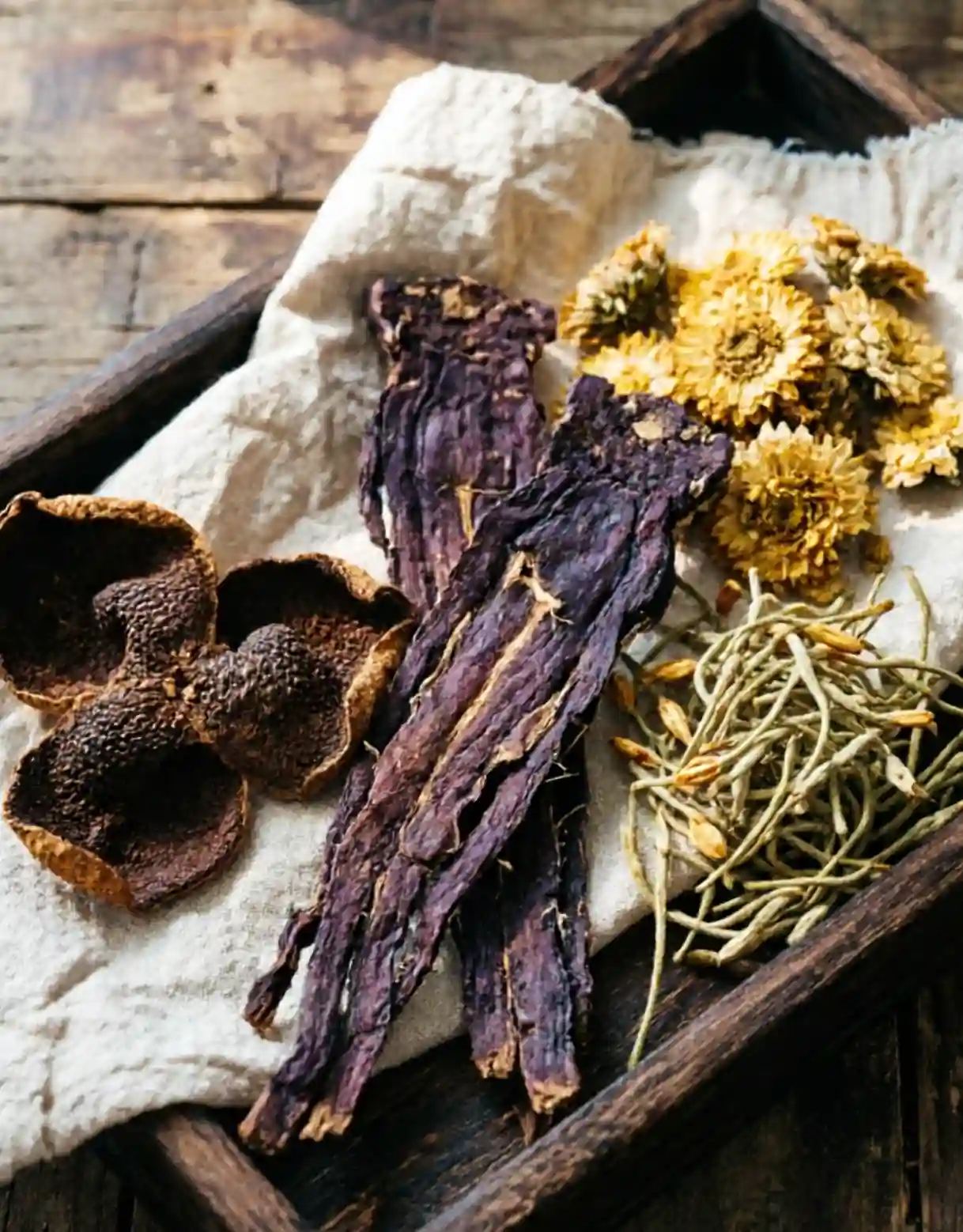
This product is irregularly spherical or oblate, 5-8 mm in diameter. The surface is red, purplish-red, or dark red, wrinkled, and appears oily; some surfaces are blackish-red or have a "white frost." The flesh is soft, with 1-2 kidney-shaped seeds, the surface is brownish-yellow, glossy, and the seed coat is thin and brittle. The flesh has a faint odor and a sour taste; when the seeds are broken, they have an aroma and a pungent, slightly bitter taste.
Chemical Constituents
This product contains schisandrin, gomisin A, gomisin D, gomisin E, gomisin N, gomisin O, deangeloylgomisin B, wuweizisu, isowuweizisu, epigomisin O, schisantherin A,α-Contains components such as water celery alkene, nerolidol, and crotonylgomicin.
Pharmacology
Promotes immune function; antioxidant and anti-aging effects; protects the liver and induces hepatic drug-metabolizing enzymes; antitussive and expectorant, antitumor; lowers blood glucose; strengthens the heart; enhances the body's adaptive capacity; anti-ulcer; anti-nephropathy; antibacterial, etc.
Properties and Channel Entry
Sour, sweet, and warm. Enters the Lung, Heart, and Kidney channels.
Functions and Indications
Astringes and consolidates to stop leakage, tonifies Qi and generates body fluids, tonifies the Kidney and calms the Heart. Used for chronic cough and deficient dyspnea, nocturnal emission and spermatorrhea, enuresis and frequent urination, prolonged diarrhea, spontaneous sweating and night sweats, fluid damage with thirst, internal heat wasting-thirst disorder, and palpitations with insomnia.
Dosage and Administration
Oral: decoct in water, 3-6 g, grind into powder, 1-3 g per dose; prepare as decoction concentrate; or made into pills or powder. External use: appropriate amount, grind into powder for sprinkling; or decoct in water for washing. For astringing the Lung to stop cough, use a small dosage; for tonifying, calming the Spirit, rescuing from collapse, etc., use a slightly larger dosage.
Precautions and Contraindications
External exterior pathogenic factors, internal excess heat, or early-stage cough, or early-stage measles: use with caution.
Prescriptions
1. For impotence: Wuweizi (Schisandra), Tusizi (Cuscuta), and Shechuangzi (Cnidium), equal parts. Grind the three ingredients into powder, mix with honey to form pills the size of wutong seeds. Take 3 pills with a drink, three times daily. (From Qianjin Yaofang) 2. For chronic diarrhea: Chenmi (aged rice) 30 g, Roudoukou (nutmeg, wrapped in flour and roasted) 30 g, Wuweizi (Schisandra) 30 g, and Chishizhi (halloysite, ground) 30 g. Grind into powder. Take 6 g per dose, mixed with millet congee, three times daily. (From Shiyi Dexiao Fang, Doukou Yin) 3. For night sweats: Wuweizi (Schisandra) 30 g, grind into powder, mix with saliva to form a paste. Apply to the navel, secure with cloth, and sleep. Remove the next morning; after one or two nights, the sweating will stop. (From Yifang Yipan Zhu) 4. For cough due to Lung Cold: Baifuling (Poria) 120 g, Gancao (licorice) 90 g, Ganjiang (dried ginger) 90 g, Xixin (Asarum) 90 g, and Wuweizi (Schisandra) 75 g. Grind into fine powder. Take 6 g per dose, boil in one cup of water until reduced to seven-tenths, strain, and take warm, regardless of meal times. (From Jifeng Puji Fang, Wuwei Xixin Tang) 5. For acute cough in children: Wuweizi (Schisandra), Gui (cinnamon, with rough bark removed), and Ganjiang (dried ginger, parched), equal parts. Coarsely grind and sift the three ingredients. Take 3 g per dose, boil in seven-tenths of a cup of water until reduced to four-tenths, strain, and take warm, adjusting dosage according to age. (From Shengji Zonglu, Wuweizi Tang)