Pinyin: Xiangyuan
Aliases
Xiangyuan, Foshougan, Xiangpaoshu, Xiangyuangan
Source
Rutaceae family plant Citri Sarcodactylis Fructus.Citrus medicaL. dried mature fruit.
Botanical Description
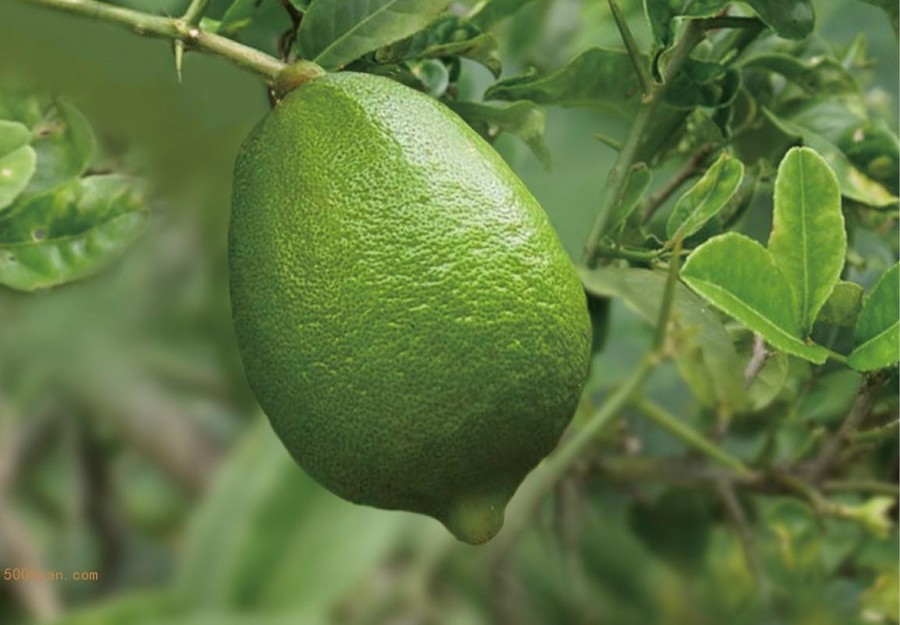
Evergreen small tree or shrub. Branches have short, hard spines; young branches are smooth, with a purplish-red color. Leaves are alternate; petioles are short, without leaf wings or with faint traces, and have no distinct joint with the leaf blade; leaf blades are oblong or obovate-oblong, 8-15 cm long, 3.5-6.5 cm wide, apex obtuse or shortly acute, base broadly cuneate, margin serrated, with translucent oil glands. Racemes, with 3-10 flowers borne in leaf axils; flowers are bisexual or male due to pistil degeneration, with short pedicels; calyx is shallowly cup-shaped, with 5 shallow apical lobes; petals 5, white inside, pale purple outside; stamens 30-60; pistil 1, ovary 10-13 locular, each locule with numerous ovules. Style is thick, persistent, stigma capitate. Hesperidium is oblong, ovoid, or nearly spherical, 10-25 cm long, apex with a nipple-like protrusion; pericarp is rough or smooth, lemon yellow when ripe, fragrant, with small pulp segments; seeds are ovoid, with smooth surface. Flowering period: April; fruiting period: October-November.
Habitat and Distribution
Cultivated in Jiangsu, Zhejiang, Fujian, Taiwan, Hubei, Hunan, Guangdong, Guangxi, Sichuan, Yunnan, and other regions.
Harvesting and Processing
Harvested when the fruit ripens in autumn, sliced fresh, and dried in the sun or at low temperature. The Xiangyuan may also be dried whole or split in half in the sun or at low temperature.
Medicinal Properties
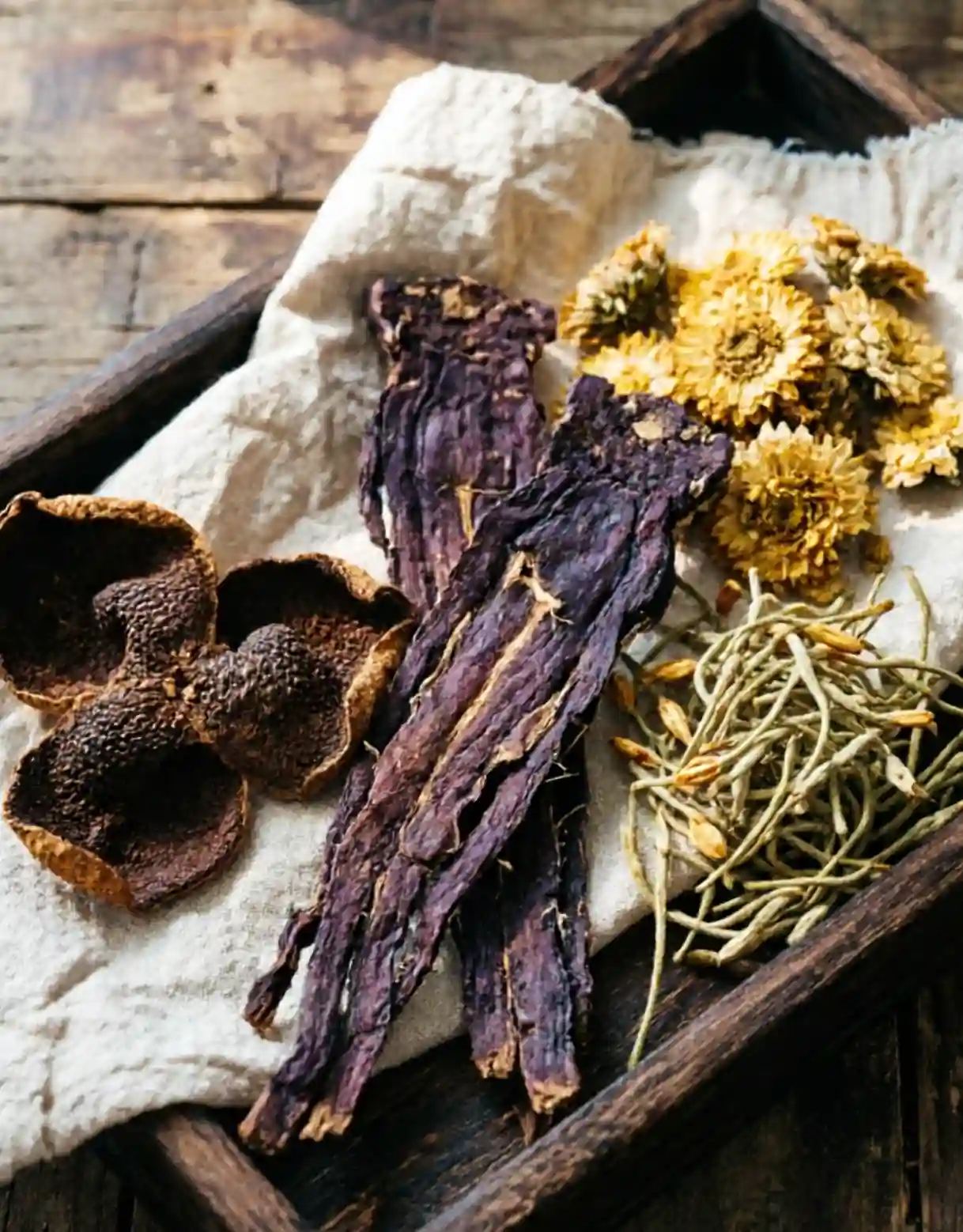
This product consists of round or oblong slices, 3-10 cm in diameter and 2-5 mm thick. The transverse section has slightly undulating edges, with the exocarp being yellow-green or light orange-yellow and scattered with sunken oil spots; the mesocarp is 1.5-3.5 cm thick, yellow-white, relatively rough, with irregular reticulate protrusions (vascular bundles). The locules are 11-16 segments. Occasionally, brownish-red wrinkled juice sac remnants are visible; there are 1-2 seeds. The central axis is prominent, up to 1.2 cm wide. The texture is pliable. The odor is faintly aromatic, and the taste is slightly sweet, bitter, and acrid.
Chemical Constituents
This product contains hesperidin, citric acid, geranial, caryophyllene, farnesal, and other components.
Pharmacology
The volatile oil contained has mild stimulating effects on the gastrointestinal tract, promoting gastrointestinal peristalsis and the secretion of digestive fluids, eliminating gas accumulation in the intestines. It also has expectorant, anti-inflammatory, and antiviral effects. The hesperidin contained has effects in preventing frostbite and inhibiting aldose reductase in the lens of rats.
Properties and Channel Entry
Acrid, bitter, and sour, warm. Enters the Liver, Spleen, and Lung channels.
Functions and Indications
Soothes the Liver and regulates Qi, widens the Middle Jiao, and transforms Phlegm
Dosage and Administration
Oral: decoct 3-6 g in water, or taken in pill or powder form.
Precautions and Contraindications
Use with caution in individuals with deficient constitution.
Prescriptions
1. For Qi counterflow with poor appetite or vomiting: Chen Xiangyuan (aged Citron) 2 pieces, Chuan Bei (Sichuan Fritillaria, core removed) 90 g, Danggui (Angelica sinensis, stir-fried black) 45 g, Bai Tongcao (white Tetrapanax, dried) 30 g, Chen Xiguapi (aged watermelon rind) 30 g, Tian Jiegeng (sweet Platycodon) 9 g. Grind all into fine powder, take Baixiang (sandalwood) chips and decoct into a thick juice, then use to form pills the size of Wutong seeds. Take 9 g each time with boiled water. (From *Meishi Yanfang Xinbian* - Xiangyuan Wan) 2. For tympanites (abdominal distension): Chen Xiangyuan (aged Citron, with pulp) 1 piece, Da Hetaorou (large walnut kernel, with skin) 2 pieces, Suo Sharen (Amomum villosum, membrane removed) 6 g. Each ingredient is calcined until the property remains, then ground into powder, mixed with granulated sugar. Take on an empty stomach in one dose. (From *Bencao Fengyuan*) 3. For tertian malaria: Chen Xiangyuan (aged Citron) 1 piece, remove the top skin, insert finely ground Ming Xionghuang (realgar), calcine in fire, then take out and grind extremely fine. Take 2.1 g each time, swallow dry without water. (From *Huatuo Shenyi Mijuan*) 4. For head wind (headache): Xiangyuan (Citron, fresh or aged, cut open) 1 piece. Duck egg (hard-boiled, cut in half) 1 piece, stuff into the Citron. Wrap each side on the Taiyang acupoint (temple), relief occurs once heat is felt. (From *Chuanya Waibian*)