Pinyin: Sangshen
Aliases
Sangshi, Shen, Wenwushi, Sangguo.
Source
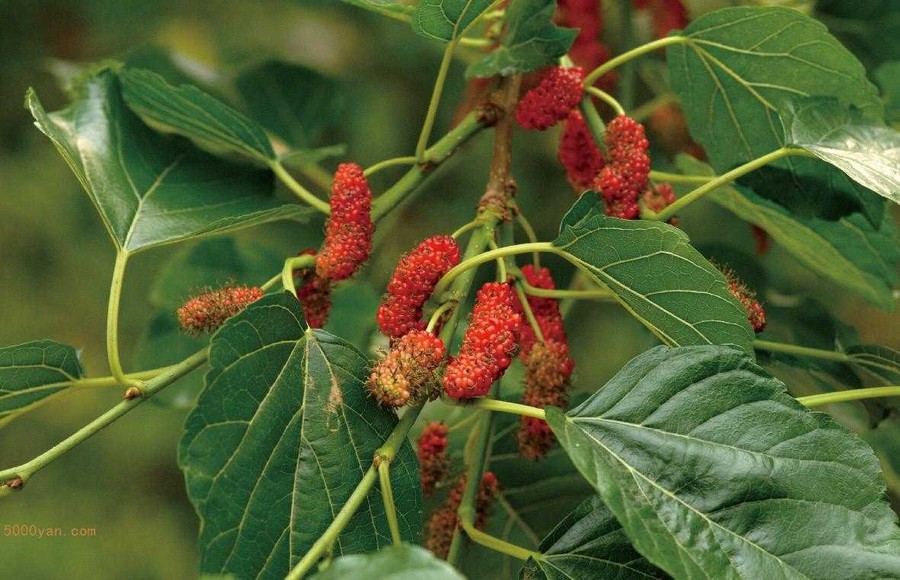
Moraceae plant mulberryMorus albaL. of the dried fruit cluster.
Botanical Description
Deciduous shrub or small tree, 3-15 m tall. Bark grayish-white, with shallow longitudinal fissures; root bark yellowish-brown or reddish-yellow, strongly fibrous. Leaves simple, alternate; petiole 1-2.5 cm long; leaf blade ovate or broadly ovate, 5-20 cm long, 4-10 cm wide, apex acute or acuminate, base rounded or subcordate, margin coarsely serrate or crenate, sometimes irregularly lobed, upper surface glabrous and glossy, lower surface with short hairs on veins and tufts of hairs in axils, three basal veins prominent, reticulate with fine veins, more distinct on the lower surface; stipules lanceolate, caducous. Flowers unisexual, dioecious; male and female inflorescences both arranged as spicate catkins, axillary; female catkin 1-2 cm long, pubescent, peduncle 5-10 mm long; male catkin 1-2.5 cm long, pendulous, slightly pubescent; male flowers with 4 tepals, 4 stamens, and a sterile central pistil; female flowers with 4 tepals, fused at base, style 2-cleft. Achenes, numerous, densely packed into an ovoid or oblong syncarp, 1-2.5 cm long, initially green, becoming fleshy, black-purple or red when mature; seeds small. Flowering period April to May, fruiting period May to June.
Habitat and Distribution
Grows in hilly areas, hillsides, village edges, and fields, mostly cultivated artificially. Distributed throughout China.
Harvesting and Processing
Harvest when the fruit turns red from April to June, sun-dry, or slightly steam then sun-dry.
Medicinal Properties
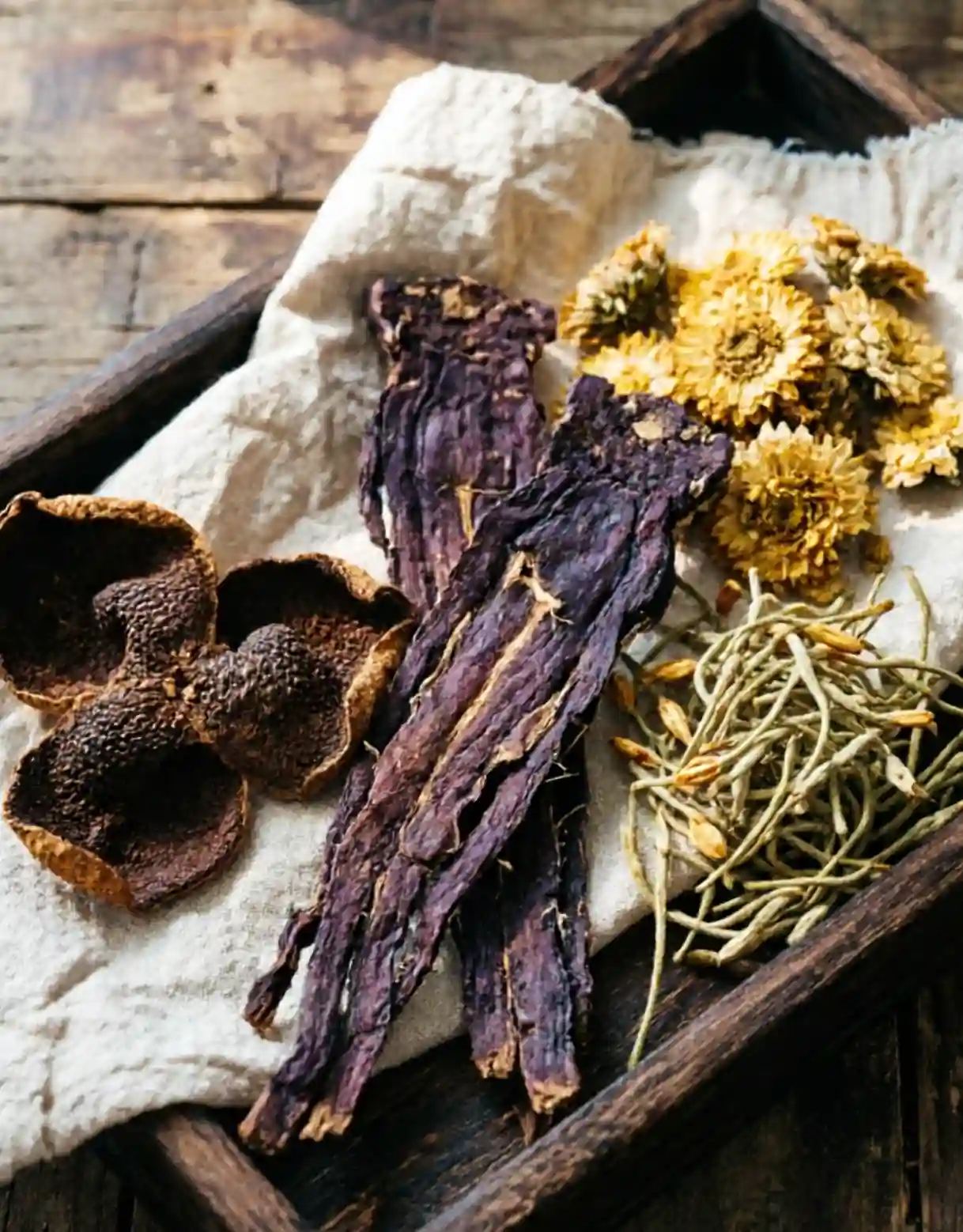
The aggregate fruit is composed of numerous small achenes, forming an oblong shape, 1-2 cm long, 5-8 mm in diameter. It is yellow-brown, brown-red to dark purple; with a short infructescence stalk. The small achenes are ovoid, slightly flattened, about 2 mm long, about 1 mm wide, externally with 4 fleshy perianth segments. Odor: faint; Taste: slightly sour and sweet.
Chemical Constituents
This product contains tannic acid, malic acid, palmitic acid, linoleic acid, and eucalyptol.
Pharmacology
Enhances immune function; lowers Na+-K+-ATPase activity.
Properties and Channel Entry
Sweet, sour, cold. Enters the Heart, Liver, and Kidney channels.
Functions and Indications
Nourishes Yin and supplements Blood, generates body fluids and moistens dryness
Dosage and Administration
Oral: decoct in water, 10-15 g; or prepare as an extract, steep in wine, consume raw; or formulated into pills or powders. External use: appropriate amount, soak in water for washing.
Precautions and Contraindications
Those with Spleen and Stomach deficiency-cold and loose stools should avoid taking it.
Prescriptions
1. For heart-kidney weakness causing insomnia or habitual constipation: fresh mulberries 30-60 g. Decoct in an appropriate amount of water and take orally. (Minnan Folk Herbal Medicine) 2. For scalds and burns: use ripe black mulberries, collect in a clean bottle, and allow to sit for a long time until they naturally produce liquid. Apply with a chicken feather. (Ba Yi Xuan Fang) 3. For scrofula: take about two dou of ripe black mulberries. Extract the juice using a cloth bag, boil down to a thin paste. Take one spoonful with plain boiling water, three times daily. (Bao Ming Ji, Wen Wu Gao) 4. For alcohol poisoning: dry mulberries, two ge. Soak the above ingredient in one sheng of wine for about one hour. Drink the wine while stirring, to relieve intoxication. (Sheng Ji Zong Lu)