Pinyin: Hulu
Aliases
Hulu, Paogua, Tianhu, Yaozhou, Hulugua.
Source
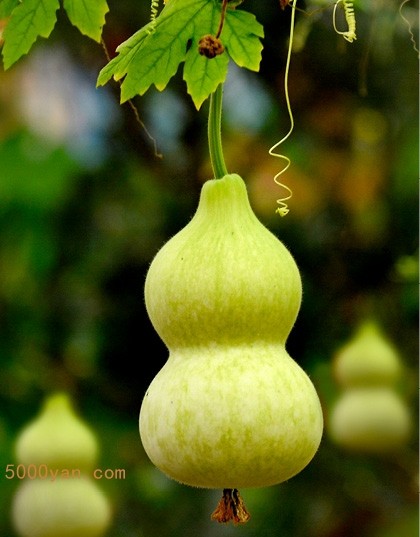
Cucurbitaceae plant *Lagenaria siceraria*Lagenaria siceraria(Molina) Standl., bottle gourdLagenaria siceraria(Molina) Standl. var.depressa(Ser.) Hara dried fruit.
Botanical Description
Annual climbing herb. Stems and branches with grooves, covered in sticky long hairs, gradually shedding with age. Petioles slender, 16-20 cm long, hairy; leaf blades ovate-cordate or reniform-ovate, 10-35 cm long and wide, entire or 3-5 lobed, with 5-7 palmate veins, apex acute, margin irregularly toothed, base cordate. Tendrils slender, initially with fine hairs, upper part bifurcated. Monoecious, male and female flowers solitary. Male flowers: pedicel slender, slightly longer than petiole, pedicel, calyx, and corolla all with fine hairs; calyx tube funnel-shaped, about 2 cm long, lobes lanceolate, 5 mm long; corolla white, lobes undulate, 3-4 cm long, 2-3 cm wide, apex slightly emarginate with a small tip, 5-veined; stamens 3, filaments 3-4 mm long, anthers 8-10 mm long, oblong, anther cells curved. Female flowers: pedicel slightly shorter than or nearly equal to petiole; calyx and corolla similar to male flowers; calyx tube 2-3 mm long; ovary constricted in the middle, densely covered with sticky long hairs; style short and thick; stigma 3, enlarged, 2-lobed. Fruit initially green, turning white to yellowish, highly variable in shape depending on variety and cultivar, ranging from dumbbell-shaped to oblate-spherical, club-shaped, or ladle-shaped; pericarp becomes woody when mature. Seeds white, obovate or triangular, apex truncate or 2-toothed, rarely rounded, about 20 mm long. Flowering period July to August, fruiting period August to September.
2. Hulu (Calabash Gourd): The main difference between this species and the bottle gourd is that the fruit is oblate-spherical, approximately 30 cm in diameter.
Habitat and Distribution
Cultivated throughout China.
Harvesting and Processing
Harvest the fruits in autumn when they are ripe but the outer skin has not yet become lignified, remove the skin for use.
Chemical Constituents
This product mainly contains 22-deoxycucurbitacin D, 22-deoxyisocucurbitacin D, as well as proteins, amino acids, and other components.
Pharmacology
Inhibits trypsin.
Properties and Channel Entry
Sweet and bland, neutral. Enters the Lung, Spleen, and Kidney channels.
Functions and Indications
Diuresis, reduces edema, promotes urination, and dissipates masses. Indications: edema, ascites, jaundice, stranguria, and carbuncles.
Dosage and Administration
Internal use: decoct in water, 9-30 g; or calcine until the property is retained and grind into powder.
Precautions and Contraindications
Contraindicated in patients with Spleen and Stomach deficiency cold.
Prescriptions
1. For edema: 1 bottle gourd, 30 g red bean (Adzuki bean). Decoct in water, take twice daily. ("Jilin Chinese Herbal Medicine") 2. For nephritis: 1 bottle gourd, 9 g each of wolfberry, Codonopsis, and Astragalus. Decoct in water, take twice daily. ("Jilin Chinese Herbal Medicine") 3. For beriberi with edema: 30 g bottle gourd, 60-120 g crucian carp. Cook and eat. ("Hunan Materia Medica") 4. For hypertension, vexation and heat with thirst, hepatitis with jaundice, and urinary tract stones: Squeeze juice from fresh bottle gourd. Mix with honey, take half to one cup each time, twice daily. Alternatively, it can be boiled in water. ("Food Chinese Medicine and Prescriptions")