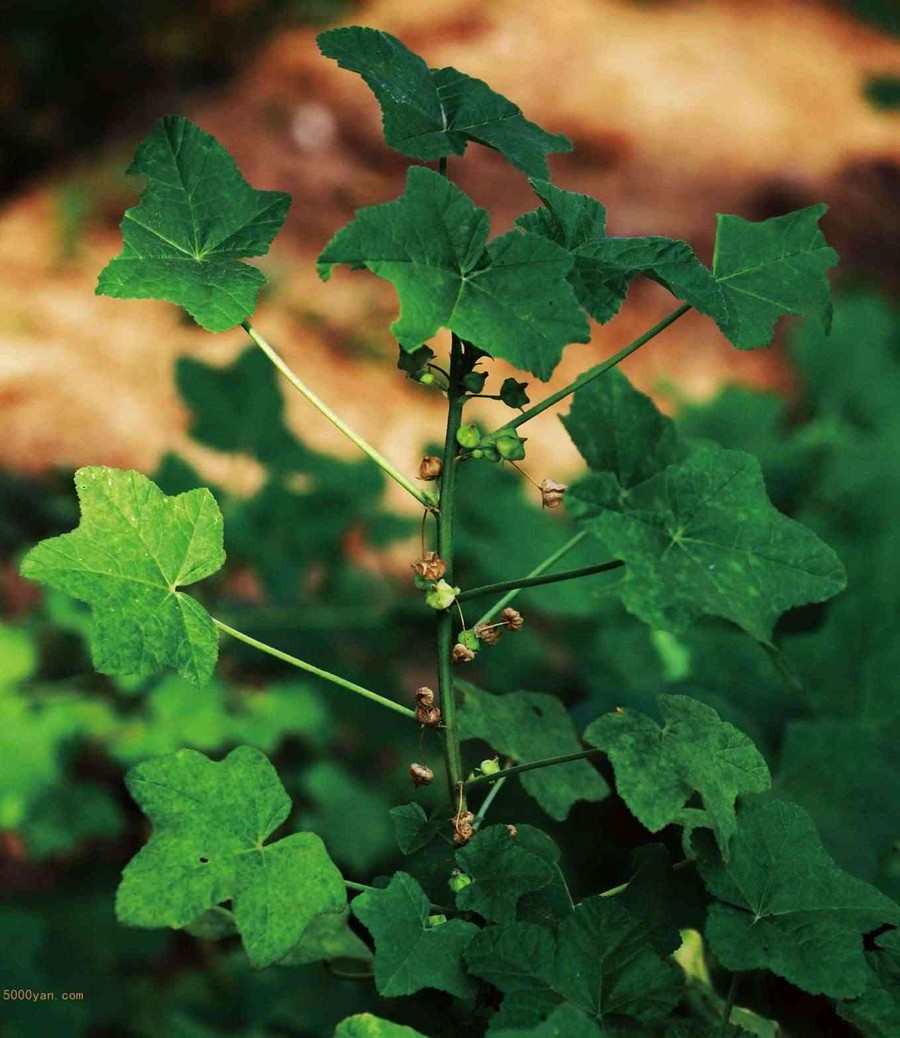
Pinyin: Dongkuiguo
Aliases
Kuizi, Kuicaizi.
Source
Malvaceae family plant *Malva verticillata* L.Melva crispaL. dried fruit.
Botanical Description
Annual herb, unbranched. Stem covered with soft hairs. Petiole slender, sparsely covered with soft hairs; leaf blade round, 5-7 lobed, 5-8 cm in diameter, cordate at base, margin with fine serrations, particularly wrinkled. Flowers 3 to several clustered in leaf axils, nearly sessile to very shortly pedicellate; involucral bracts 3, linear-lanceolate, ciliate; calyx cup-shaped, 5-lobed, broadly triangular, sparsely covered with stellate stiff hairs; corolla pale white to pale red, petals 5, 6-8 mm long, apex concave, with claw. Fruit oblate-spherical, about 8 mm in diameter, reticulate, with fine soft hairs. Seeds about 1 mm in diameter, dark black. Flowering period June to September.
Habitat and Distribution
Cultivated in Southwest China, Hebei, Gansu, Jiangxi, Hubei, Hunan, and other regions.
Harvesting and Processing
Take the seeds from the mature fruit.
Medicinal Properties
The fruit of Malva verticillata consists of 7-9 small mericarps, forming a flat disc shape with a persistent calyx at the base. The mericarps are orange segment-shaped or kidney-shaped, 1.5-2 mm in diameter, with a slight depression at the center of the thinner edge. The outer surface of the pericarp is brownish-yellow, relatively smooth on the back, with a slightly concave spot on each side near the depression, from which radial stripes extend outward. The seeds are orange segment-shaped and kidney-shaped, with a seed coat ranging from black to brownish-brown. The texture is hard; when broken, the cotyledons are heart-shaped, with two overlapping and folded pieces. Odor: faint; Taste: astringent.
Chemical Constituents
This product primarily contains fatty oils, proteins, anthocyanins, rutin, mucilage, and other components.
Pharmacology
Enhances the phagocytic activity of the reticuloendothelial system.
Properties and Channel Entry
1. For pneumonia: Renshen 6 g, decoct in water and take orally.
Sweet, cold. Enters the Large Intestine, Small Intestine, and Bladder channels.
Functions and Indications
Promotes urination and treats stranguria, lubricates the intestines and unblocks bowels, promotes lactation. Main indications: stranguria, edema, constipation, and insufficient lactation.
Dosage and Administration
Oral: decoct in water, 6-15 g; or take as powder.
Precautions and Contraindications
Those with Spleen deficiency and slippery intestines should avoid taking this, and pregnant women should use with caution.
Prescriptions
1. For postpartum urinary dribbling and obstruction: Dongkuizi (Malva verticillata seed) 1 he (approximately 18 g), and Puxiao (Mirabilite) 2.4 g. Boil in 2 sheng (approximately 600 mL) of water down to 8 he (approximately 240 mL), then add the mirabilite and take orally. (From *Yao Seng Tan Ji Yan Fang*) 2. For urinary tract infection with difficult and painful urination: Dongkuizi (Malva verticillata seed), Cheqianzi (Plantago seed), Bianxu (Polygonum aviculare), and Puhuang (Typha pollen) 12 g each. Decoct in water and take orally. (From *Ningxia Zhongcaoyao Shouce*)