Pinyin: Shaji
Aliases
Da'er, Shazao, Culiuguo, Suanci
Source
Plants of the Elaeagnaceae family: SeabuckthornHippophae rhamnoidesL. dried mature fruit.
Botanical Description
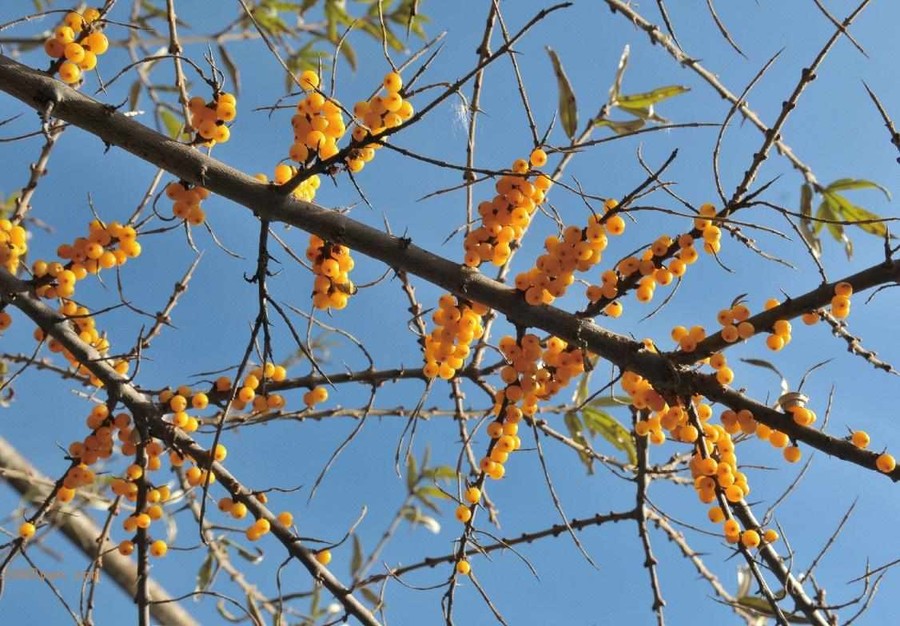
Deciduous shrub or tree, 1-5 m tall, up to 18 m in mountain valleys. Spines numerous, stout, terminal or lateral; branchlets brownish-green, densely covered with silvery-white and brownish scales or sometimes with white stellate hairs, older branches grayish-black, rough; buds large, golden-yellow or rust-colored. Leaves simple, usually subopposite; petiole very short; leaf blade papery, narrowly lanceolate or oblong-lanceolate, 3-8 cm long, about 1 cm wide, apex obtuse or base subrounded, upper surface green, initially covered with white peltate or stellate hairs, lower surface silvery-white or pale white, scaly. Fruit spherical, 4-6 mm in diameter, orange-yellow or orange-red; pedicel 1-2.5 mm long. Seeds small, black or purplish-black, shiny. Flowering period April to May, fruiting period September to October.
Habitat and Distribution
Born at an altitude of 800-3600 m on sunny slopes, river valley terraces in desert areas, flat sandy land, and gravelly hillsides. Distributed in North China, Northwest China, and Sichuan.
Harvesting and Processing
Harvest in autumn and winter when the fruit is ripe or frozen, remove impurities, and dry or dry after steaming.
Medicinal Properties
This product is subglobose or oblate, sometimes several connate, single diameter 5-8 mm. Surface orange-yellow or brownish-red, wrinkled, apex with persistent style remnant, base with short fruit stalk or fruit stalk scar. Pulp oily, texture soft. Seeds obliquely ovoid, about 4 mm long, about 2 mm wide; surface brown, glossy, with a longitudinal groove in the middle; seed coat relatively hard, kernel milky white, oily. Odor faint, taste sour and astringent.
Chemical Constituents
This product contains isorhamnetin, apigenin, quercetin, kaempferol, carotene,β- β-sitosterol, cryptoxanthin, and other constituents.
Pharmacology
Enhances immune function; Antitumor; Improves cardiovascular system function; Promotes hematopoietic function; Reduces whole blood viscosity; Inhibits platelet aggregation; Reduces serum total cholesterol, increases serum high-density lipoprotein and liver total cholesterol; Inhibits experimental thrombosis formation; Hepatoprotective; Antigastric ulcer; Antioxidant; Anti-inflammatory; Increases phagocytic function of the reticuloendothelial system; Antiallergic.
Properties and Channel Entry
Sour, astringent, and warm. Enters the Spleen, Stomach, Lung, and Heart channels.
Functions and Indications
Tonifies the Spleen and promotes digestion, relieves cough and expels phlegm, activates Blood and disperses stasis. Used for Spleen deficiency with reduced appetite, food accumulation with abdominal pain, cough with copious phlegm, chest impediment with heart pain, Blood stasis amenorrhea, and traumatic bruising with swelling.
Dosage and Administration
Internal: decoct in water, 3-9 g; or made into pills or powder. External: appropriate amount, apply by crushing or grinding into powder and sprinkling.
Prescriptions
1. For cough with excessive phlegm: Seabuckthorn, licorice, white raisins, gardenia, and costus root, equal parts. Grind into powder, add a little borneol. Take 1.5-3 g each time, with warm boiled water. (Inner Mongolia Chinese Herbal Medicine) 2. For stomach pain, indigestion, gastric ulcers, subcutaneous bleeding, and irregular menstruation: Dried seabuckthorn 3-9 g. Decoct in water for oral administration, or crush ripe fruit and boil with water, strain the liquid, concentrate into a paste, and take an appropriate amount. (Desert Area Medicinal Plants) 3. For sore throat: Crush fresh seabuckthorn fruit, wrap in gauze, squeeze out the juice, add white sugar, and take with warm boiled water. (Desert Area Medicinal Plants) 4. For amenorrhea: Trichosanthes root 18 g, mirabilite 15 g, seabuckthorn and rhubarb 9 g each, whole scorpion 6 g, kaempferia galanga 1.5 g, and alkali powder 1.5 g. Grind together into fine powder, take 1.5-3 g each time, with warm boiled water. (Inner Mongolia Chinese Herbal Medicine)