Pinyin: Mihoutao
Aliases
Tengli, Muzi, Mihouli, Yangtao.
Source
1. For pneumonia: Renshen 6 g, decoct in water and take orally.Actinidia chinensisDried ripe fruit of *Planch*.
Botanical Description
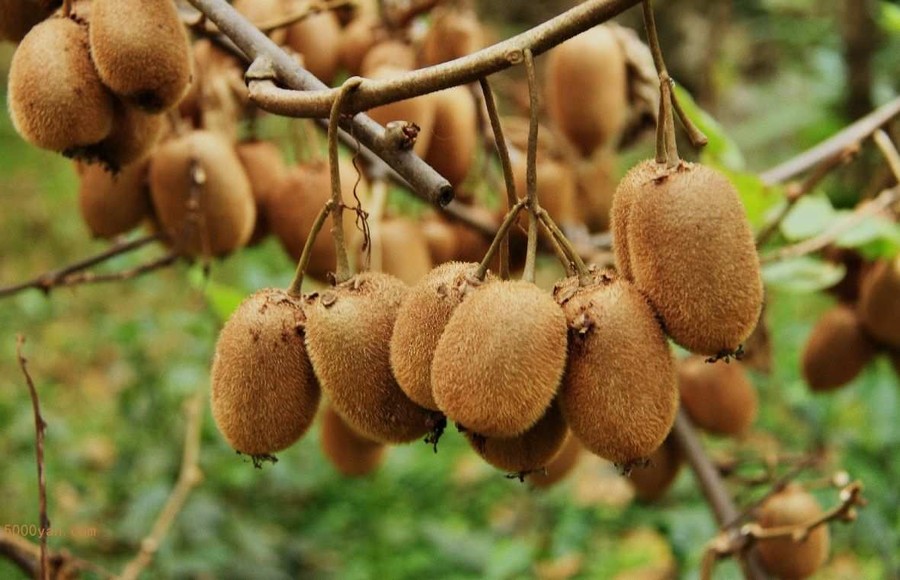
Vine. Young branches red, densely covered with grayish-brown soft hairs along with petioles; old branches glabrous; pith large, white, lamellar. Leaves simple, alternate; petioles up to 6 cm long; leaf blade papery, round, ovate or obovate, 5-17 cm long, apex acute, slightly emarginate or truncate, base broadly cuneate to cordate, margin with bristle-like teeth, upper surface dark green, hairy only on veins, lower surface grayish-white, densely covered with grayish-brown stellate tomentum. Flowers solitary or several clustered in leaf axils; unisexual, dioecious, or unisexual and bisexual flowers coexisting; sepals 5, rarely 4, base slightly connate, together with pedicels covered with light brown tomentum; petals 5, rarely 4, or up to 6-7, milky white when first opening, turning yellow later; stamens numerous, anthers dorsifixed; ovary superior, multilocular, styles filiform, numerous. Berry ovoid or oblong, 3-5 cm long, densely covered with brown long hairs, fragrant. Seeds small, black. Flowering June-July, fruiting August-September.
Habitat and Distribution
Growing in mountain forests or thickets, often twining around other plants. Distributed in Central and South China, as well as Shaanxi, Sichuan, Jiangsu, Anhui, Zhejiang, Jiangxi, Fujian, Guizhou, Yunnan, and other regions.
Harvesting and Processing
9. Pick ripe fruits in mid-to-late September to early October, use fresh or sun-dried for use.
Medicinal Properties
Berries subglobose, cylindrical, obovate, or ellipsoid, 4-6 cm long. Surface yellowish-brown or greenish-brown, covered with tomentum, long stiff hairs, or bristle-like long stiff hairs, sometimes glabrous, with numerous small pale brown spots; apex beak indistinct, slightly pointed. Base with fruit stalk 1.2-4 cm long, persistent calyx reflexed; outer flesh green, inner flesh yellow. Seeds small, 2.5 mm long. Odor faint; taste sour, sweet, and slightly astringent.
Chemical Constituents
This product mainly contains sugars, vitamins, organic acids, and pigments, as well as components such as actinidine, zeatin, emodin, and carotenoids.
Pharmacology
Anti-cancer; delays aging; enhances hypoxia tolerance; lowers blood lipids; protects the liver; anti-inflammatory.
Properties and Channel Entry
Sour, sweet, and cold. Enters the Stomach, Liver, and Kidney channels.
Functions and Indications
Relieves fever, quenches thirst, strengthens the stomach, and promotes diuresis
Dosage and Administration
Oral: decoct 30-60 g in water; or consume raw, or extract juice for drinking.
Precautions and Contraindications
Those with Spleen and Stomach deficiency-cold should use with caution.
Prescriptions
1. For vexing heat with thirst: Yangtao fruit 30 g, decoct in water and take orally. (Qingdao Chinese Herbal Medicine Handbook) 2. For urinary tract stones: Yangtao fruit 15 g, decoct in water and take orally. (Guangxi Compendium of Chinese Herbal Medicine) 3. For cirrhotic ascites: Yangtao fruit and Lobelia chinensis each 30 g, with 10 pieces of Fructus Jujubae (Chinese date), decoct and take. (Anhui Chinese Herbal Medicine) 4. For indigestion and poor appetite: Dried Yangtao fruit 60 g, decoct in water and take orally. (Hunan Materia Medica)