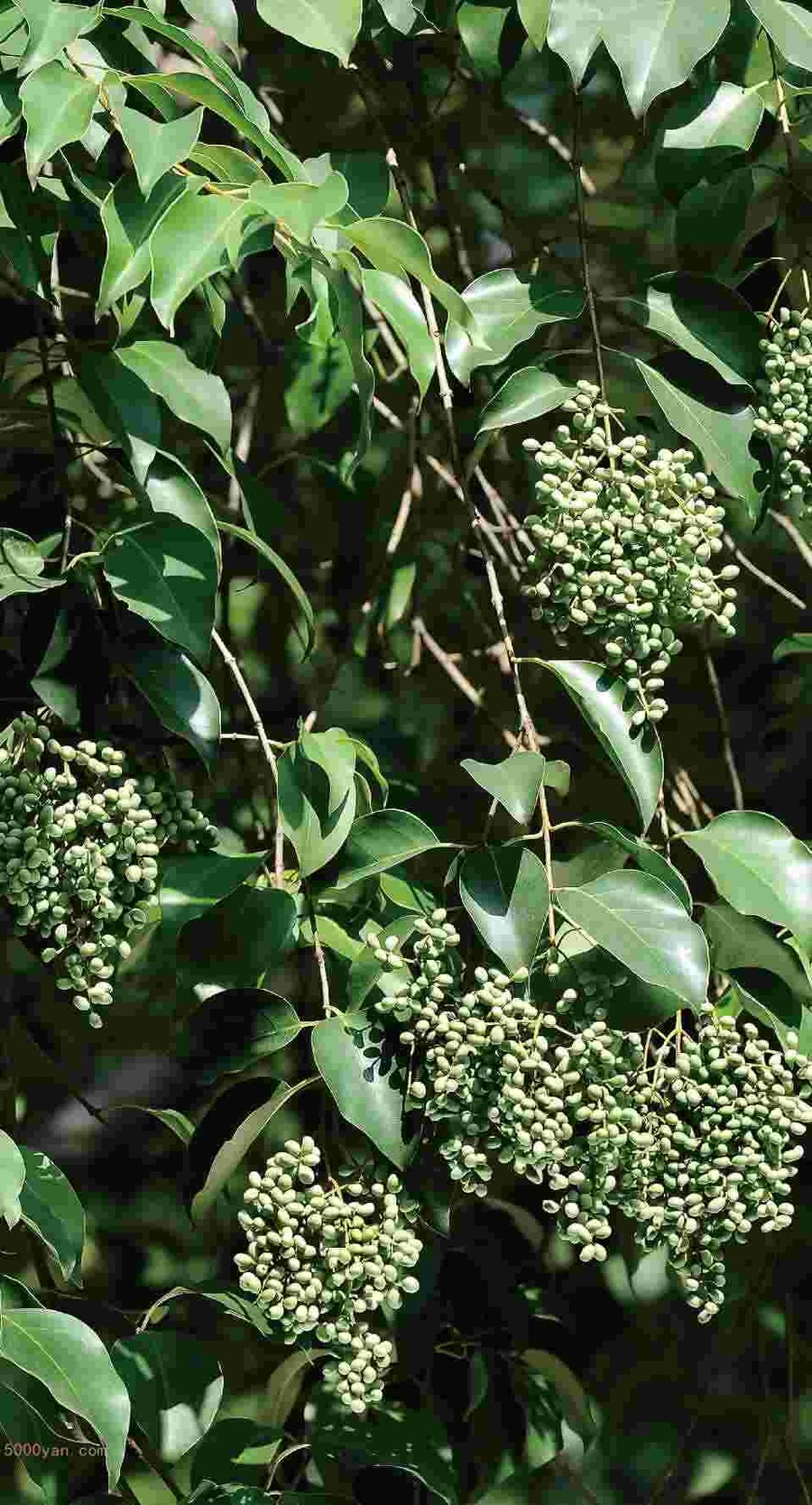
Pinyin: Nüzhenzi
Aliases
Nüzhenshi, Dongqingzi, Bailashuzi, Shuzizi.
Source
Oleaceae plant *Ligustrum lucidum* Ait.Ligustrum lucidumDried ripe fruit of Ait.
Botanical Description
Evergreen shrub or tree, up to 25 m tall. Bark gray-brown. Branches yellow-brown, gray, or purplish-red, cylindrical, with scattered round or oblong lenticels. Leaves opposite, simple; petiole 1-3 cm long, grooved above; leaf blade leathery, ovate, long-ovate, or elliptic to broadly elliptic, 6-17 cm long, 3-8 cm wide, apex acute to acuminate or obtuse, base rounded, sometimes broadly cuneate or attenuate. Panicles terminal, 8-20 cm long, 8-25 cm wide; peduncle up to 3 cm long; bracts at base of inflorescence often similar to leaves, bracteoles lanceolate or linear, deciduous; flowers sessile or subsessile; calyx glabrous, 1.5-2 mm long, teeth indistinct or nearly truncate; corolla 4-5 mm long, lobes 2-2.5 mm long, reflexed; filaments 1.5-3 mm long, anthers oblong, 1-1.5 mm long; style 1.5-2 mm long, stigma clavate. Fruit reniform or subreniform, 7-10 mm long, 4-6 mm in diameter, dark blue-black, becoming red-black when mature, covered with white powder. Flowering May to July, fruiting July to May of the following year.
Habitat and Distribution
Distributed in sparse or dense forests below 2900 m elevation, also commonly cultivated in courtyards or along roadsides. Found in Shaanxi, Gansu, and areas south of the Yangtze River.
Harvesting and Processing
Harvested when the fruit ripens in winter, remove branches and leaves, steam briefly or blanch in boiling water, then dry; or dry directly.
Medicinal Properties
This product is ovoid, ellipsoid, or reniform in shape, 6-8.5 mm long, 3.5-5.5 mm in diameter. The surface is black-purple or gray-black, wrinkled and uneven, with a fruit stalk scar or persistent calyx and short stalk at the base. Light in weight. The exocarp is thin, the mesocarp is relatively loose and soft, easy to peel off, and the endocarp is woody, yellow-brown, with longitudinal ridges. After breaking open, there is usually 1 seed, reniform, purple-black, and oily. Odor: faint; Taste: sweet, slightly bitter and astringent.
Chemical Constituents
This product contains oleanolic acid.β-β-sitosterol, acetyloleanolic acid, acetylursolic acid, quercetin, acteoside, ligustroside, and neonuezhenide.
Pharmacology
Anti-inflammatory; promotes immune function; inhibits allergic reactions; prevents atherosclerosis; lowers blood glucose; protects the liver; promotes hematopoietic activity; resists mutagenesis and inhibits microbial photooxidation of hematoporphyrin; antibacterial.
Properties and Channel Entry
Sweet, bitter, cool. Enters the Liver and Kidney channels.
Functions and Indications
Nourishes and tonifies the Liver and Kidney, brightens the eyes and darkens the hair
Dosage and Administration
Internal administration: decoction 6-15 g; or in pill form
Precautions and Contraindications
Patients with diarrhea due to Spleen and Stomach deficiency-cold and those with Yang deficiency should use with caution.
Prescriptions
1. For seborrheic alopecia: Nüzhenzi (Ligustrum lucidum) 10 g, Heshouwu (Polygonum multiflorum) 10 g, Tusizi (Cuscuta chinensis) 10 g, Danggui (Angelica sinensis) 10 g. Decoct in water and take orally, 1 dose daily for 2 consecutive months. (Sichuan Chinese Materia Medica, 1979) 2. For Yin deficiency with bone-steaming tidal fever: Nüzhenzi (Ligustrum lucidum) 9 g, Digupi (Lycium chinense root bark) 9 g, Qinghao (Artemisia annua) 6 g, Xiakucao (Prunella vulgaris) 6 g. Decoct and take orally. (Anhui Chinese Herbal Medicine) 3. For leukopenia: Zhi Nüzhenzi (processed Ligustrum lucidum) 45 g, Longkui (Solanum nigrum) 45 g. Decoct and take orally. (Anhui Chinese Herbal Medicine) 4. For wind-heat red eyes: Nüzhenzi (Ligustrum lucidum) in an appropriate amount. Pound to extract juice, steam over water to concentrate into a paste, store in a clean bottle, and use as eye drops. (Jiji Xianfang) 5. For optic neuritis: Nüzhenzi (Ligustrum lucidum) 30 g, Caojueming (Cassia tora) 30 g, Qingxiangzi (Celosia argentea) 30 g. Decoct in water and take orally. (Zhejiang Folk Commonly Used Herbs)