Pinyin: Fuxiaomai
Aliases
Fumai
Source
1TriticumaestivumL. Dry, shriveled, and light dry caryopsis.
Botanical Description
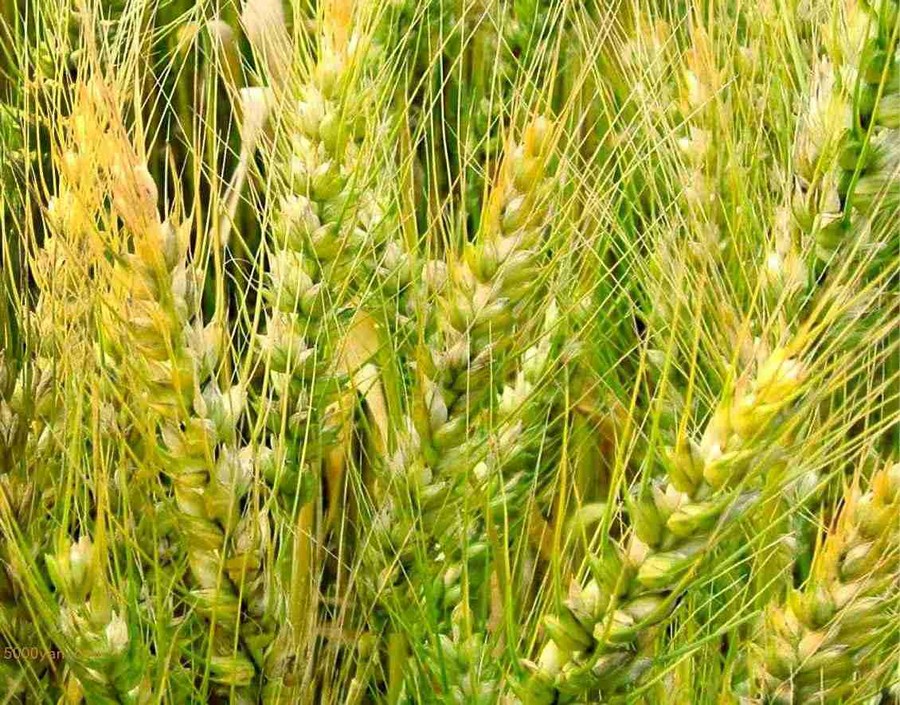
Annual or biennial herb, 60-100 cm tall. Culms erect, usually with 6-9 nodes. Leaf sheaths smooth, often shorter than internodes; ligule membranous, short and small; leaf blade flat, long-lanceolate, 15-40 cm long, 8-14 mm wide, apex acuminate, base square-rounded. Spike erect, 3-10 cm long; spikelets flat on both sides, about 12 mm long, arranged in parallel or nearly parallel rows on the rachis, each spikelet with 3-9 flowers, only the lower flowers fertile; glumes short, the first glume wider than the second, both with sharp keels on the back, sometimes extended into awns; lemma membranous, slightly split into 3 teeth, the central tooth often extended into an awn; palea equal to or slightly shorter than lemma, with narrow scaly wings on the keel; stamens 3; ovary ovoid. Caryopsis oblong or nearly ovoid, about 6 mm long, light brown. Flowering period April to May, fruiting period May to June.
Habitat and Distribution
Extensively cultivated throughout the country.
Harvesting and Processing
Around the Summer Solstice, after the mature fruits are harvested, take the shriveled, light, floating grains and those with husks still attached, sift out ash and dust, rinse with water, and sun-dry.
Medicinal Properties
The withered caryopsis is oblong, slightly pointed at both ends, approximately 7 mm long and 2.6 mm in diameter. The surface is yellowish-white and wrinkled. Sometimes it still retains the attached lemma and palea. On the ventral side, there is a deep longitudinal groove; the apex is blunt with light yellowish-brown soft hairs, while the other end is obliquely pointed with a hilum. The texture is hard and brittle, easily broken; the cross-section is white with poor starchy quality. Odor: none; Taste: bland.
Chemical Constituents
This product mainly contains starch, protein, sugars, and other components.
Properties and Channel Entry
Sweet, cool. Enters the Heart channel.
Functions and Indications
Clears vacuous Heat and stops sweating. Primarily indicated for yin deficiency fever, night sweats, and spontaneous sweating.
Dosage and Administration
Internal: decoct in water, 15-30 g; or grind into powder. For stopping sweating, it is suitable to slightly stir-fry before use.
Precautions and Contraindications
Contraindicated in cases without sweating with irritability, or in profuse sweating due to collapse (prostration syndrome).
Prescriptions
1. For night sweats and incessant sweating due to deficiency: Use an unspecified amount of Fuxiaomai (light wheat). Stir-fry over moderate and high heat until scorched, then grind into a fine powder. Take 6 g each time, mixed with rice-gruel water (rice soup). Frequent administration is best (Dusheng San from *Weisheng Baojian*). 2. For night sweats: Use one handful of Fuxiaomai. Decoct in water. Mix the strained decoction with 6 g of Fangfeng powder and take (from *Weisheng Yijian Fang*). 3. For incessant hematuria in men: Stir-fry Fuxiaomai with the urine of a male child (tongbian) until charred, then grind into powder. Mix with sugar water and take (from *Qifang Leibian*). 4. For visceral agitation disorder (Zang Zao): Use Fuxiaomai 30 g, Gancao (licorice) 15 g, and Dazao (jujube) 10 pieces. Decoct in water and take orally (from *Qingdao Zhongcaoyao Shouce*).