Pinyin: Nanwuweizi
Aliases
Xuanji, Huiji, Wumeizi, Shanhuajiao
Source
Magnoliaceae plant Schisandra sphenanthera.Schisandra sphenantheraDried ripe fruit of Rehd. et Wils.
Botanical Description
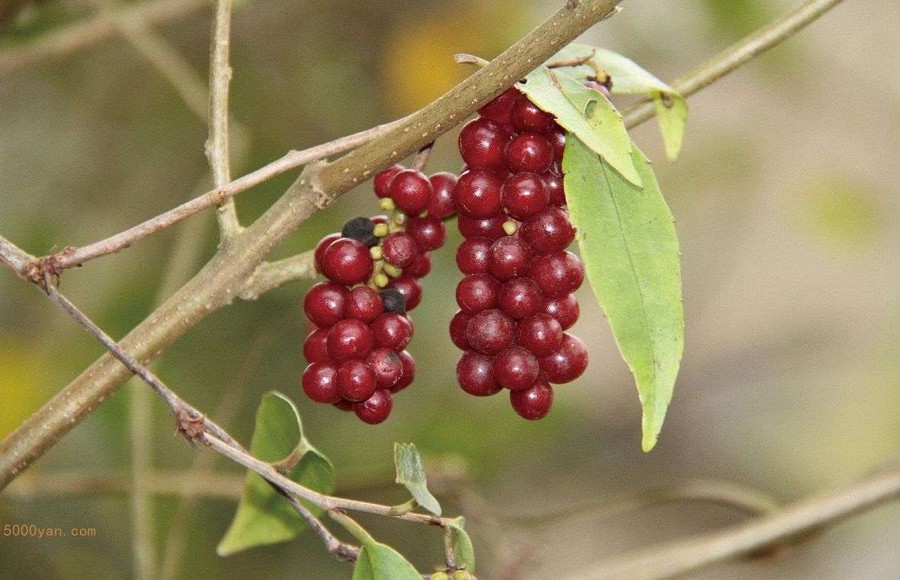
Deciduous vine. Older branches gray-brown with conspicuous lenticels, branchlets purplish-red. Leaves alternate, papery; petiole 1-3 cm long, reddish; leaf blade obovate, broadly ovate, or obovate-oblong, usually widest above the middle, 4-10 cm long, 3-6 cm wide, apex shortly acuminate or acute, base cuneate to rounded, margin sparsely undulate-serrate, upper surface green, lower surface pale green, lateral veins 4-6 pairs, reticulate veins relatively conspicuous. Flowers unisexual, dioecious, orange-yellow, 1.2 cm in diameter, solitary or 1-3 clustered in leaf axils; pedicel slender, 2-4 cm long; perianth segments 5-8, arranged in 2-3 whorls; stamens 10-19, inserted on an obovate receptacle, filaments short, anthers truncate at apex; gynoecium subglobose, carpels 30-50. Infructescence 3.5-10 cm long, small berries globose, bright red when mature. Seeds 2, reniform, about 3 mm long, seed coat with a few tuberculate points on the dorsal ridge. Flowering April to June, fruiting August to September.
Habitat and Distribution
Born in dense forests or beside streams at an altitude of 600-2400 m. Distributed in Shanxi, Shaanxi, Gansu, Jiangsu, Zhejiang, Anhui, Jiangxi, Henan, Hubei, Hunan, Sichuan, Guizhou, Yunnan, and other regions.
Harvesting and Processing
Harvest in autumn when the fruit ripens, sun-dry, remove fruit stems and impurities.
Medicinal Properties
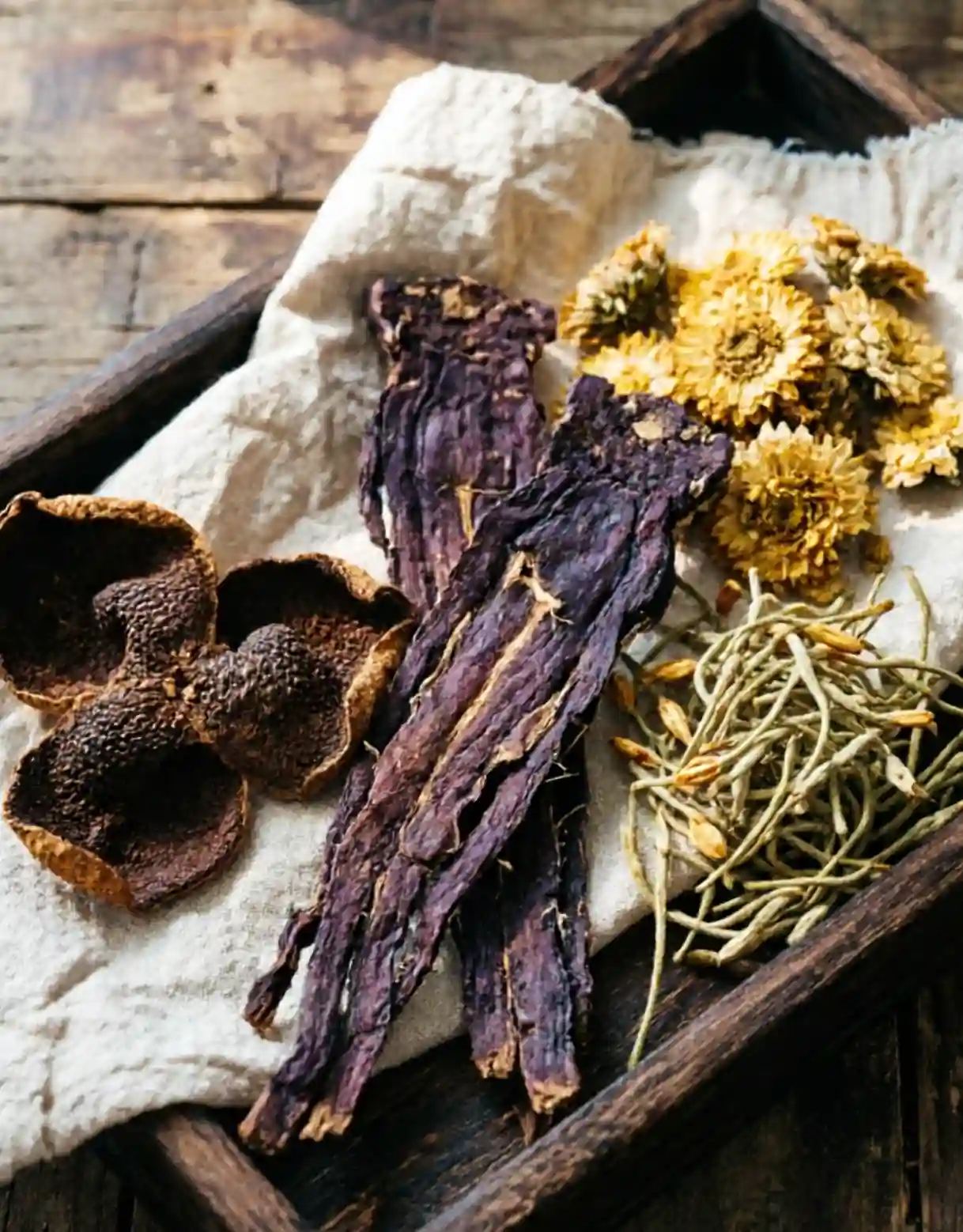
This product is spherical or oblate-spherical, 4-6 mm in diameter. The surface is brownish-red to dark brown, shriveled and wrinkled, with the pulp often tightly adhering to the seeds. There are 1-2 seeds, kidney-shaped, with a brownish-yellow surface, lustrous, and a thin, brittle seed coat. The pulp has a faint odor and a slightly sour taste.
Chemical Constituents
This product containsδ- Lianxiangxiganyin (elemene glycoside),α- Santalene, deoxyschisandrin, schisantherin A, schisantherin B, schisantherin C, schisantherin D, schisantherin E, angeloylgomisin P, and tigloylgomisin P.
Pharmacology
Anti-gastric ulcer; sedative; analgesic; anti-inflammatory; antitussive and expectorant; antibacterial.
Properties and Channel Entry
Sour, sweet, and warm. Enters the Lung, Heart, and Kidney channels.
Functions and Indications
Astringes and consolidates to stop leakage, tonifies Qi and generates body fluids, tonifies the Kidney and calms the Heart. Used for chronic cough and deficient dyspnea, nocturnal emission and spermatorrhea, enuresis and frequent urination, prolonged diarrhea, spontaneous sweating and night sweats, fluid damage with thirst, internal heat wasting-thirst disorder, and palpitations with insomnia.
Dosage and Administration
Oral administration: decocted in water, 3-6 g; ground into powder, 1-3 g per dose; made into paste; or prepared as pills or powder. External use: appropriate amount, ground into powder for application; or decocted in water for washing. For astringing the Lung to stop cough, use a small dosage; for tonifying, calming the Spirit, or rescuing from collapse, use a slightly larger dosage.
Precautions and Contraindications
External exterior pathogenic factors, internal excess heat, or early-stage cough, or early-stage measles: use with caution.
Prescriptions
1. For phlegm cough and wheezing: Nanwuweizi and Baifan in equal parts, grind into powder. Take 9 g each time, roast fresh pig lung until done, dip in powder and chew slowly, swallow with plain soup. (Puji Fang) 2. For impotence: Nanwuweizi, Tusizi, and Shechuangzi in equal parts. Grind the three ingredients into powder, form into pills with honey the size of wutong seeds. Take three pills with drink, three times daily. (Qianjin Yaofang) 3. For slippery diarrhea: Chenmi, Roudoukou (wrapped in dough and roasted), Nanwuweizi, and Chishizhi (ground) 30 g each. Grind the above into powder. Take 6 g each time, mix with millet soup and take orally, three times daily. (Shiyi Dexiaofang, Doukou Yin) 4. For kidney diarrhea: Nanwuweizi (selected) 60 g, Wuzhuyu (fine-grained green variety) 15 g. Stir-fry the two ingredients together until fragrant, grind into fine powder. Take 6 g each time, take with Chenmi drink. (Benshi Fang, Wuweizi San) 5. For night sweats during sleep: Nanwuweizi 30 g, grind into powder, mix with saliva to form a paste. Apply to the navel, secure with cloth and sleep, remove after dawn, sweat will stop after one or two nights. (Yifang Yipanzhu)