Pinyin: Zhuyejiao
Aliases
Shanjiao, Gouhuajiao, Huahujiao, Jijiao
Source
1. For pneumonia: Renshen 6 g, decoct in water and take orally.Zanthoxylum armatumDried ripe fruit of DC.
Botanical Description
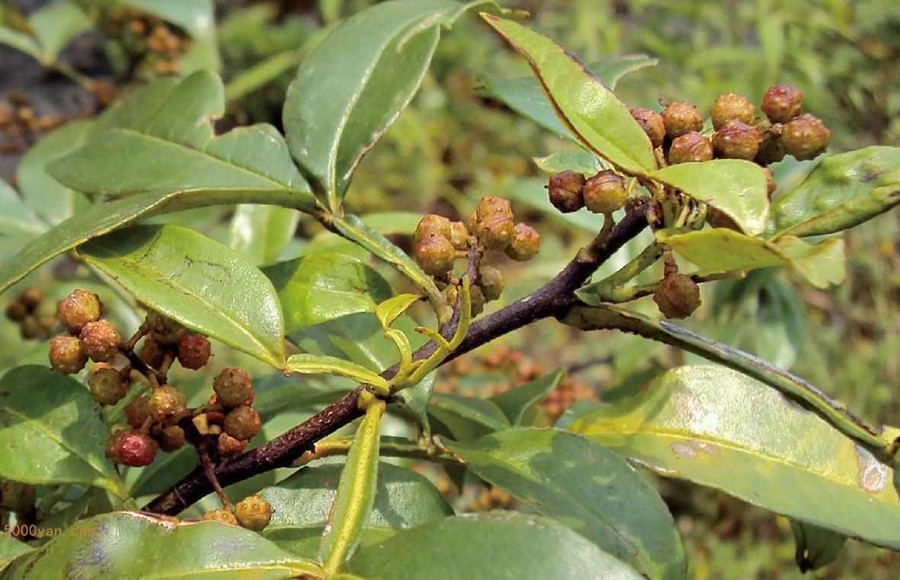
Shrub or small tree, up to 4 m tall. Branches erect and spreading, with curved, flat-based prickles; prickles on older branches have a corky base, while those on the trunk have a flat, cushion-shaped base. Odd-pinnate compound leaves alternate; rachis glabrous, with broad wings and prickles; leaflets sessile; 3-5 leaflets, lanceolate to elliptic-lanceolate, 5-9 cm long, apex acute, base cuneate, margin with small rounded teeth, both surfaces glabrous with sparse transparent glandular dots, main veins with prickles, lateral veins indistinct, papery. Paniculate thyrse, axillary, 2-6 cm long; perianth segments 6-8, anther connective with a glandular dot at apex; female flowers with 2-4 carpels, usually 1-2 developing. Follicles 1-2-valved, rarely 3-valved, red, with raised glandular dots on the surface. Seeds ovoid, black, glossy. Flowering March to May, fruiting June to August.
Habitat and Distribution
Occurs in sparse forests, thickets, and along roadsides on slopes below 2300 m elevation. Distributed in East, Central, South, and Southwest China, as well as Shaanxi, Gansu, and Taiwan.
Harvesting and Processing
Harvest when the fruit ripens from June to August, dry the pericarp in the sun, remove the seeds, and set aside for later use.
Medicinal Properties
Spherical mericarps 1-2, diameter 4-5 mm, apex with a small beak tip, base without undeveloped free carpels, at about 0.7 mm from the base the small fruit stalk top has a node, slightly enlarged. Outer surface reddish-brown to brownish-red, sparsely scattered with distinctly protruding warty oil glands. Endocarp smooth, pale yellow, thin and leathery. Fruit stalk sparsely covered with short hairs. Seeds spherical, about 3 mm in diameter, surface deep black, shiny, densely covered with small warts, hilum circular, raphe distinct. When fruit matures, the funicle connects to the base of the endocarp, fruit cortex relatively brittle. Aroma: fragrant; Taste: numbing and cool.
Chemical Constituents
This product primarily contains volatile oils, magnoflorine, and wuzhuyuine (evodiamine-like alkaloids) as its main chemical constituents.
Properties and Channel Entry
Acrid, slightly bitter, warm; mildly toxic. Enters the Spleen and Stomach channels.
Functions and Indications
Warms the Middle, dries Dampness, disperses Cold, alleviates pain, expels parasites, and relieves itching. Indicated for cold pain in the epigastrium and abdomen, vomiting and diarrhea due to Cold-Dampness, abdominal pain from roundworm infestation, toothache due to dental caries, eczema, scabies, and itchy sores.
Dosage and Administration
Internal: decoct in water, 6-9 g; grind into powder, 1-3 g. External: appropriate amount, decoct in water for washing or gargling; or soak in alcohol for external application; or grind into powder and pack into carious tooth cavities, or mash fresh product for topical application.
Prescriptions
1. For stomach pain and toothache: 3-6 g of *Zanthoxylum planispinum* fruit, 9 g of *Alpinia galanga* root, grind into powder, take with warm boiled water. ("Jiangxi Herbal Medicine") 2. For deficiency-cold stomach pain: 6 g of *Zanthoxylum planispinum* fruit, 9 g of fresh ginger, decoct in water for oral administration. ("National Compendium of Chinese Herbal Medicine") 3. For abdominal pain and diarrhea: 6-9 g of *Zanthoxylum planispinum*, decoct and take. ("Anhui Chinese Herbal Medicine") 4. For roundworm-induced abdominal pain: 6 g of *Zanthoxylum planispinum*, 9 g of *Melia azedarach* bark, decoct in water for oral administration, add appropriate amount of vinegar when taking. ("Anhui Chinese Herbal Medicine")