Pinyin: Gouqizi
Aliases
Gouqi hongshi, Tiancaizi, Xi gouqi, Gouqi dou.
Source
Dried ripe fruit of the Solanaceae plant *Lycium barbarum* L.
Botanical Description
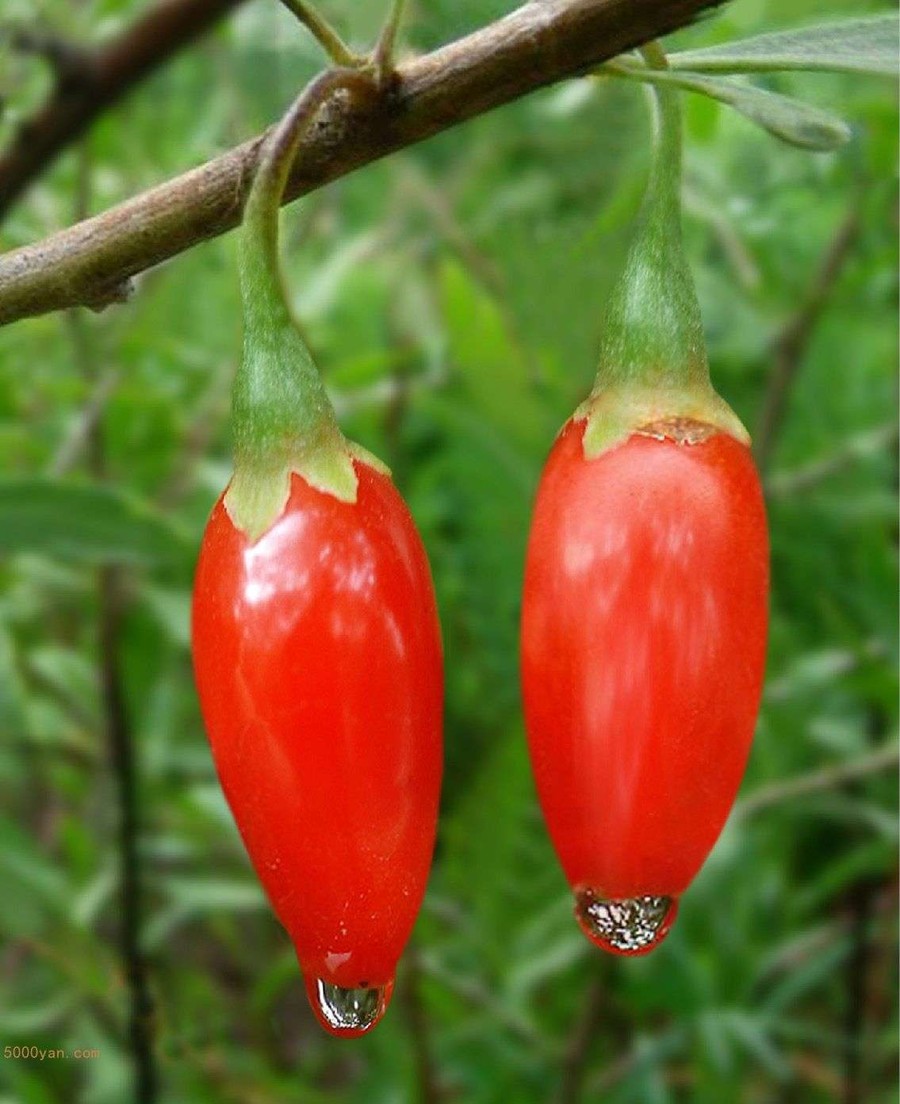
Shrub, 1-3 m tall. Main stems several, stout; branchlets with longitudinal ridges, with short leafless spines and long spines bearing leaves and flowers; fruit branches slender, usually pendulous at apex, outer bark pale grayish-yellow. Glabrous (hairless). Leaves alternate or clustered on short branches; petiole short; leaf blade lanceolate or oblong-lanceolate, 2-8 cm long, 0.5-3 cm wide, apex acute, base cuneate or narrowly cuneate and decurrent into petiole, margin entire. Upper surface dark green, lower surface pale green, glabrous. Flowers axillary, usually solitary or 2-6 clustered on short branches; pedicel slender; calyx campanulate, 4-5 mm long, apex 2-3 deeply lobed, lobes broadly ovate or ovate-triangular; corolla funnelform, tube ca. 8 mm long, apex 5-lobed, lobes ovate, ca. 5 mm long, pink or pale purplish-red, with dark purple veins, with a ring of pubescence above the stamen insertion inside the tube; stamens 5; pistil 1, ovary oblong, 2-locular, style linear, stigma capitate. Berry ovoid, ellipsoid, or broadly ovoid, 8-20 mm long, 5-10 mm in diameter, red or orange-red, pericarp fleshy. Seeds numerous, nearly reniform-orbicular and flattened, brownish-yellow. Flowering May to October, fruiting June to November.
Habitat and Distribution
It grows in ditches, on slopes, along irrigation ridges, and beside canals, both wild and cultivated, distributed in northern and northwestern China, as well as other regions where it is also cultivated.
Harvesting and Processing
Harvest in summer and autumn when the fruit turns red, dry with hot air, remove fruit stems, or air-dry until the skin wrinkles, then sun-dry and remove fruit stems.
Medicinal Properties
This product is fusiform or ellipsoid in shape, 6-20 mm long and 3-10 mm in diameter. The surface is red or dark red, with a small protruding style scar at the apex and a white fruit stalk scar at the base. The pericarp is flexible and wrinkled; the flesh is fleshy and moist. There are 20-50 seeds, reniform, flat and winged, 1.5-1.9 mm long and 1-1.7 mm wide, with a light yellow or brownish-yellow surface. Odor: faint; Taste: sweet.
Chemical Constituents
This product contains atropine, betaine, daucosterol, carotene, cryptoxanthin, zeaxanthin, scopoletin, and other constituents.
Pharmacology
Enhances immune function; delays aging; anti-tumor; lowers blood lipids; protects the liver; promotes hematopoietic function; resists genetic damage; lowers blood sugar; lowers blood pressure; inhibits cardiac activity and stimulates intestinal motility (cholinergic effects); enhances hypoxia tolerance in mice and prolongs their swimming time.
Properties and Channel Entry
Sweet, neutral. Enters the Liver and Kidney channels.
Functions and Indications
Tonifies and nourishes the Liver and Kidneys, benefits the essence and brightens the eyes
Dosage and Administration
Internal: decoct 5-15 g; or prepared into pills, powders, pastes, or medicinal wine.
Precautions and Contraindications
Patients with Spleen deficiency and loose stools should use with caution.
Prescriptions
1. For kidney deficiency with lower back pain: Gouqizi (Lycium barbarum) and Digupi (Lycium chinense root bark) 500 g each, Chuanbixie (Dioscorea hypoglauca) and Chuanduzhong (Eucommia ulmoides) 300 g each. All ingredients are dried in the sun, lightly stir-fried, then steeped in three dou of good wine in a clean jar, boiled for one day, and filtered to remove the dregs. Take freely in the morning and evening according to tolerance. (From Qianjin Yaofang) 2. For bi syndrome (painful obstruction) of wind-damp type: Gouqizi 500 g, Zhenhanfangji (Stephania tetrandra) 120 g (both stir-fried with wine), Qianghuo (Notopterygium incisum) and Duhuo (Angelica pubescens) 30 g each, Chuanniuxi (Cyathula officinalis) and Mugua (Chaenomeles sinensis) 15 g each. All are lightly stir-fried, ground into powder, and made into pills with refined honey, the size of Wutong seeds. Take 9 g each morning with plain water. (From Shenghui Fang) 3. For consumptive disease with unrelenting thirst: Gouqizi (stir-fried with wine) 240 g, Digupi (lightly stir-fried) 300 g, both ground together into powder; Maimendong (Ophiopogon japonicus, with core removed) and Shudihuang (Rehmannia glutinosa, prepared) 120 g each, boiled with wine, pounded into a paste, combined with the previous powder to form pills the size of Wutong seeds. Take 12 g each morning and evening with white wine. (From Qianjin Yaofang)