Pinyin: Cangerzi
Aliases
Canger Shi, Niushizi, Cangzi, Hucangzi, Cangkezi, Laocangzi.
Source
Plant of the Asteraceae family: Xanthium sibiricum.Xanthium sibiricumThe dried mature fruit with involucre of Patr.
Botanical Description
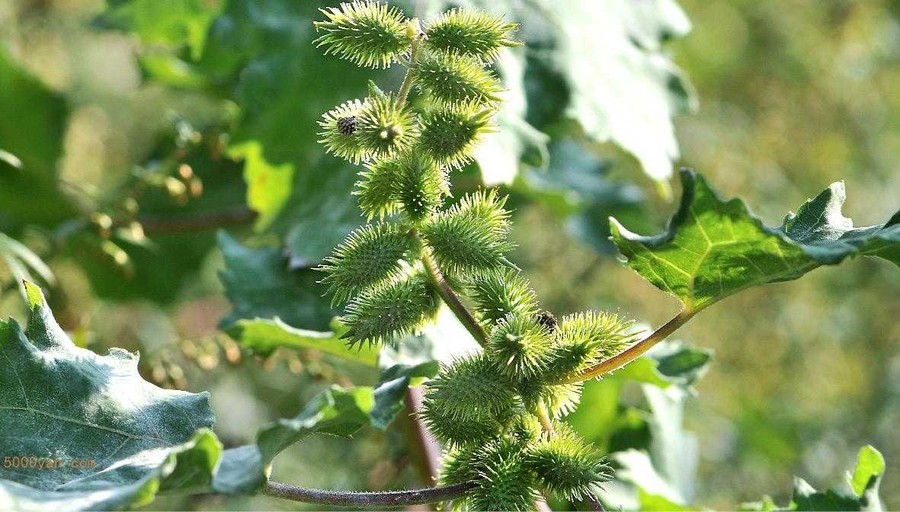
Annual herb, 20-90 cm tall. Root fusiform. Stem erect, unbranched or sparsely branched, lower part cylindrical, upper part with longitudinal grooves, covered with gray-white rough hairs. Leaves alternate; petiole long, 3-11 cm; leaf blade triangular-ovate or cordate, 4-9 cm long, 5-10 cm wide, nearly entire, or with 3-5 inconspicuous shallow lobes, apex acute or obtuse, basal veins 3, upper surface green, lower surface pale green, covered with rough or short white hairs. Capitulum nearly sessile, clustered, monoecious; male inflorescence globose, involucral bracts small, 1 series, densely hairy, receptacle columnar, bractlets oblanceolate, florets tubular, apex 5-toothed, stamens 5, anthers oblong-linear; female inflorescence ovate, involucral bracts 2-3 series, outer bracts small, inner bracts large, forming a sac-like ovoid, 2-locular hard body, outer surface with barbed hairs, apex with 2 conical tips, florets 2, without corolla, ovary within involucre, each locule with 1 floret, style linear, protruding beyond involucre. Mature involucre containing achenes becomes hard, ovoid or ellipsoid, including beak 12-15 mm long, 4-7 mm wide, green, pale yellow, or red-brown, outer surface sparsely covered with hooked involucral spines, spines slender, 1-1.5 mm long, base not thickened, beak 1.5-2.5 mm long; achenes 2, obovoid, each achene containing 1 seed. Flowering period July-August, fruiting period September-October.
Habitat and Distribution
It grows in plains, hills, low mountains, wilderness areas, roadsides, ditches, field edges, grasslands, and village surroundings, and is distributed throughout the country.
Harvesting and Processing
Harvest in autumn when the fruit is ripe, dry, and remove stems, leaves, and other impurities.
Medicinal Properties
This product is fusiform or ovoid in shape, 1-1.5 cm long and 0.4-0.7 cm in diameter. The surface is yellowish-brown or yellowish-green, covered with hooked spines, with 2 thicker spines at the apex that are either separate or connected, and a fruit stalk scar at the base. It is hard and tough in texture; in cross-section, the center has a longitudinal septum, 2 chambers, each containing 1 achene. The achene is slightly fusiform, with a relatively flat side, a protruding style base at the apex, thin pericarp, grayish-black, with longitudinal striations. The seed coat is membranous, light gray, with 2 cotyledons, oily. Odor: faint; Taste: slightly bitter.
Chemical Constituents
This product contains linoleic acid, palmitic acid, stearic acid, oleic acid, myrcene, and Xanthium sibiricum glycoside, among other components.
Pharmacology
Antimicrobial; hypoglycemic; reduces heart rate, weakens myocardial contractility, dilates blood vessels, and increases vascular permeability; exhibits antithrombin effects, decreases total peripheral white blood cell count, and can restore cholesterol and triglycerides to normal levels; provides anti-inflammatory and analgesic effects; inhibits cellular and humoral immune function; at low doses stimulates respiratory activity, while at high doses suppresses it; demonstrates antioxidant and anticancer activities; stimulates intestinal motility. Toxicity: may cause degenerative changes or necrosis of the liver, congestion and edema of the lungs and brain, and can induce severe convulsions upon poisoning.
Properties and Channel Entry
Acrid, bitter, warm; toxic. Enters the Lung channel.
Functions and Indications
Disperses Wind-Cold, opens the nasal passages, and dispels Wind-Dampness
Dosage and Administration
Oral: decoct in water, 3-10 g; or made into pills or powder. External use: appropriate amount, mashed for application; or decocted for washing.
Precautions and Contraindications
This product is toxic, and excessive dosage may cause poisoning. Mild cases present with generalized fatigue, listlessness, poor appetite, nausea and vomiting, abdominal pain, diarrhea or constipation, followed by dizziness, headache, drowsiness or restlessness, increased or decreased heart rate, low-grade fever with sweating, flushed cheeks with pale yellow or cyanotic color around the mouth and nose, or mild jaundice, and liver enlargement. Severe cases may progress to coma, convulsions, shock, urinary retention, massive gastrointestinal hemorrhage, or pulmonary edema, leading to respiratory, circulatory, or renal failure and death.
Prescriptions
1. For various wind-induced dizziness or severe headache: Cangerren (Xanthium fruit) 90 g, Tianma (Gastrodia tuber) 9 g, and Bai Juhua (white chrysanthemum flower) 9 g. Take as pills or powder according to severity. (From *Compendium of Materia Medica*, citing Yang's formula) 2. For sinusitis with persistent turbid nasal discharge: Xinyiren (Magnolia flower bud) 15 g, Cangerzi (Xanthium fruit) 7.5 g, Xiang Baizhi (Angelica dahurica root) 30 g, and Bohe Ye (peppermint leaf) 1.5 g. Dry all ingredients and grind into fine powder. Take 6 g per dose with scallion and tea infusion after meals. (From *Life-Saving Formulas*, Canger San) 3. For scrotal eczema: Cangerzi (Xanthium fruit), Shechuangzi (Cnidium fruit), and Gancao (licorice root) 10 g each. Decoct in water to yield 1000 ml, use externally to wash the scrotum several times daily. (From *Compilation of Traditional Chinese Medicine Preparations*) 4. For blurred vision and tinnitus: Cangerzi (Xanthium fruit) 0.15 g. Mash, add 2 sheng of water, strain to extract juice, mix with 15 g of polished round-grained rice to cook porridge and eat, or prepare as a powder for decoction. (From *Sacred Benevolent Formulas*, Cangerzi Porridge) 5. For severe abdominal edema with difficult urination: Ash of Cangerzi (Xanthium fruit) and Tinglizi (Lepidium seed powder) in equal parts. Take 6 g per dose with water, twice daily. (From *Essential Formulas for Emergencies Worth a Thousand Gold*)