Pinyin: Dafupi
Aliases
Binglangpi, Binglangke, Dafumao
Source
Arecaceae plant Areca catechuAreca catechuL. dried pericarp.
Botanical Description
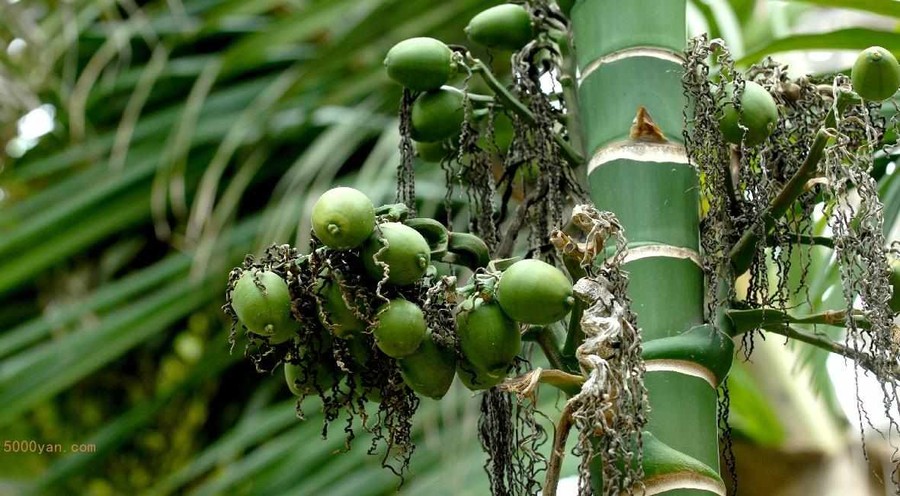
Tree, 10-18 m tall, unbranched, with distinct ring-like leaf scars after leaf fall. Leaves pinnately compound, clustered at stem apex, 1.3-2 m long, glabrous, rachis triangular; leaflets lanceolate-linear or linear, 30-70 cm long, 2.5-6 cm wide, base narrow, apical leaflets fused, irregularly divided. Inflorescence borne at base of lowest leaf, with large spathe-like bract, long-obovate, glabrous, inflorescence much-branched; flowers monoecious; male flowers small, numerous, sessile, tightly appressed to upper part of branches, usually solitary, rarely paired, sepals 3, thick and minute, petals 3, ovate-oblong, 5-6 mm long, stamens 6, filaments short, staminodes 3, filiform; female flowers larger and fewer, sessile, borne on inflorescence axis or base of branches, sepals 3, oblong-ovate, 12-15 mm long. Nut ovoid or oblong, 5-6 cm long, with persistent calyx and petals, red when ripe. Flowers twice annually, flowering March to August, winter flowers sterile; fruiting December to June of the following year.
Habitat and Distribution
It is cultivated in Hainan, Yunnan, Fujian, Taiwan, Guangdong, Guangxi, and other regions of China.
Harvesting and Processing
Harvest unripe fruit from winter to the following spring, boil and dry, split longitudinally into two halves, peel off the pericarp, commonly known as "Da Fupi (Pericarpium Arecae)"; harvest ripe fruit from late spring to early autumn, boil and dry, peel off the pericarp, loosen, sun-dry, commonly known as "Da Fumao (Fibrous Pericarp of Areca Nut)".
Medicinal Properties
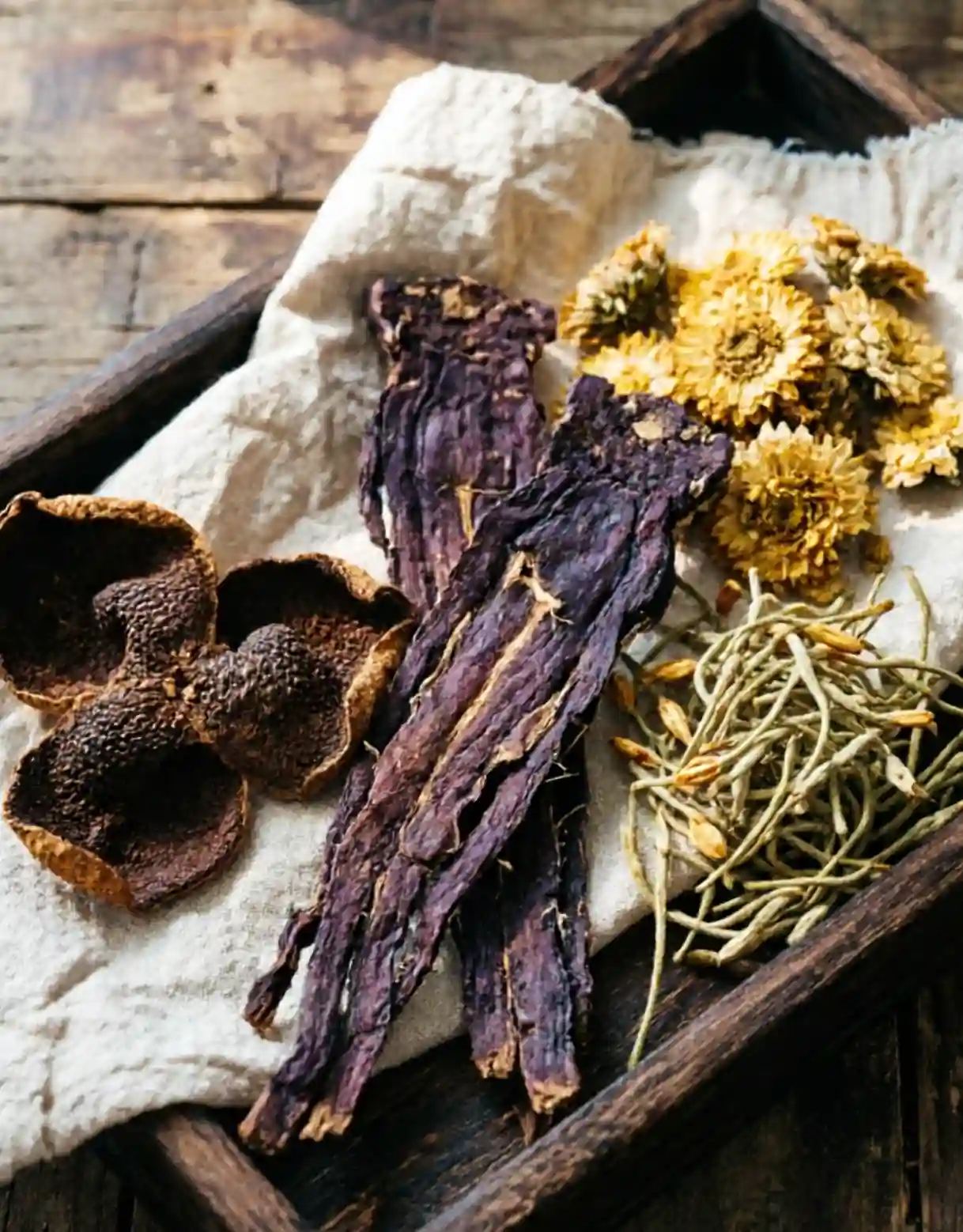
1. Arecae Pericarpium: Slightly oval or long-ovoid gourd-shaped, 4-7 cm long, 2-3.5 cm wide, 0.2-0.5 cm thick. Exocarp dark brown to nearly black, with irregular longitudinal wrinkles and raised transverse striations, apex with style remnant, base with fruit stalk and persistent calyx lobes. Endocarp concave, brown or dark brown, smooth and hard shell-like. Light in weight, hard texture, after longitudinal tearing the mesocarp fibers can be seen. Odor: faint; Taste: slightly astringent.
2. Areca peel: Slightly oval or gourd-shaped. The exocarp is mostly shed or remnants remain. The mesocarp is brownish, bristly, yellowish-white or pale brown, loose and soft in texture. The endocarp is hard and shell-like, yellowish-brown or brown, with a smooth inner surface, sometimes longitudinally cracked. Odor: faint; Taste: bland.
Chemical Constituents
This product primarily contains catechin.
Pharmacology
Promotes gastrointestinal motility.
Properties and Channel Entry
Acrid, slightly warm. Enters the Spleen, Stomach, Large Intestine, and Small Intestine channels.
Functions and Indications
Promotes the movement of Qi and relieves stuffiness in the middle burner, promotes the movement of water and reduces edema. Used for Dampness obstructing Qi stagnation, epigastric and abdominal distension and fullness, difficulty with bowel movements, edema and distension, beriberi with swelling, and difficult urination.
Dosage and Administration
Internal use: 5-10 g decocted in water; or made into pills or powder. External use: appropriate amount, decocted in water for washing; or ground into powder for topical application.
Precautions and Contraindications
Caution should be exercised when administering to individuals with weak constitution due to Qi deficiency.
Prescriptions
1. For men and women with stagnation in the Spleen and Stomach, swelling of the head, face, and upper limbs, abdominal distension and fullness, shortness of breath and rapid breathing, chest and diaphragm oppression, phlegm and saliva congestion, inability to eat, and difficulty walking with gasping resembling edema: Shengjiangpi (Fresh Ginger Peel), Sangbaipi (White Mulberry Root Bark), Chenjupi (Aged Tangerine Peel), Dafupi (Areca Peel), and Fulingpi (Poria Peel) in equal amounts. Grind into coarse powder. Take 9 g per dose with one and a half cups of water, decoct to eight-tenths, remove dregs, and take warm without regard to mealtime. Avoid raw, cold, greasy, and hard foods. (Wu Pi San from *Zhong Cang Jing*) 2. For beriberi, swollen and distended abdomen, and constipation and dysuria: Dafupi (Areca Peel) 30 g (sliced), Binglang (Areca Seed) 30 g, Muxiang (Costus Root) 15 g, Mutong (Akebia Stem) 60 g (sliced), Yuliren (Bush Cherry Seed) 30 g (soaked in boiling water, peeled, and lightly stir-fried), Sanggenbaipi (White Mulberry Root Bark) 60 g (sliced), and Qianniu (Pharbitis Seed) 60 g (lightly stir-fried). Pound and sift into a powder. Take 12 g per dose with one medium cup of water, add 0.15 g of Shengjiang (Fresh Ginger) and 27 sections of Congbai (Scallion White). Decoct to six-tenths, remove dregs. Take warm without regard to mealtime, until bowel movement occurs. (From *Sheng Hui Fang*) 3. For severe heart pain due to cold: Dafupi (Areca Peel) 15 g (sliced), Wuzhuyu (Evodia Fruit) 3 g (soaked overnight in water, dried, and stir-fried), Gaoliangjiang (Galangal Rhizome) and Shaoyao (Peony Root) each 30 g. Grind into a powder. Take 6 g per dose with warm wine; if unable to drink wine, ginger decoction may be used instead. (Dafupi San from *Pu Ji Fang*) 4. For pregnancy at eight to nine months, with a large fetus, scanty urine, lower abdominal distension, heavy body, aversion to cold, dizziness upon standing (tending to collapse), fetal Qi compressing and blocking the Bladder Qi: Chifuling (Red Poria) 9 g, Dafupi (Areca Peel), Zhiqiao (Bitter Orange, stir-fried with bran), and Gancao (Licorice, honey-fried) each 3 g. Grind into a powder. Take 3 g per dose with a strong decoction of Congbai (Scallion White). (Dafupi San from *Ji Yin Gang Mu*) 5. For foul-smelling anal fistulas and sores: decoct Dafupi (Areca Peel) in water and use to wash the affected area. (From *Zhi Zhi Fang*)