Pinyin: Mudingxiang
Aliases
Jishexiang, Tingjiong dusheng, Ci Dingxiang.
Source
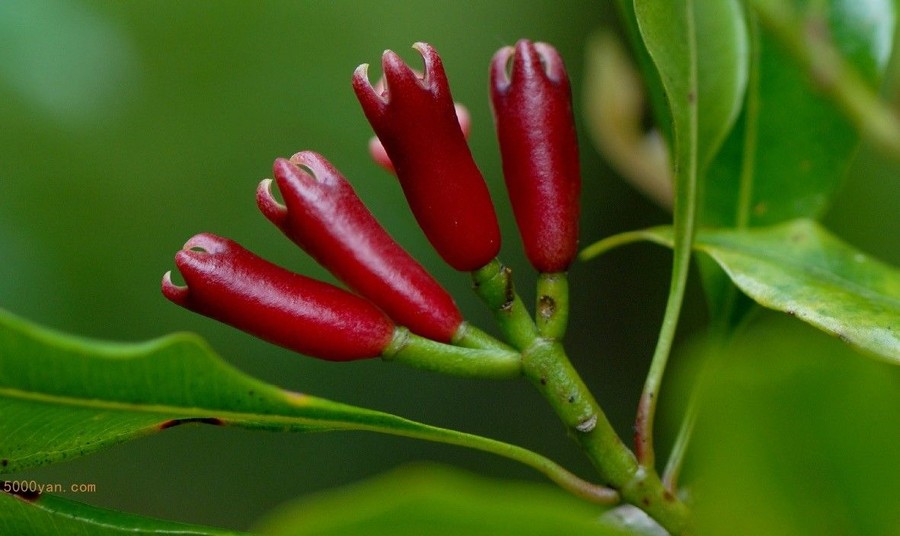
Myrticaceae family plant *Syzygium aromaticum*Eugenia caryophyllataThunb. dried nearly ripe fruit.
Botanical Description
Evergreen tree, up to 10 m tall. Leaves opposite, petiole distinct; leaf blade oblong-ovate or oblong-obovate, 5-10 cm long, 2.5-5 cm wide, apex acuminate or acute, base narrow and often decurrent into petiole, margin entire. Flowers fragrant, forming terminal thyrses; calyx fleshy, green turning purple, long tubular, apex 4-lobed, lobes triangular; corolla white, slightly tinged with purple, short tubular, 4-lobed; stamens numerous, anthers dehiscing longitudinally; ovary inferior, adnate to calyx tube, style thick, stigma inconspicuous. Berry reddish-brown, oblong-elliptic, 1-1.5 cm long, 5-8 mm in diameter, apex with persistent calyx lobes, seeds rectangular.
Habitat and Distribution
Cultivated in Guangdong, Hainan, Guangxi, Yunnan, and other regions of China; native to the Malay Archipelago and Africa.
Harvesting and Processing
Harvest when the fruit is about to ripen, then dry in the sun.
Medicinal Properties
The product is ovoid or oblong-ovoid in shape, 1.5-3 cm long and 0.5-1 cm in diameter. The surface is yellowish-brown or brownish-brown with fine wrinkles; the apex has four persistent sepals that curve inward into a hook shape; the base has a fruit stalk scar; the pericarp and seed kernel can be separated. The seed kernel is composed of two cotyledons clasped together, brown or dark brown, oily, with a distinct longitudinal groove in the center; inside is an embryo, slender and rod-shaped. The texture is relatively hard and difficult to break. Odor: aromatic; Taste: numbing and spicy.
Chemical Constituents
This product contains eugenol, caryophyllene, aristolene, longipinocarvone, piperine, and other constituents.
Pharmacology
Promotes gastric juice secretion, protects the gastric mucosa, stops diarrhea, and benefits bile flow; has analgesic effects, anti-hypoxia, anticoagulant, anti-mutation, antibacterial, and insecticidal properties, among others.
Properties and Channel Entry
Acrid, warm. Enters the Spleen, Stomach, Lung, and Kidney channels.
Functions and Indications
Warms the Middle Warmer, descends rebellious Qi, tonifies the Kidneys and assists Yang
Dosage and Administration
Internal: decoct in water for oral administration, 1-3 g; or grind into powder. External: appropriate amount, grind into powder for topical application or use as suppository.
Precautions and Contraindications
It should not be used together with Yujin (Curcuma Root). It is contraindicated in Heat syndromes and internal Heat due to Yin Deficiency.
Prescriptions
1. For sudden heart pain due to Qi stagnation: powdered clove (*Caryophylli Flos*) 3 g, taken with wine. (From *Zhou Hou Fang*). 2. For cold stomach with nausea and vomiting, and qi reversal with obstruction: clove (crushed) 3 pieces, dried tangerine peel (soaked in water to remove white pith, then baked) 1 piece. Decoct the two ingredients in one cup of water until half a cup remains, remove the dregs, and take while warm. (From *Sheng Ji Zong Lu*). 3. For infantile malnutrition due to cold, with yellow complexion, distended abdomen, and vomiting after eating: clove 7 pieces, ground into powder, mixed with breast milk and steamed twice, then taken with ginger decoction. (From *Wei Sheng Yi Jian Fang*). 4. For dental caries: decoct clove in water and use as a mouthwash. (From *Wai Tai* citing *Yao Seng Tan Ji Yan Fang*). 5. For sudden sores on lips or tongue: burn clove to ash, wrap in cotton, and apply to the affected area until healed. (From *Wai Tai*).