Pinyin: Shidi
Aliases
Shiqian, Shiding, Shiziba, Shie
Source
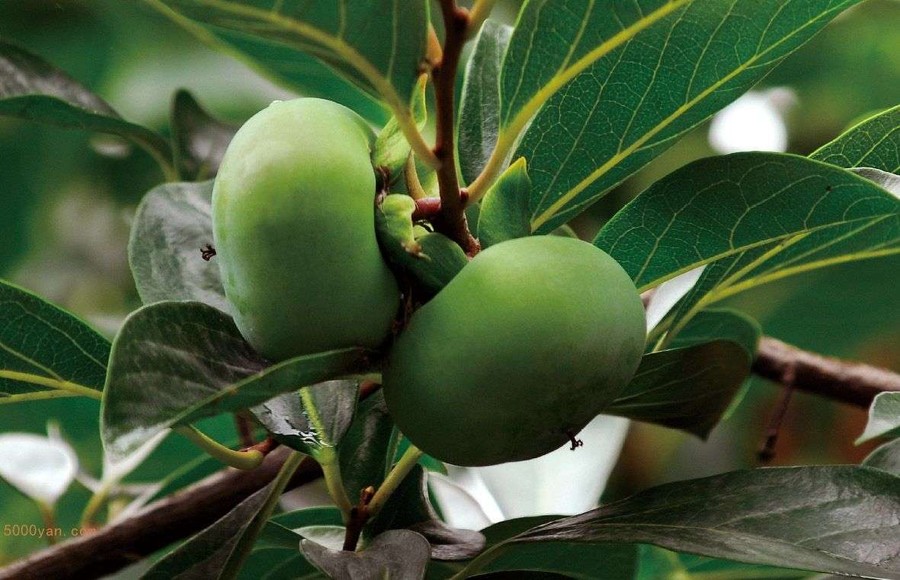
Ebenaceae plant Diospyros kakiDiospyroskakiDried persistent calyx of *Thunb*.
Botanical Description
Deciduous large tree, up to 14 m tall. Bark dark gray to gray-black, cracking into rectangular plates; branches spreading, with deep brown lenticels, young branches pubescent. Leaves simple, alternate; petiole 8-20 mm long; leaf blade ovate-elliptic to obovate or suborbicular, 5-18 cm long, 2.8-9 cm wide, apex acuminate or obtuse, base broadly cuneate, margin entire, dark green above, with pubescent midvein, pale green below, shortly pubescent, densely brown-tomentose along veins. Flowers polygamous; male flowers in cymes, female flowers solitary in leaf axils; peduncle about 5 mm long, with minute bracts; calyx lower part short-tubular, 4-lobed, hairy inside; corolla yellowish-white, campanulate, 4-lobed; stamens 16 in male flowers, 8-16 in bisexual flowers, female flowers with 8 staminodes; ovary superior, 8-locular, style free from base. Berry mostly ovoid-globose, 3.5-8 cm in diameter, orange-yellow or bright yellow, with persistent calyx at base. Seeds brown, elliptic. Flowering in May, fruiting in September-October.
Habitat and Distribution
Mostly cultivated species. Distributed in East China, Central South China, and Liaoning, Hebei, Shanxi, Shaanxi, Gansu, and Taiwan.
Harvesting and Processing
Harvest in winter when the fruit is ripe, collect during consumption, wash clean, and sun-dry.
Medicinal Properties
Calyx persistent, nearly disc-shaped, apex 4-lobed, lobes broadly triangular, mostly reflexed outward or broken and incomplete, with longitudinal veins; calyx tube thickened, flattened, nearly square, 1.5-2.5 cm in diameter, surface reddish-brown, sparsely covered with short hairs, center with a short fruit stalk or a circular sunken fruit stalk scar; inner surface yellowish-brown, densely covered with rust-colored short pubescence, radially arranged and lustrous, center with a circular raised scar after fruit detachment. Lobes brittle, easily broken, calyx tube hard and woody. Texture light, odor faint, taste astringent.
Chemical Constituents
This product contains oleanolic acid, betulinic acid, 24-hydroxyoleanolic acid, hyperoside, quercetin, kaempferol, friedelin, gallic acid, and trifolin among other constituents.
Pharmacology
Antiarrhythmic; sedative; antifertility.
Properties and Channel Entry
Bitter, astringent, and neutral. Enters the Stomach channel.
Functions and Indications
Descends counterflow and stops hiccups. Used for hiccups.
Dosage and Administration
Internal use: decoct in water, 5-10 g; or used in powder form. External use: appropriate amount, ground into powder for sprinkling.
Prescriptions
1. For persistent hiccups: Shidi (Persimmon Calyx), burned to ash while retaining its properties and ground into powder. Take with Huangjiu (yellow wine), or mix equal parts ginger juice and sugar, heat gently, and take slowly. (From *Cunju Jijiufang*) 2. For hiccups: Shiqian (Persimmon Calyx), Dingxiang (Clove), and Renshen (Ginseng), equal parts. Grind into fine powder, decoct in water, and take after meals. (From *Jiegu Zhenjia* - Shiqian San) 3. For chest fullness and incessant cough with hiccups: Shidi (Persimmon Calyx) and Dingxiang (Clove), 30 g each. Finely slice. Each dose: 12 g, decoct with 1.5 cups of water and 5 slices of ginger until reduced to 7/10, remove residue, and take warm, regardless of mealtime. (From *Jisheng Fang* - Shidi Tang) 4. For cold damage with cough, hiccups, and sweating: Shidi (Persimmon Calyx) and Dingxiang (Clove), 3 g each; Gancao (Licorice, roasted) and Liangjiang (Galangal), 1.5 g each. Grind into powder. Take 6 g with hot water while still warm, regardless of mealtime. (From *Zhong Cang Jing* - Dingxiang San)