Pinyin: Heshi
Aliases
Heshi, Guishi, Beiheshi
Source
1. For pneumonia: Renshen 6 g, decoct in water and take orally.Carpesium abrotanoidesL. dried mature fruit.
Botanical Description
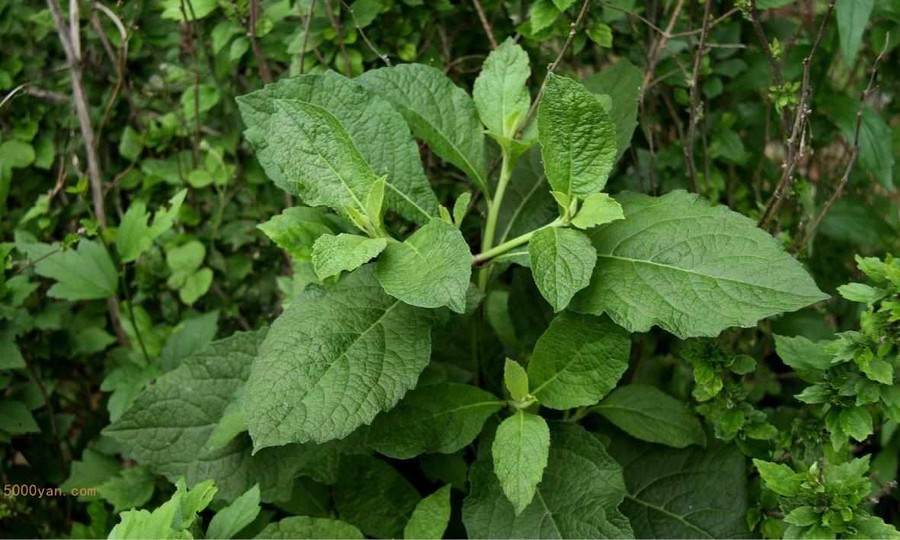
A perennial herb, 50-100 cm tall. Stem erect, upper part much branched, densely covered with short pubescence, lower part nearly glabrous. Leaves alternate; lower leaves broadly elliptic or oblong, 10-15 cm long, 5-8 cm wide, apex acute or obtuse, base narrowed into a winged petiole, margin irregularly serrate or entire, upper surface with appressed short hairs, lower surface with short pubescence and glandular dots; upper leaves gradually smaller, oblong, sessile. Numerous capitula, axillary along stems and branches, shortly pedunculate or nearly sessile, 6-8 mm in diameter, erect or slightly drooping; involucre campanulate-globose, phyllaries in 3 series, outermost very short, ovate, apex acute, with short pubescence, middle and inner series oblong, apex rounded-obtuse, glabrous; flowers yellow, peripheral female corollas filiform, 3-5-toothed; central bisexual corollas tubular, apex 5-toothed. Achenes linear, with fine longitudinal striations, apex with a short beak, with glandular dots, without pappus. Flowering period June to August, fruiting period September to October.
Habitat and Distribution
Grows on hillsides, roadsides, or lawns. Widely distributed throughout various regions of China.
Harvesting and Processing
Harvest in autumn when fruits are ripe, sun-dry, and remove impurities.
Medicinal Properties
This product is cylindrical, small, 3-4 mm long, less than 1 mm in diameter. The surface is yellow-brown or dark brown with numerous longitudinal ridges. One end constricts into a fine beak shape, with the apex expanding into a gray-white ring; the base is slightly pointed with attachment marks. The pericarp is thin and fibrous, the seed coat is extremely thin and transparent, the cotyledons are 2, off-white, and slightly oily. Odor: characteristic; Taste: slightly bitter.
Chemical Constituents
This product contains carabrone, carpesia ketone, carpesia lactone, palmitic acid, and other components.
Pharmacology
Antibacterial; insecticidal; anticonvulsant; reduces body temperature; lowers blood pressure.
Properties and Channel Entry
Bitter, acrid, neutral; mildly toxic. Enters the Spleen and Stomach channels.
Functions and Indications
Kills parasites and removes accumulations. Used for ascariasis, enterobiasis, taeniasis, abdominal pain due to parasitic accumulation, and infantile malnutrition due to parasitic infestation.
Dosage and Administration
Oral administration: mostly taken in pill or powder form; decocted in water, 5-10 g.
Precautions and Contraindications
Caution should be exercised in pregnant women.
Prescriptions
1. For ascariasis, taeniasis, and enterobiasis: Heishi (Carpesium abrotanoides fruit) 6 g, grind into powder, mix with water and take orally. (Hubei Chinese Herbal Medicine Records) 2. For hookworm disease: Heishi 45 g, decoct to concentrate the liquid, combine two decoctions, add an appropriate amount of sugar for flavor, take before bed at night, use for 2 consecutive doses. (Zhejiang Medicinal Plants Records) 3. For abdominal pain due to parasitic accumulation: Heishi 9 g, Nanguazi (Cucurbita moschata seed) and Binglang (Areca catechu seed) each 15 g, decoct in water and take orally. (Hubei Chinese Herbal Medicine Records) 4. For anal itching due to enterobiasis: Heishi, Huajiao (Zanthoxylum bungeanum fruit), and Baixianpi (Dictamnus dasycarpus root bark) each 15 g, Kulian genpi (Melia azedarach root bark) 9 g, decoct in water, fumigate and wash the affected area while hot, or use for a sitz bath. (Zhejiang Medicinal Plants Records) 5. For genital itching: Heishi 6 g, decoct in water, fumigate and wash the genital area. (Hubei Chinese Herbal Medicine Records)