Pinyin: Shijunzi
Aliases
Liuqiuzi, Wulengzi, Shanyangshi, Dongjunzi.
Source
1QuisqualisindicaL. dried mature fruit.
Botanical Description
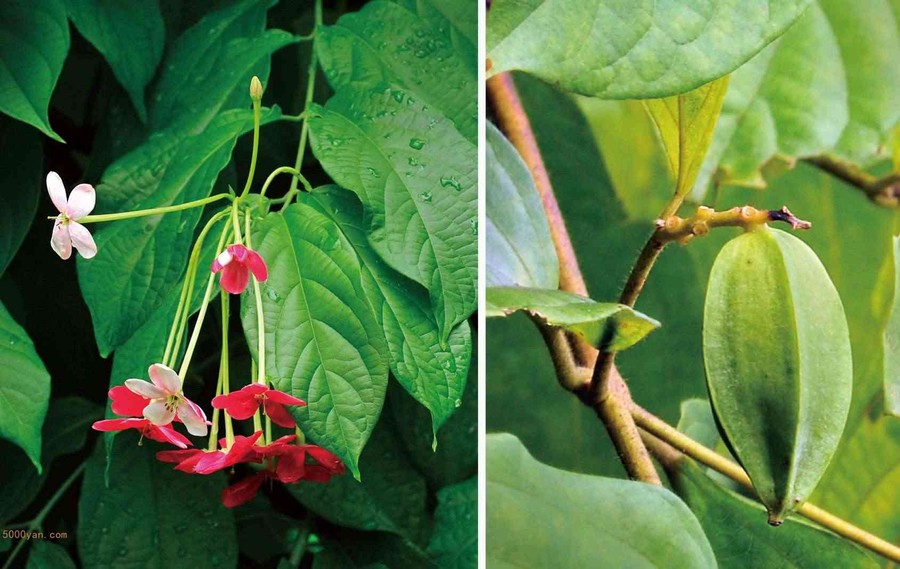
Deciduous climbing shrub, 2-8 m tall. Young branches covered with brownish-yellow short pubescence. Leaves opposite or subopposite; petiole without joints, persistent after leaf fall; leaf blade membranous, ovate or elliptical, 5-11 cm long, 2.5-5.5 cm wide. Apex shortly acuminate, base obtuse-rounded, glabrous on the surface, sometimes sparsely covered with brown pubescence on the underside. Terminal spicate inflorescences forming corymbose inflorescences; flowers bisexual; bracts ovate to linear-lanceolate, hairy; calyx tube covered with yellow pubescence, apex with 5 widely spreading, recurved, small calyx teeth; petals 5, 1.8-2.4 cm long, 4-10 mm wide, apex obtuse-rounded, initially white, later turning pale red; stamens 10, in 2 whorls, not exserted beyond the corolla, anthers about 1.5 mm long; ovary inferior. Fruit ovoid, shortly pointed, 2.7-4 cm long, glabrous, with 5 distinct sharp ridges, exocarp thin and brittle when mature, greenish-black or chestnut-colored. Seed 1, white, cylindrical-fusiform, 2.5 cm long. Flowering period May-September, fruiting period late autumn.
Habitat and Distribution
Born in sunny thickets on flatlands, hillsides, and roadsides, also cultivated, distributed in southwestern China and in Jiangxi, Fujian, Taiwan, Hunan, Guangdong, and Guangxi.
Harvesting and Processing
Harvest when the fruit peel turns purplish-black in autumn, remove impurities, and dry.
Medicinal Properties
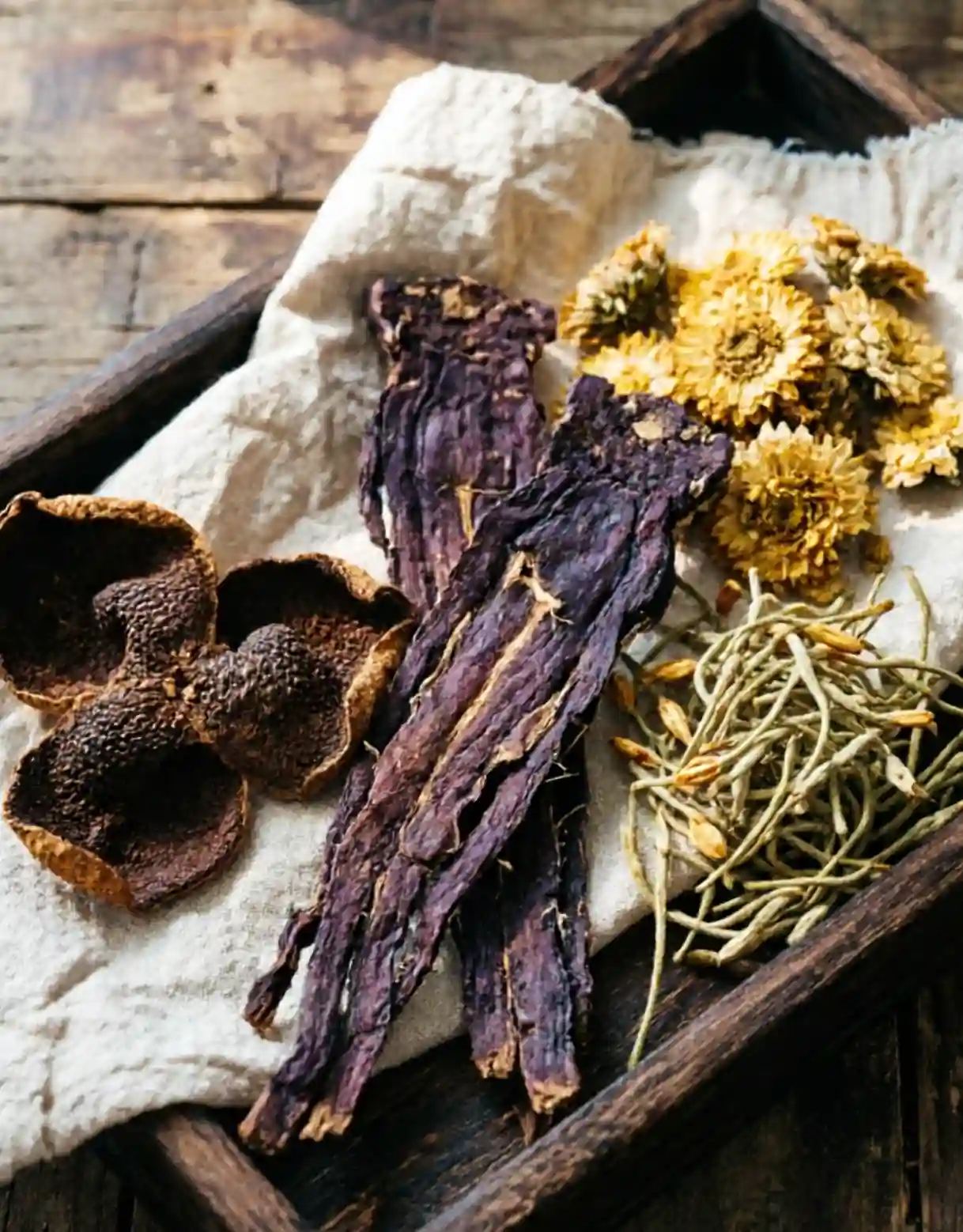
This product is oval or ovate in shape, with 5 longitudinal ridges, occasionally 4-9 ridges, 2.5-4 cm long and about 2 cm in diameter. The surface is dark brown to purple-black, smooth, and slightly lustrous. The apex is narrowly pointed, the base is bluntly rounded, and there is a distinct circular fruit stalk scar. The texture is hard; the cross-section is mostly pentagram-shaped, with thicker shell at the ridges and a nearly circular cavity in the center. The seeds are oblong or fusiform, about 2 cm long and about 1 cm in diameter; the surface is brown or dark brown with numerous longitudinal wrinkles; the seed coat is thin and easily peeled; the cotyledons are 2, yellowish-white, oily, and the section shows fissures. The odor is faintly aromatic, and the taste is slightly sweet.
Chemical Constituents
This product contains trigonelline, betulinic acid, stearic acid, oleic acid, mannitol, quisqualic acid, gallic acid, and other components.
Pharmacology
Repels parasites and resists skin fungi. Has mild toxicity and may cause hiccups, vomiting, or diarrhea.
Properties and Channel Entry
Sweet, warm. Enters the Spleen and Stomach channels.
Functions and Indications
Kills parasites and eliminates accumulation. Used for ascariasis, enterobiasis, abdominal pain due to parasitic accumulation, and infantile malnutrition due to parasitic infestation.
Dosage and Administration
Internal: decoct 6-15 g, crush before decoction; or made into pills or powder; shelled and stir-fried until fragrant for chewing, children 1-1.5 pills per year of age daily, total not exceeding 20 pills.
Precautions and Contraindications
Taking excessive doses or consuming together with hot tea may cause reactions such as hiccups, dizziness, and vomiting.
Prescriptions
1. For adults and children with intestinal parasites: Shijunzi (Quisqualis indica, shell removed) 3 g, Binglang (Areca catechu) 3 g, Xionghuang (Realgar) 1.5 g. Grind the above into powder. Adults take 3 g per dose, taken with a decoction of Kulianpi (Melia toosendan root bark). (From *Gujin Yijian* - Xia Chong San) 2. For pediatric abdominal masses, abdominal distension, muscle wasting, sallow complexion, gradually developing into malnutrition: Shijunzi kernel 9 g, Mubiezi (Momordica cochinchinensis) kernel 15 g. Grind into powder, form into pills with water, each the size of a Longan fruit. Take one pill, place it into an egg after opening the top, steam on rice until cooked, and eat on an empty stomach. (From *Jianbian Danfang*) 3. For pediatric deficiency edema with swelling of the head, face, and scrotum: Shijunzi (shell removed) 30 g, grind into powder. Take 3 g with rice soup after each meal. (From *Jianbian Fang*) 4. For chronic head sores that do not heal: Burn Shijunzi until charred, then grind into a fine powder, mix with raw oil and apply topically. (From *Sheng Hui Fang*) 5. For dental pain due to worms: Decoct Shijunzi in water and use the decoction to rinse the mouth frequently. (From *Binhu Ji Jian Fang*)