Pinyin: Yuzhizi
Aliases
Yanfuzi, Bayuezha, Yajingzi, Lalaguo.
Source
1. For pneumonia: Renshen 6 g, decoct in water and take orally. 2. For deficiency of Qi and Blood: Renshen 10 g, Danggui 10 g, decoct in water and take orally. 3. Internal use: decoct 3-10 g.Akebiaquinata(Thunb.) Decne, SanyemutongAkebia trifoliata(Thunb.) Koidz. or Baumu TongAkebia trifoliata(Thunb.) Koidz. var.austalisThe dried nearly mature fruit of (Diels) Rehd.
Botanical Description
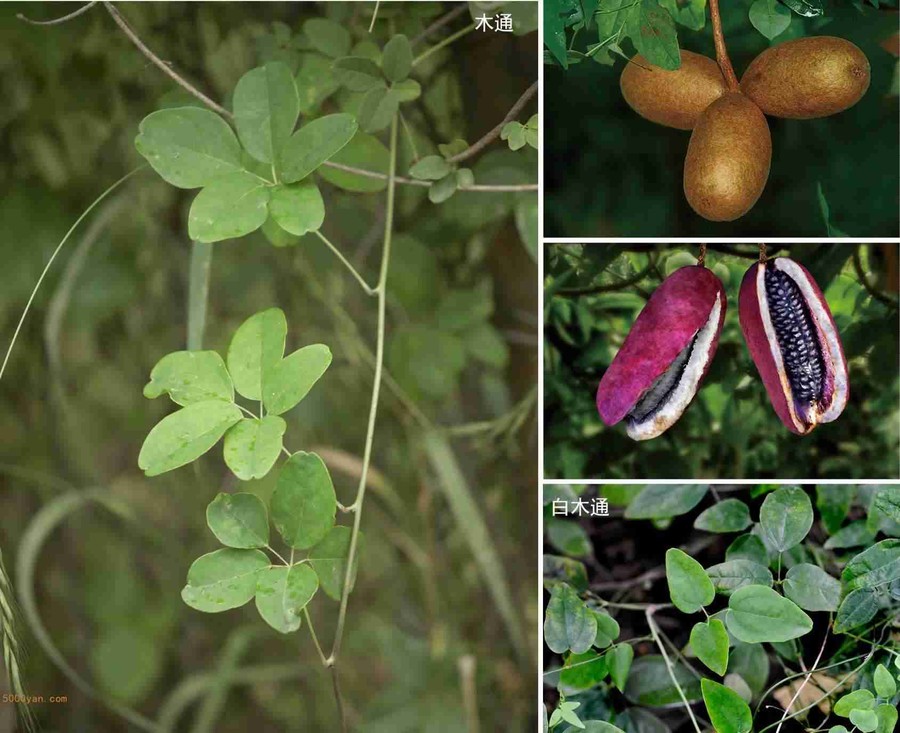
1. Mutong: Deciduous woody twining vine, 3-15 cm long. The entire plant is glabrous (hairless). Young branches are gray-green with longitudinal striations. Palmately compound leaves, clustered at the apex of short branchlets; petioles slender; leaflets 5, obovate or elliptic, 3-6 cm long, apex rounded often slightly emarginate with a fine short tip, base rounded or cuneate, entire margin. Short racemes axillary, flowers unisexual. Monoecious; the base of the inflorescence bears 1-2 female flowers, the upper part bears dense and more slender male flowers; perianth segments 3; male flowers with 6 stamens; female flowers larger than male flowers, with 2-13 separate carpels. Fruit fleshy, berry-like, long-elliptic or slightly reniform, both ends rounded, about 8 cm long, diameter 2-3 cm, purple when ripe, soft, dehiscing along the ventral suture. Seeds numerous, long-ovoid and slightly flattened, black or blackish-brown. Flowering period April to May, fruit ripening period August. 2. San Ye Mu Tong (Three-leaf Akebia): Similar to the previous species. The main difference is that the leaves are trifoliolate compound; leaflets ovate, broadly ovate, or long-ovate, with great variation in length and width, apex obtuse-rounded, slightly emarginate or with a short tip, base rounded or cuneate, sometimes slightly cordate, margin shallowly lobed or undulate, lateral veins 5-6 pairs. 3. Bai Mu Tong (White Akebia): This variety is similar in morphology to San Ye Mu Tong, but the leaflets are entire and thicker in texture.
Habitat and Distribution
1. Mutong grows on slopes, ravines, and streamsides in forests of trees and shrubs, distributed in Shaanxi, Shandong, Jiangsu, Anhui, Jiangxi, Henan, Hubei, Hunan, Guangdong, Sichuan, Guizhou, and other areas. 2. Sanyemutong is distributed in Hebei, Shanxi, Shaanxi, Gansu, Shandong, Henan, and throughout the Yangtze River basin. 3. Baimutong is distributed in the southwest and in Shanxi, Shaanxi, Jiangsu, Zhejiang, Jiangxi, Henan, Hubei, Hunan, Guangdong, and other areas.
Harvesting and Processing
Harvest in summer and autumn when the fruit is greenish-yellow, dry in the sun, or scald briefly in boiling water before drying in the sun.
Medicinal Properties
1. *Akebia quinata* (Mutong): Fruit reniform or long-elliptic, slightly curved, 3-9 cm long, 1.5-3.5 cm in diameter; surface yellowish-brown, with irregular longitudinal reticulate wrinkles, apex obtuse-rounded, base with fruit stalk scar; texture hard and heavy, fruit pulp white, powdery; seeds numerous, slightly triangular, purplish-red, surface slightly flat. Odor: faintly aromatic; Taste: bitter. 2. *Akebia trifoliata* (Sanye Mutong): Fruit long-elliptic or slightly reniform, 3-8 cm long, 2-3 cm in diameter; surface light grayish-brown or yellowish-brown, with irregular longitudinal reticulate wrinkles, finer in immature specimens, apex obtuse-rounded, occasionally with circular stigma remnant, base with round, slightly concave fruit stalk scar; fruit peel leathery, relatively thick. Transverse section light grayish-yellow, containing numerous seeds embedded in grayish-white fruit pulp; pulp odor faintly aromatic, taste slightly astringent. Seeds long-ovate or irregularly triangular, slightly flattened, about 5 mm wide, about 2 mm thick; surface reddish-brown or deep reddish-brown, glossy, densely covered with fine reticulate wrinkles, apex slightly pointed, base obtuse-rounded, hilum slightly off-center, adjacent to a white aril; seed coat thin, oily; embryo small, about 1 mm long, located near the base; odor weak, taste bitter, oily sensation. 3. *Akebia trifoliata* var. *australis* (Bai Mutong): Fruit ovoid or ellipsoid, about 8 cm long, 3-3.5 cm in diameter; surface slightly brownish, smooth or with coarse longitudinal reticulate wrinkles, often with small cracks. Commercial products are sometimes cut into longitudinal slices; fruit peel slightly smooth, slightly concave inward; fruit pulp earthy gray, woody; seeds triangular, purplish-red, surface with dense fine longitudinal striations. Odor: faintly aromatic; Taste: bitter.
Chemical Constituents
This product contains oleanolic acid, akebia saponin stc, and other constituents.
Properties and Channel Entry
Bitter, cold. Enters the Liver, Gallbladder, Stomach, and Bladder channels.
Functions and Indications
Soothing the Liver and regulating Qi, activating Blood and alleviating pain, dispersing masses, and promoting urination. Used for epigastric and hypochondriac distension and pain, dysmenorrhea and amenorrhea, phlegm nodules and masses, and difficult urination.
Dosage and Administration
Oral: decoct in water, 9-15 g; for large doses, 30-60 g; or steep in wine.
Precautions and Contraindications
Caution should be exercised in pregnant women.
Prescriptions
1. For cold-induced abdominal pain and hernia pain: Yuzhizi 30 g, Xiaohuixiang 12 g, decoct in water and take orally. (1979 *Sichuan Traditional Chinese Medicine Records*) 2. For ureteral stones: Yuzhizi combined with Yimiren, 60 g each, decoct and take orally. (*Traditional Chinese Medicine Records*) 3. For lymphatic tuberculosis: Yuzhizi, Jinyingzi, and Haijinshagen 120 g each, Tiankuizi 240 g, decoct in water and take over 3 days. (Suzhou Medical College *Chinese Herbal Medicine Manual*) 4. For liver cancer: Yuzhizi, Shiyan, and Mabiancao 30 g each, decoct in water and take orally. (*Common Anticancer Drug Manual*)