Pinyin: Yiyiren
Aliases
Yizhuzi, Huihui Mi, Yimi, Yiren
Source
1. For pneumonia: Yiyi (Coix seed) 6 g, decoct in water and take orally. 2. For warts: Yiyi (Coix seed) 10-15 g, decoct in water and take orally. Internal use: decoct 3-10 g, large dose 10-30 g.Coixlacryma-jobiL.var.mayuenDried mature seed kernel of (Roman) stapf.
Botanical Description
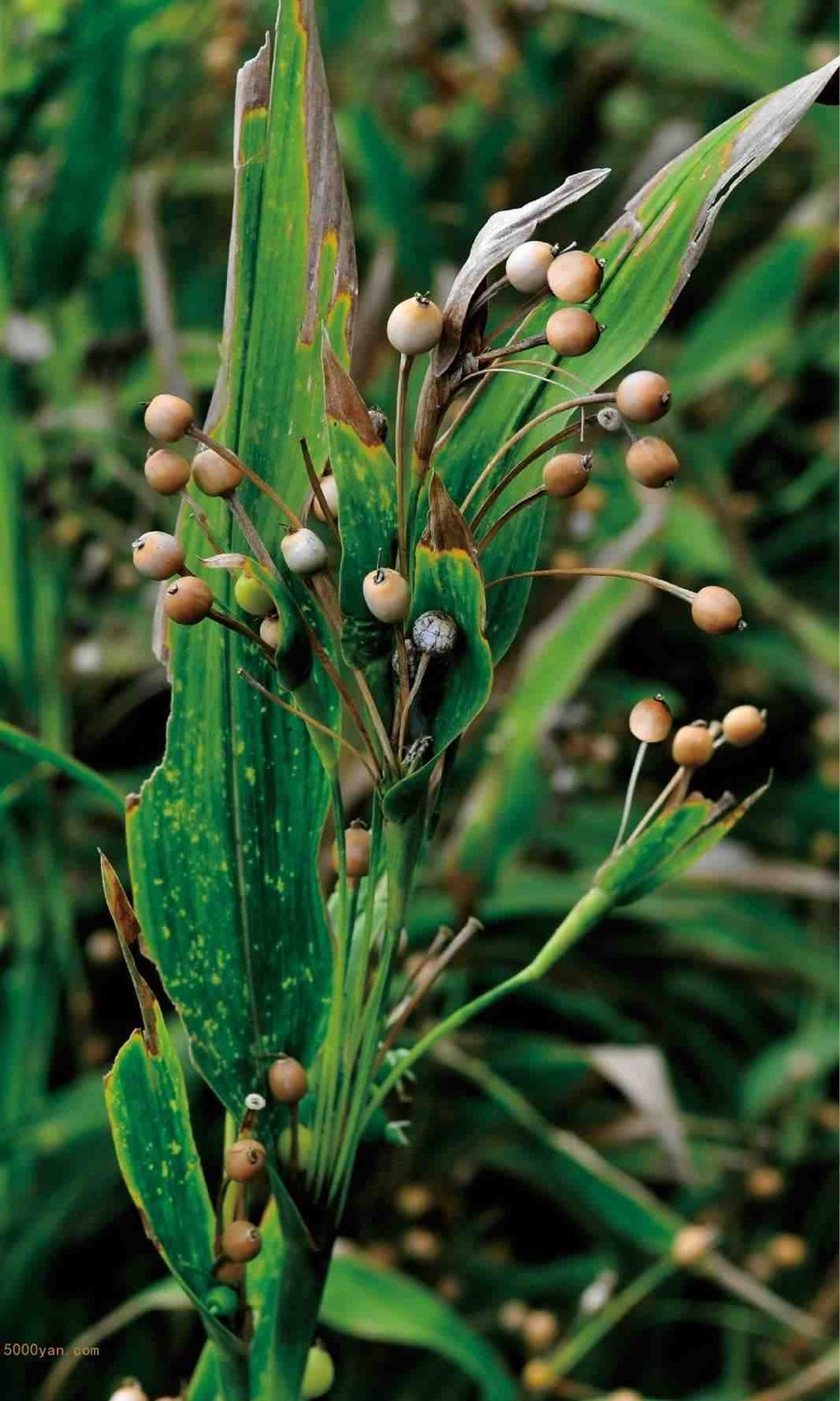
Annual or perennial herb, 1-1.5 m tall. Fibrous roots relatively thick, up to 3 mm in diameter. Culms erect, with approximately 10 nodes. Leaves linear-lanceolate, up to 30 cm long, 1.5-3 cm wide, margins rough, midrib thick and prominent on the abaxial surface; leaf sheaths glabrous, upper ones shorter than internodes; ligule hard, about 1 mm long. Racemes axillary, clustered; female spikelets located at the lower part of the inflorescence, each enclosed by a bony, bead-like involucre about as long as the spikelet; fertile spikelet: first glume membranous below, thickly papery above, apex obtuse; second glume boat-shaped, enclosed within the first glume; second lemma shorter than the first lemma; palea similar to lemma but smaller; stamens 3, reduced; pistil with a long style; sterile spikelets reduced to tubular glumes; male spikelets usually 2-3 on the first node; sessile spikelet: first glume flat, with infolded keels bearing wings of unequal width; second glume boat-shaped; lemma and palea both membranous; stamens 3; pedicellate spikelet similar to sessile spikelet. Caryopsis enclosed in a hard involucre, ovoid or ovoid-globose. Flowering July to September, fruiting September to October.
Habitat and Distribution
It grows beside houses, in wilderness areas, along riverbanks, streams, or in damp, shaded valleys. It is distributed throughout most regions of China and is generally cultivated.
Harvesting and Processing
During autumn when the fruits are mature, harvest the plants, dry them in the sun, beat out the fruits, dry them again in the sun, remove the shells, yellowish-brown seed coats, and impurities, and collect the kernels.
Medicinal Properties
This product is broadly ovoid or oblong-elliptical in shape, 4-8 mm long and 3-6 mm wide. The surface is milky white, smooth, occasionally with remnants of yellowish-brown seed coat. One end is bluntly rounded, the other end is broader and slightly concave, with a light brown dot-like hilum. The dorsal side is rounded and convex, while the ventral side has a broader and deeper longitudinal groove. The texture is firm, the cross-section is white and starchy. Odor: faint; Taste: slightly sweet.
Chemical Constituents
This product contains coixol (coixenolide), palmitic acid, linoleic acid, coixan A, coixan B, coixan C, and other components.
Pharmacology
Anti-tumor; inhibits skeletal muscle contraction; analgesic; antipyretic; anti-inflammatory; at small doses stimulates the respiratory center, at large doses inhibits the respiratory center; enhances humoral immunity; lowers blood glucose; promotes ovulation; inhibits trypsin, etc.
Properties and Channel Entry
Sweet and bland, cool. Enters the Spleen, Stomach, and Lung channels.
Functions and Indications
Promotes urination and drains Dampness, strengthens the Spleen and stops diarrhea, alleviates Bi (painful obstruction) syndrome, expels pus, and resolves toxicity and dissipates masses. Used for edema, beriberi (jiaoqi), difficult urination, diarrhea due to Spleen deficiency, Dampness-Bi with muscle spasms and contractures, Lung abscess (feiyong), Intestinal abscess (changyong), verruca (warts), and cancerous swellings.
Dosage and Administration
Oral: Decoction, 10-30 g; or made into pills, powder, steeped in wine, cooked in porridge, or made into soup. To strengthen the Spleen and benefit the Stomach, use stir-fried; for promoting urination and draining Dampness, clearing Heat and expelling pus, relaxing tendons and relieving arthralgia, use raw.
Precautions and Contraindications
This product is mild in nature, so it is suitable for long-term and frequent use. Caution is advised in cases of Spleen deficiency without Dampness, dry and bound stools, and during pregnancy.
Prescriptions
1. For nasal sores: Use Yiyiren (Coix seed) and Donggua (wax gourd), decoct in water and drink as tea. (From *Guren Jiyan Fang*) 2. For breast cancer: Yanhusuo (Corydalis tuber) and Yiyiren (Coix seed) 15 g each. Two cups of yellow wine, decoct to one cup. Take on an empty stomach; sweating indicates efficacy. (From *Waike Dacheng*, Ru'ai Formula) 3. For papular urticaria: Yiyiren (Coix seed) 50 g, Chixiaodou (Adzuki bean) 50 g, Dazao (jujube) 15 pieces, Hongtang (brown sugar) 30 g. One dose daily, decoct in water and take orally. Three consecutive doses constitute one course of treatment. [From *Guangzhou College of Traditional Chinese Medicine Journal*, 1986, 3(1): 16, Yiren Chixiaodou Decoction]