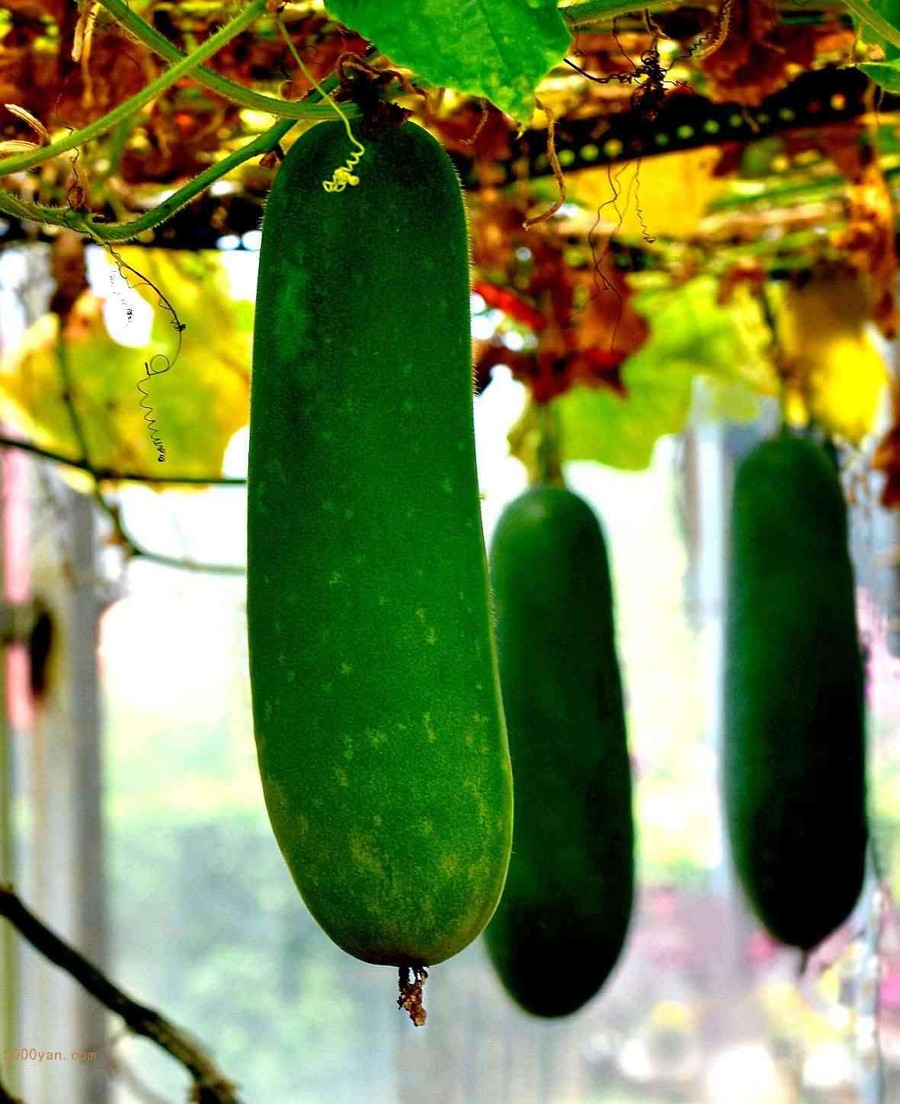
Pinyin: Dongguapi
Aliases
Baiguapi, Baidongguapi.
Source
Cucurbitaceae plant Donggua (wax gourd).Benincasa hispidaThe dried outer pericarp of (Thunb.) Cogn.
Botanical Description
An annual herbaceous vine or climbing plant. The stem is covered with yellow-brown stiff hairs and long soft hairs, with angular grooves, approximately 6 m long. Leaves are simple and alternate; petioles are stout, 5-20 cm long, covered with yellow-brown stiff hairs and long soft hairs; leaf blades are kidney-shaped to nearly round, 15-30 cm wide, with 5-7 shallow or sometimes medium lobes, lobes broadly ovate, apex acute, margin with small teeth, base deeply cordate, both surfaces covered with coarse hairs, veins reticulate, slightly raised on the abaxial side and densely hairy. Tendrils arise from leaf axils, 2-3 branched, covered with coarse stiff hairs and long soft hairs. Flowers are unisexual, monoecious; flowers solitary in leaf axils, pedicels with stiff hairs; calyx tubular, lobes triangular-ovate, margin serrate, reflexed; corolla yellow, 5-lobed to the base, spreading; male flowers have 3 stamens, filaments free, anthers ovate, thecae S-shaped curved; female flowers have an ovary oblong-cylindrical to long-ovoid, densely covered with yellow-brown long stiff hairs, stigmas 3, slightly twisted. The fruit is a large pepo, fleshy, long-cylindrical to nearly spherical, 25-60 cm long, 10-25 cm in diameter, surface with stiff hairs and a waxy white bloom. Seeds numerous, ovate, white or pale yellow, compressed. Flowering period May to June, fruiting period June to August.
Habitat and Distribution
Cultivated throughout various regions in China.
Harvesting and Processing
When eating winter melon, wash it, peel off the outer layer of the pericarp, and sun-dry.
Medicinal Properties
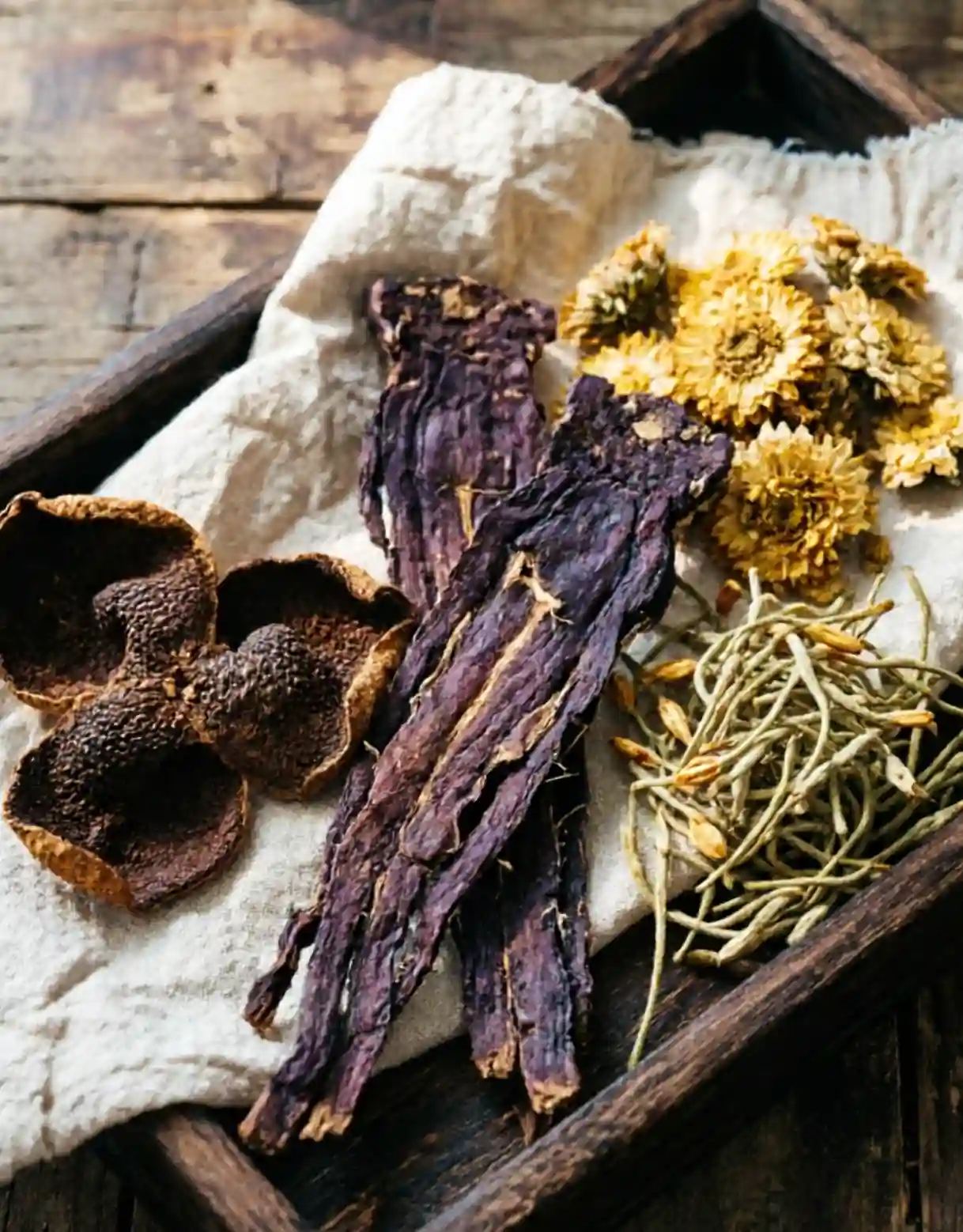
This product consists of irregular fragments, often curled inward, varying in size. The outer surface is grayish-green or yellowish-white, covered with white frost, while some are relatively smooth without white frost; the inner surface is relatively rough, and some show striated vascular bundles. Light in weight, brittle texture. Odor: faint; Taste: bland.
Chemical Constituents
This product contains E-2-hexenal, n-hexenal, n-hexyl formate, 2,5-dimethylpyrazine, 2-methylpyrazine, isopolyfloral trienyl hexanoate, carotene, and other components.
Pharmacology
Diuretic.
Properties and Channel Entry
Sweet, cool. Enters the Spleen and Small Intestine channels.
Functions and Indications
Diuretic and reduces edema. Used for edema and abdominal distension, difficult urination, summer heat with thirst, and scanty dark urine.
Dosage and Administration
Internal use: decoct in water, 15-30 g; external use: appropriate amount, decoct in water for washing.
Precautions and Contraindications
Use with caution in cases of deficiency edema caused by malnutrition.
Prescriptions
1. For edema: Dongguapi (wax gourd peel) 30 g, Wujiapi (Acanthopanax root bark) 9 g, Jiangpi (ginger peel) 12 g. Decoct in water and take orally. (Hunan Materia Medica) 2. For nephritis, dysuria, and generalized edema: Dongguapi 20 g, Xiguapi (watermelon peel) 20 g, Baimaogen (Imperata rhizome) 20 g, Yushushurui (corn silk) 15 g, Chidou (red bean) 100 g. Decoct in water and take in 3 divided doses daily. (Modern Practical Chinese Materia Medica) 3. For edema due to deficiency: Dongguapi 30 g, Duchidou (red bean) 60 g, brown sugar to taste. Cook until tender, eat the beans and drink the soup. (Zhejiang Medicinal Flora) 4. For cough: Dongguapi (frosted wax gourd peel) 15 g, a little honey. Decoct in water and take orally. (Diannan Materia Medica) 5. For summer heat thirst with scanty dark urine: Dongguapi and Xiguapi in equal amounts, decoct in water and drink as tea. (Sichuan Materia Medica, 1960 edition)