Pinyin: Baiguo
Aliases
Yajiaozi, Lingyan, Fozhijia, Fozhigan.
Source
Family: Ginkgoaceae, plant: *Ginkgo biloba* L.Ginkgo bilobaL. of dried ripe seeds.
Botanical Description
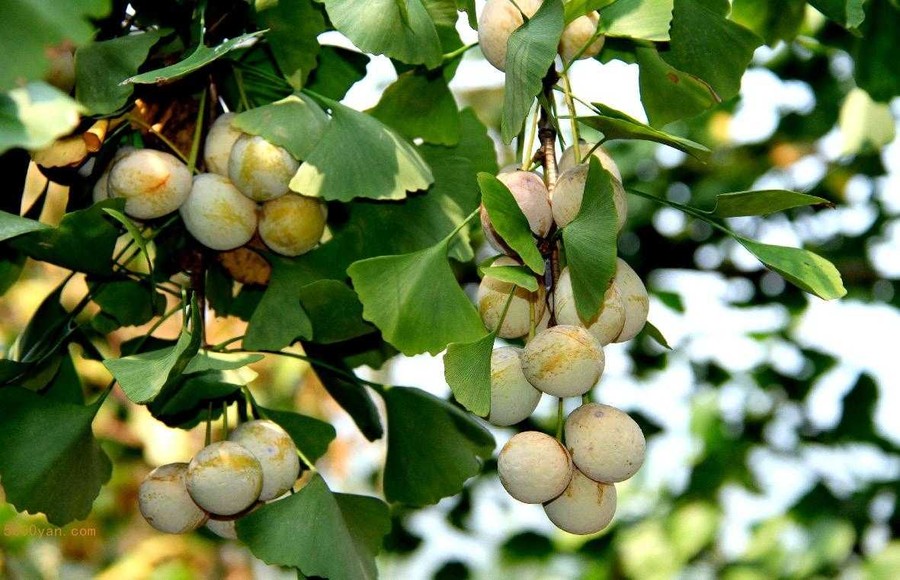
Deciduous tree, up to 40 m tall. Branches include long and short shoots; bark on young trees pale grayish-brown with shallow longitudinal fissures, becoming grayish-brown with deep longitudinal fissures with age. Leaves spirally arranged on long shoots, clustered 3-5 (-8) on short shoots; petiole 3-10 cm long; leaf blade fan-shaped, pale green, glabrous (hairless), with numerous forked parallel fine veins, upper margin 5-8 cm wide, shallowly undulate, sometimes shallowly or deeply lobed centrally. Dioecious, flowers unisexual, rarely monoecious; strobili borne in axils of scale-like leaves at tips of short shoots; male strobili catkin-like, pendulous; female strobili with long peduncle, often forked at apex, each fork bearing a disc-shaped ovule receptacle, each receptacle bearing one ovule, only one developing into a seed; seed drupe-like, ellipsoid to subglobose, 2.5-3.5 cm long, about 2 cm in diameter; outer seed coat fleshy, with white bloom, turning pale yellow or orange-yellow when ripe; middle seed coat bony, white, with 2-3 ridges; inner seed coat membranous, endosperm abundant. Flowering period March-April, seed maturation period September-October.
Habitat and Distribution
Growing naturally in forests at altitudes of 500-1000 m, in acidic, well-drained soil, cultivated from Shenyang in the north to Guangzhou in the south, east to East China, and southwest to Guizhou and Yunnan.
Harvesting and Processing
Harvest in autumn when seeds are mature, remove the fleshy outer seed coat, wash clean, steam briefly or boil slightly, then dry in an oven.
Medicinal Properties
This product is slightly ellipsoid, with one end slightly pointed and the other end blunt, 1.5-2.5 cm long, 1-2 cm wide, and about 1 cm thick. The surface is yellowish-white or pale brownish-yellow, smooth, with 2-3 ridges. The mesosperm (shell) is bony and hard. The endosperm is membranous, the kernel is broadly ovoid or ellipsoid, with one end pale brown and the other end golden yellow. The cross-section shows an outer layer that is yellow and gelatinous, an inner layer that is pale yellow or pale green and powdery, with a cavity in the middle. Odor: faint; Taste: sweet, slightly bitter.
Chemical Constituents
This product contains ginkgotoxin, anacardic acid, ginkgolic acid, hydroginkgolic acid, hydroginkgolinic acid, ginkgol, and bilobol.
Pharmacology
Expectorant; has antihypertensive effects, can reduce aortic output and increase coronary blood flow; can significantly enhance the tolerance to hypoxia under normal pressure in animals; immunosuppressive; antiallergic; delays aging; antimicrobial; treats cerebral ischemia; contracts isolated uterus, among other effects. Toxic.
Properties and Channel Entry
Sweet, bitter, astringent, neutral; toxic. Enters the Lung and Kidney channels.
Functions and Indications
Arrests Lung Qi, calms wheezing, stops vaginal discharge and reduces urination. Used for copious phlegm with wheezing and cough, vaginal discharge and leukorrhea, enuresis and frequent urination.
Dosage and Administration
Oral: decoct in water, 3-9 g; or crush for juice. External: apply an appropriate amount of crushed material as a poultice; or apply sliced pieces topically.
Precautions and Contraindications
Those with excess pathogens should avoid taking it. Raw or fried consumption in excessive amounts may cause poisoning.
Prescriptions
1. For nocturnal emission: Bai Guo (Ginkgo seed) 3 pieces, boil with wine and consume, take continuously for 4-5 days. (Hunan Materia Medica) 2. For frequent urination and enuresis: aged Bai Guo 5 pieces, together with 3 land snails (dried), grind into powder, take with water. (Selected Chinese Herbal Medicines from Shaanxi, Gansu, Ningxia, and Qinghai) 3. For stopping headache and eye pain: mash Bai Guo flesh and apply to the temples. (Diannan Materia Medica) 4. For vertigo with falling, especially effective in the elderly: fresh Bai Guo 2 pieces, remove shells and skins, grind thoroughly, take on an empty stomach with boiling water; the most severe cases recover after no more than 3-5 doses. (Huizhitang Empirical Prescriptions) 5. For pulmonary tuberculosis: Bai Guo kernel 12 g, together with Bai Mao Xia Ku Cao (Prunella vulgaris) 30 g, decoct and take. (Anhui Chinese Herbal Medicine)