Pinyin: Tusizi
Source
1. For pneumonia: Renshen 6 g, decoct in water and take orally. Internal use: decoct 3-10 g, large dose 10-30 g.Cuscuta australisDried mature seeds of R.Br.
Botanical Description
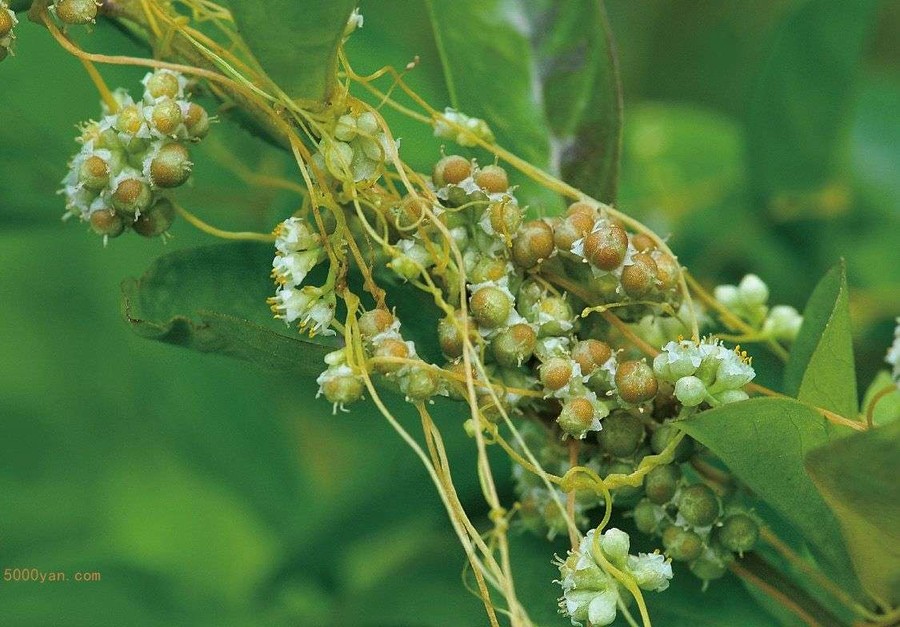
Annual parasitic herb. Stems twining, yellow, slender, approximately 1 mm in diameter, much branched, producing parasitic roots wherever they contact the host. Leaves sparse, scalelike, triangular-ovate. Flowers bisexual, mostly clustered in small umbels or glomerules; bracts small, scalelike; pedicels slightly stout, approximately 1 mm long; calyx cup-shaped, approximately 2 mm long, united below the middle, lobes 5, triangular, apex obtuse; corolla white, urceolate, approximately 3 mm long, shallowly 5-lobed, lobes triangular-ovate, apex acute or obtuse, reflexed outward; scales 5 at base of corolla tube, oblong, apex 2-lobed; stamens 5, inserted at the sinuses of the corolla lobes, filaments relatively long; pistil 2-carpellate, syncarpous, ovary nearly spherical, 2-locular, styles 2, stigma capitate. Capsule nearly spherical, slightly flattened, approximately 3 mm in diameter, only the lower half enclosed by persistent corolla, irregularly dehiscent at maturity; seeds usually 4, ovoid, 0.7-2 mm long, light brown. Flowering and fruiting period: June to August.
Sheng
Habitat and Distribution
Parasitic on herbs or small shrubs of the Leguminosae family, Artemisia genus of the Asteraceae family, and Vitex genus of the Verbenaceae family near fields and roadsides; distributed in Jilin, Liaoning, Hebei, Gansu, Ningxia, Xinjiang, Shaanxi, Shandong, Anhui, Jiangsu, Zhejiang, Fujian, Jiangxi, Taiwan, Hunan, Hubei, Guangdong, Sichuan, Yunnan, and other regions.
Harvesting and Processing
During autumn when the fruit ripens, harvest the whole plant, dry it in the sun, beat out the seeds, and remove impurities.
Medicinal Properties
This product is subglobose in shape, with a diameter of 1-2 mm. The surface is grayish-brown to brownish-black, rough, with a linear or oblate hilum. The texture is firm and not easily crushed with a fingernail. Odor: faint; Taste: bland.
Chemical Constituents
This product contains quercetin, astragalin, hyperoside, and kaempferol-3-O-β-D-glucopyranoside, kaempferol, neocuscutaside, and Cuscuta polysaccharides.
Pharmacology
Stimulates the hypothalamic-pituitary-gonadal axis; promotes hematopoiesis; enhances immune function; prevents and treats myocardial ischemia; inhibits tumorigenesis; protects against liver damage, etc.
Properties and Channel Entry
Acrid, sweet, and neutral. Enters the Liver, Kidney, and Spleen channels.
Functions and Indications
Tonifies and benefits the Liver and Kidney, secures essence and reduces urination, calms the fetus, brightens the eyes, and stops diarrhea; for external use, it dispels Wind and removes spots. Used for Liver and Kidney insufficiency, soreness and weakness of the lower back and knees, impotence and nocturnal emission, enuresis and frequent urination, Kidney deficiency causing threatened miscarriage and fetal irritability, blurred vision and tinnitus, Spleen and Kidney deficiency with diarrhea; for external treatment of vitiligo.
Dosage and Administration
Oral: decoct in water, 6-15 g, or taken as pills or powder. External: appropriate amount, stir-fry, grind, and apply as a paste.
Precautions and Contraindications
Contraindicated in cases of Yin deficiency with effulgent Fire, persistent penile erection without flaccidity, and dry bound stool.
Prescriptions
1. For urinary dribbling and astringent pain: Cheqianzi (Plantago seed, roasted), Tusizi (Cuscuta seed), equal parts. Grind into powder, form pills with honey, take after meals. (From "Yifang Leiju" citing "Qianjin Yueling" Zhujing Wan). 2. For Spleen and Kidney deficiency with loose stools: Tusizi (Cuscuta seed) 9 g, Shilianzi (Nelumbo seed) 9 g, Fuling (Poria) 12 g, Shanyao (Dioscorea) 15 g. Decoct in water and take orally. (From "Anhui Zhongcaoyao"). 3. For arthritis: Tusizi (Cuscuta seed) 6 g, Jidanke (egg shell) 9 g, Niugu fen (cattle bone powder) 15 g. Grind into powder, take 6 g per dose, 3 times daily. (From "Liaoning Changyong Zhongcaoyao Shouce"). 4. For facial acne: Pound Tusizi (Cuscuta seed), squeeze out juice and apply topically. (From "Zhouhou Fang"). 5. For vitiligo: Tusizi (Cuscuta seed) 9 g, soak in 60 g of 95% ethanol for 2-3 days, then extract the liquid and apply externally, 2-3 times daily. (From "Qingdao Zhongcaoyao Shouce").