Pinyin: Taoren
Aliases
Taoheren
Source
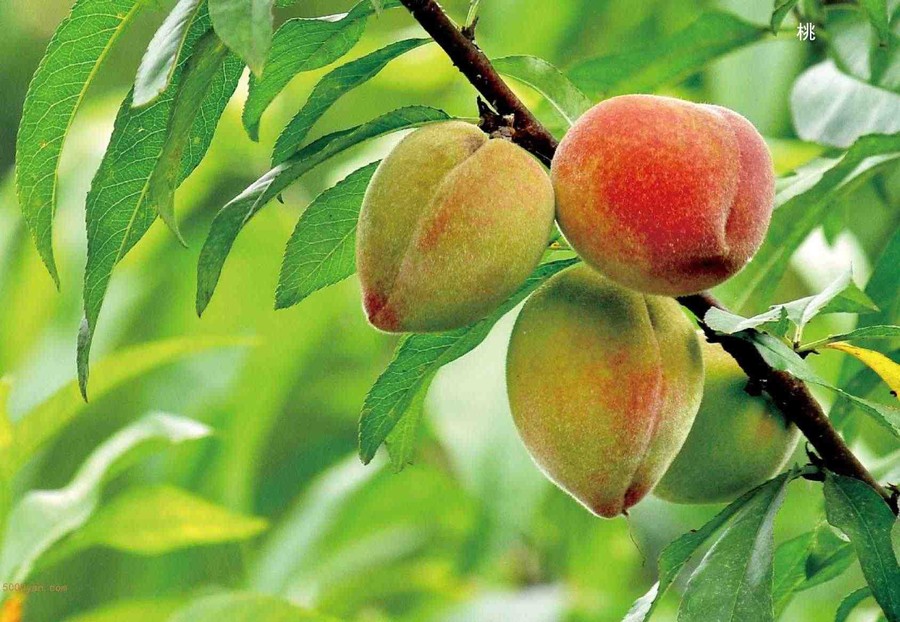
Rosaceae family plant, peach.Prunus persica(L.) Batsch or mountain peachPrunus davidianaDried ripe seeds of (Carr.) Franch.
Botanical Description
1. Peach (*Prunus persica*): Deciduous small tree, 3-8 m tall; branchlets green or half reddish-brown, glabrous. Leaves alternate, appearing fascicled on short branches; petiole 1-2 cm long, usually with 1 to several glands; leaf blade elliptic-lanceolate to obovate-lanceolate, margin finely serrate, glabrous on both surfaces. Flowers usually solitary, opening before leaves, about 2.5-3.5 cm in diameter, with short pedicel; sepals 5, basally connate into a short calyx tube, externally tomentose; petals 5, obovate, pink, rarely white; stamens numerous; ovary 1-loculed; style slender, stigma small, capitate. Drupe subglobose, 5-7 cm in diameter, surface with short tomentum; fruit pulp white or yellow, free or adherent to the stone; seed 1, flat ovoid-cordate. Flowering: March to April; fruit ripening: June to July. 2. Mountain peach (*Prunus davidiana*): Deciduous small tree, 5-9 m tall. Leaves alternate, stipules deciduous early; petiole 1.5-3 cm long; leaf blade ovate-lanceolate, 4-8 cm long, 2-3.5 cm wide. Flowers solitary; sepals 5; petals 5, broadly obovate, pink to white. Drupe suborbicular, yellowish-green, surface covered with yellow pubescence; fruit pulp free from the stone; stone small, hard; seed 1, brownish-red. Flowering: March to April; fruiting: June to July.
Habitat and Distribution
Peach is native to China and is widely cultivated throughout the country. *Amygdalus davidiana* (Carrière) de Vos ex L. Henry grows on mountain slopes, valley bottoms, or in sparse forests and thickets at altitudes of 800-1200 m, and is distributed in Hebei, Shanxi, Shaanxi, Gansu, Shandong, Henan, Sichuan, Yunnan and other regions.
Harvesting and Processing
After the fruit has ripened, harvest it, remove the pulp and shell, extract the seeds, and dry them in the sun.
Medicinal Properties
1. Taoren (Peach Seed): Seeds are flat-elliptical in shape, with a pointed apex, slightly enlarged middle, blunt and oblique base, and thin edges. Length 1.2-1.8 cm, width 0.8-1.2 cm, thickness 2-4 mm. Surface is reddish-brown or yellowish-brown with fine granular protrusions. On the pointed side, there is a linear hilum; at the base, there is a chalaza from which numerous brown vascular bundle striations radiate, forming longitudinal depressions covering the seed coat; the seed coat is thin. Cotyledons are plump and rich in oil. Odor: faint; Taste: slightly bitter. 2. Shantaoren (Mountain Peach Seed): Seeds are ovoid, with an oblique base, smaller but thicker. Length 0.9-1.5 cm, width about 7 mm, thickness about 5 mm. Seed coat is reddish-brown or yellowish-brown, with coarser and denser granular surface.
Chemical Constituents
This product contains components such as amygdalin, 24-methylenecycloartanol, citrostadienol, and 7-dehydroavenasterol.
Pharmacology
Improves microcirculation; anticoagulant and antithrombotic; anti-inflammatory; antiallergic; antitussive and analgesic; has anthelmintic effect. Mildly toxic.
Properties and Channel Entry
Bitter, sweet, neutral. Enters the Heart, Liver, and Large Intestine channels.
Functions and Indications
Activates Blood and dispels stasis, moistens the Intestines and unblocks the bowels, stops cough and calms panting. Used for amenorrhea and dysmenorrhea, abdominal masses and lumps, lung abscess and intestinal abscess, traumatic injuries, dry Intestinal constipation, cough and wheezing.
Dosage and Administration
Oral administration: decoct in water, 6-10 g. Crush before use; or use in pills or powders. When used as processed frost, wrap before decoction.
Precautions and Contraindications
Contraindicated in patients without blood stasis and in pregnant women. Overdose may cause toxicity; mild cases present with dizziness, nausea, listlessness, and weakness, while severe cases can lead to respiratory paralysis and death.
Prescriptions
1. For amenorrhea with five-center heat sensation in women and unmarried girls: Honghua (Carthami Flos), Danggui (Angelicae Sinensis Radix, washed and roasted), Duniuxi (Achyranthes root), and Taoren (Persicae Semen, roasted) in equal parts, grind into fine powder. Take 9 g each time, mixed with warm wine, on an empty stomach before meals. (From *Yang's Family Formulary*, Taoren San). 2. For persistent postpartum lochia with wiry and astringent pulse: Taoren (Persicae Semen) 9 g, Danggui (Angelicae Sinensis Radix) 9 g, Chishao (Paeoniae Radix Rubra) and Guixin (Cinnamomi Ramulus) 4.5 g each, and Shatang (cane sugar) 9 g (charred). Decoct in water, strain, and take warm. (From *A Brief Outline of Medical Cases*, Taoren Jian). 3. For epigastric pain due to long-standing food stagnation with blood stasis: Chew raw Taoren (Persicae Semen) with the skin, and take with one cup of fresh leek juice. (From *Cures for Myriad Diseases*). 4. For constipation due to deficiency in the elderly: Taoren (Persicae Semen), Baiziren (Platycladi Semen), Huomaren (Cannabis Fructus), and Songziren (Pini Semen) in equal parts. Grind together, melt white wax, and form pills the size of wutong seeds. Take with a small amount of Huangdan (lead oxide) decoction. (From *Materia Medica of Decoctions*).