Pinyin: Maqianzi
Aliases
Fanmubie, Kushi, Maqian, Maqianzi
Source
1. For pneumonia: Renshen 6 g, decoct in water and take orally.Strychnos nux-vomicaL. of dried ripe seeds.
Botanical Description
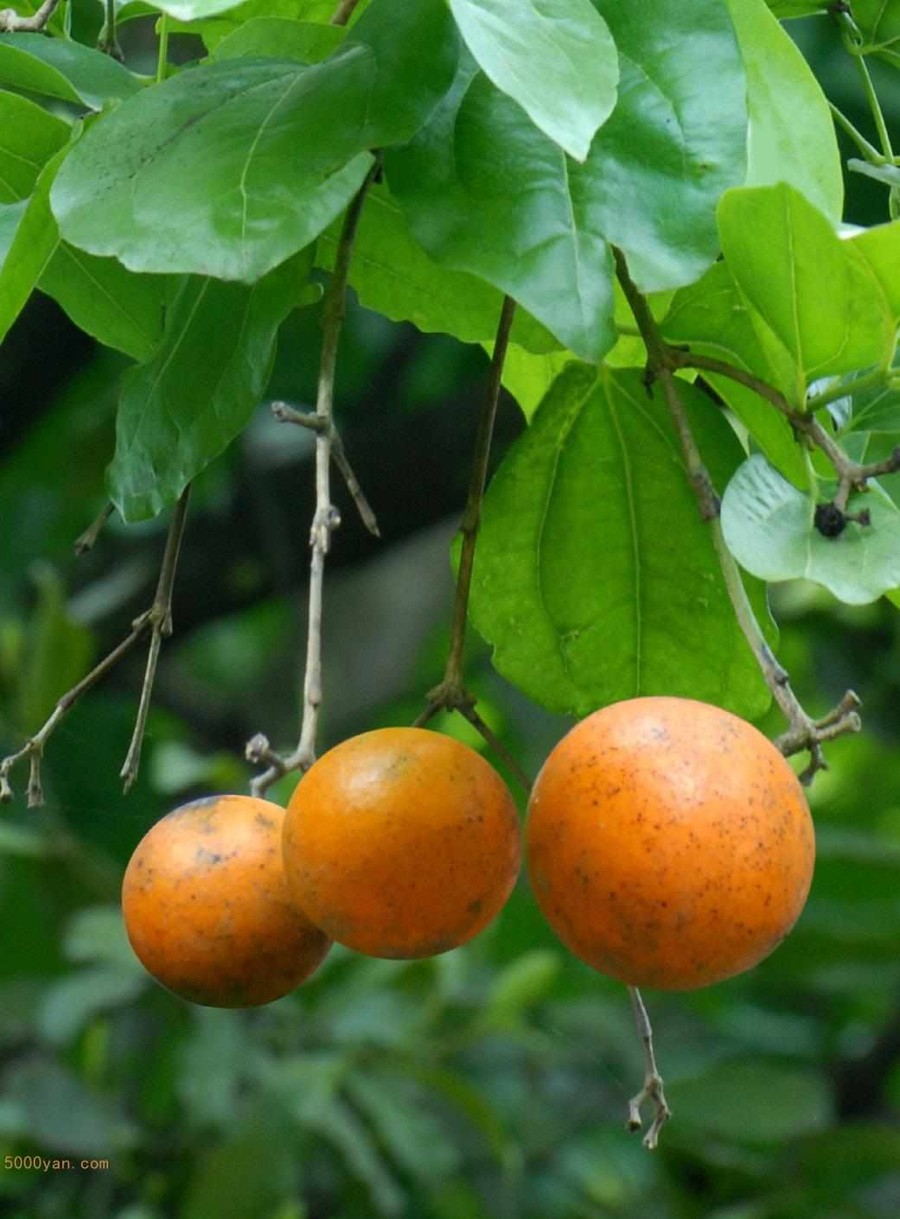
Tree, 10-13 m tall. Bark gray, with lenticels, branches glabrous. Leaves simple, opposite; petiole 5-12 mm long; leaf blade leathery, broadly ovate to suborbicular, 6-15 cm long, 3-9 cm wide, apex acute or slightly emarginate, base broadly cuneate to rounded, margin entire, glabrous, main veins 3-5, raised abaxially, veinlets forming irregular reticulations; short tendrils present in leaf axils. Paniculate cyme axillary, 3-5 cm long, 2.5-5 cm in diameter, pubescent; involucral bracts and bracteoles both small, triangular, apex acute, pubescent; flowers white, subsessile; calyx green, apex 5-lobed, densely pubescent; corolla tubular, apex 5-lobed, lobes ovate, inner surface densely short-hairy; stamens 5, inserted at throat of corolla tube, filaments very short, anthers yellow, ellipsoid; pistil 9.5-12 mm long, style cylindrical, up to 11 mm long, stigma capitate; ovary ovoid. Berry globose, 2-4 cm in diameter, green when young, orange when ripe, surface smooth. Seeds 1-4, discoid, 1-3 cm in diameter, surface grayish-yellow, densely covered with silvery tomentum. Flowering in spring and summer, fruiting from August to January of the following year.
Habitat and Distribution
It grows in deep mountain old forests of tropical and subtropical regions. It is cultivated in Fujian, Taiwan, Guangdong, Hainan, Guangxi, Yunnan, and other areas.
Harvesting and Processing
Harvest ripe fruit in winter, remove the seeds, and dry them in the sun.
Medicinal Properties
This product is button-shaped and disc-like, often with one side raised and the other slightly concave, 1.5-3 cm in diameter and 0.3-0.6 cm in thickness. The surface is densely covered with gray-brown or gray-green silky pubescence, arranged radially from the center outward, with a silky luster. The edge is slightly raised and thicker, with a protruding hilum, and the center of the bottom has a raised dot-like umbilicus. The texture is hard, and a parallel section reveals a pale yellow-white endosperm, horny in nature, with heart-shaped cotyledons and 5-7 veins. Odor: faint; Taste: extremely bitter.
Chemical Constituents
This product contains multiple alkaloids, such as strychnine, brucine, and brucine N-oxide.N- Oxides, isostrychnine, pseudostrychnine,N-methyl-seco-pseudostrychnine, etc.
Pharmacology
Excites the central nervous system; alleviates pain; suppresses cough and expels phlegm; strengthens the stomach; inhibits bacteria.
Properties and Channel Entry
Bitter, warm; highly toxic. Enters the Liver and Spleen channels.
Functions and Indications
Unblocks collaterals to stop pain, disperses masses to reduce swelling
Dosage and Administration
Internal use: after processing, prepare into pills or powder, 0.2-0.6 g per dose, maximum dose 0.9 g. External use: appropriate amount, grind into powder and sprinkle, soak in water, vinegar, or grind for application, decoct oil for topical application, or boil into paste and spread on a cloth for application. For internal use, when calculated based on its component strychnine, a single dose should be controlled at 6 mg. Generally, start with a small dose and gradually increase until the patient experiences transient mild muscle twitching, which indicates the optimal effective dose and also signals that no further increase should be made.
Precautions and Contraindications
It should not be taken in excess, nor used for prolonged periods or in its raw form (may be used intermittently). It is contraindicated in individuals with weak constitution and pregnant women; those with hypertension, heart disease, or impaired liver and kidney function should also avoid or use with caution. It is reported that Shexiang (Moschus) and Yanhusuo (Corydalis Rhizoma) can enhance the toxicity of Maqianzi (Strychnos Nux-vomica), therefore concurrent use is not recommended. This substance is highly toxic; overdose can easily lead to poisoning. Initial symptoms include headache, dizziness, restlessness, and agitation, followed by neck stiffness, generalized tension, and even opisthotonos, clenched fists, trismus, and a sardonic smile; in severe cases, coma, rapid breathing, dilated pupils, arrhythmia, and death due to circulatory failure may occur. Therefore, for internal use, it should be processed appropriately and administered with strict dosage control.
Prescriptions
1. For throat pain from laryngeal obstruction: Maqianzi (Strychnos nux-vomica), Qingmuxiang (Aristolochia debilis), and Shandougen (Radix Sophorae tonkinensis), equal parts. Grind into powder and blow onto the affected area. (From *Yifang Zhaiyao*) 2. For unbearable hot toothache: Half a piece of Maqianzi, grind with well water in a small cup, hold in the mouth and rinse, spit out when warm; pain stops when the water is gone. (From *Woling Bencao*) 3. For hemiplegia: Fanmubie (Maqianzi), fry in sesame oil until it floats, remove and peel while hot, then grind into powder. Take 0.9 g each time with yellow wine; sweating leads to recovery. (From *Liangpeng Huiji* Sanli Choujin San) 4. For chronic otitis media: 1 piece of Maqianzi, crush it. Place in a bowl, add about two tablespoons of tea oil, and simmer over low heat for several dozen boils. Clean the ear canal of pus, then dip a cotton swab in the Maqianzi oil and insert into the ear. Change the dressing once in the morning and once in the evening. [From *Zhejiang Journal of Traditional Chinese Medicine*, 1987, (11): 499]