Pinyin: Wutongzi
Aliases
Piao'er Guo, Tongma Wan, Fengyan Guo, Honghua Guo.
Source
Internal use: decoct 3-10 g.Firmiana plantanifoliaDried mature seeds of (L.f.) Marsilil.
Botanical Description
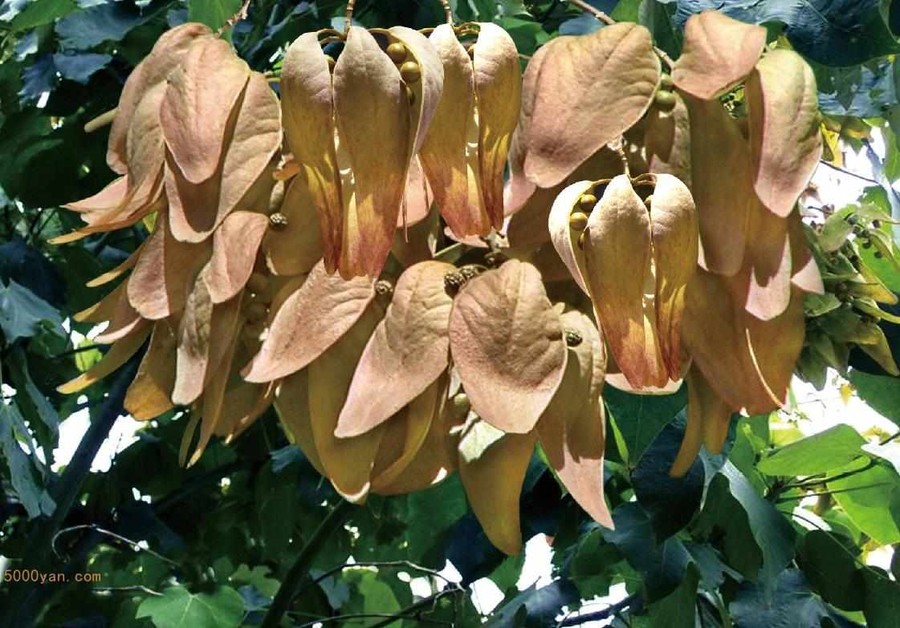
Deciduous tree, up to 16 m tall. Bark bluish-green, smooth. Leaves simple, alternate; petiole 8-30 cm long; leaf blade cordate, palmately 3-5-lobed, 15-20 cm in diameter, lobes triangular, apex acuminate, base cordate, both surfaces glabrous or slightly pubescent; basal veins 7. Panicle terminal, 20-50 cm long; lower branches up to 12 cm long. Flowers unisexual or polygamous, pale yellowish-green; calyx tube about 2 mm long, lobes 5, linear, recurved, 7-9 mm long, externally sparsely yellowish pubescent, petals absent; male flowers with 10-15 stamens united, filaments fused into a column about as long as calyx lobes; female flowers often with staminodes surrounding base of ovary, ovary composed of 5 partially united carpels, style long, stigma 5-lobed. Follicles 5, papery, stipitate, 6-11 cm long, 1.5-2.5 cm wide, sparsely tomentose or nearly glabrous, each carpel splitting ventrally before maturity into leaf-like valves. Seeds 4-5, globose, about 7 mm in diameter, surface wrinkled when dry, attached to margin of leaf-like valves. Flowering June-July, fruiting October-November.
Habitat and Distribution
Mostly artificially cultivated. Distributed in most regions of the country.
Harvesting and Processing
During autumn when the seeds are mature, harvest the fruiting branches, beat off the seeds, remove impurities, and dry under the sun.
Medicinal Properties
Seeds spherical, pea-shaped, approximately 7 mm in diameter, surface yellow-brown to brown, slightly lustrous, with distinctly raised reticulate wrinkles. Texture light and hard; outer seed coat relatively brittle and easily broken, inner seed coat tough. When the seed coat is removed, several layers of light red perisperm are visible; inside is thick, light yellow endosperm, oily, with 2 thin and large cotyledons closely attached to the endosperm; the radicle is located at the smaller end.
Chemical Constituents
This product contains sterculic acid, malvalic acid, caffeine and other components.
Pharmacology
Lowers blood pressure; stops bleeding.
Properties and Channel Entry
Sweet, neutral. Enters the Heart, Lung, and Kidney channels.
Functions and Indications
Regulates Qi and harmonizes the Stomach, tonifies the Spleen and promotes digestion, and stops bleeding. Indications: epigastric pain, diarrhea due to improper diet, hernia, premature graying of hair and beard, infantile mouth sores, and epistaxis.
Dosage and Administration
Internal: decoct 3-9 g; or grind into powder, 2-3 g. External: appropriate amount, calcined to retain property, grind into powder for application.
Precautions and Contraindications
Excessive consumption may cause deafness; those with pre-existing ear conditions should avoid intake; individuals with cough and excessive phlegm should not consume.
Prescriptions
1. For abdominal pain and diarrhea due to food damage: stir-fry Wutongzi (Firmiana simplex seed) until charred, grind into powder. Take 3 g with water. (Guangzhou Military Region, *Commonly Used Chinese Herbal Medicine Manual*) 2. For abdominal pain and diarrhea due to food damage: stir-fried Wutongzi (charred) 15 g, Qingtengxiang 12 g. Grind together into fine powder. Take 3 g with boiling water. (*Sichuan Journal of Chinese Materia Medica*, 1979) 3. For hernia: stir-fry Wutongzi until fragrant, peel and eat the kernels. (*Guizhou Provincial Secret Prescriptions of Chinese Medicine*) 4. For white hair: Wutongzi 9 g, Heshouwu 15 g, Heizhima 9 g, Shudihuang 15 g. Decoct in water and take orally. (*Shandong Chinese Herbal Medicine Manual*)